






 Portuguese
  Spanish
  6 min of reading
  0 comments


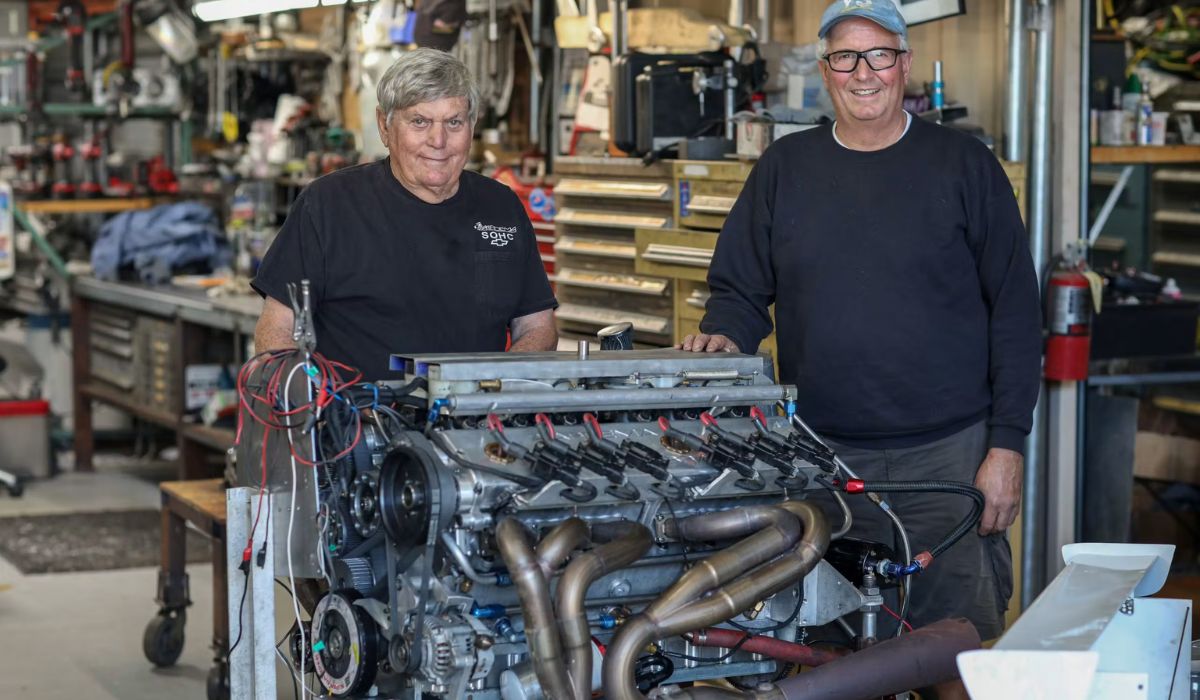
Handcrafted project created by Pete Aardema and Kevin Braun took a workshop V12 to speeds near 430 km/h at El Mirage, bringing together own engineering, extreme testing, and tradition of land speed racing.
Pete Aardema and Kevin Braun took on an unusual project even for the world of land speed racing in a workshop in San Diego, California: building a handcrafted V12 engine to equip a car made to race on dry lakes.
The initiative gained attention after the vehicle reached 267 mph, about 429.7 km/h, at El Mirage Dry Lake, in San Bernardino County, also in California.
The record was set on June 9, 2024, according to the American magazine Road & Track, with the driver Scott Goetz at the wheel.
-
Plug the charger into the outlet first or connect it to the phone? Experts warn that a simple sequence can reduce electrical fluctuations, minimize voltage spikes, and influence the battery’s lifespan after years of continuous use.

-
Neymar focuses on Dubai and buys a penthouse worth R$ 314 million in a Bugatti building, with an elevator that takes the car inside the house, an artificial beach inspired by the French Riviera, and only 11 residential units of this type in the building.

-
Brazilian city focuses on Colombians, Peruvians, Mexicans, and Dutch in an ambitious plan supported by Embratur and Sebrae to expand international tourism, targeting 4 priority markets and foreign revenue in Goiás.
-
Former millionaire banana producer in Corupá went bankrupt in Brazil, lost a farm with 50,000 plants and trucks after defaults, went to the United States with $28 in his pocket, and rebuilt his life with a flooring company in Massachusetts.





Before that, the same project had already appeared in a run of 244 mph, approximately 393 km/h, attributed to Cal Rothe, indicating a gradual evolution of the mechanical assembly developed by the duo.
Handcrafted V12 engine created for land speed racing
The core of the project is a 6.0-liter V12 engine, also described by specialized publications in the United States as 369 cubic inches.
Aardema and Braun developed the assembly without the structure of a car manufacturer, focusing on land speed competitions, a category in which long and low vehicles aim to reduce aerodynamic drag to achieve high speeds on open surfaces.
Before the installation of the nitrous oxide system, the naturally aspirated V12 already produced about 920 hp and reached 9,500 rpm, according to the site The Drive.
These numbers began to attract attention because the engine did not come from a supercar or an official factory prototype, but from an independent work of engineering, machining, and workshop development.
The technical base was built from the study and adaptation of competition components.
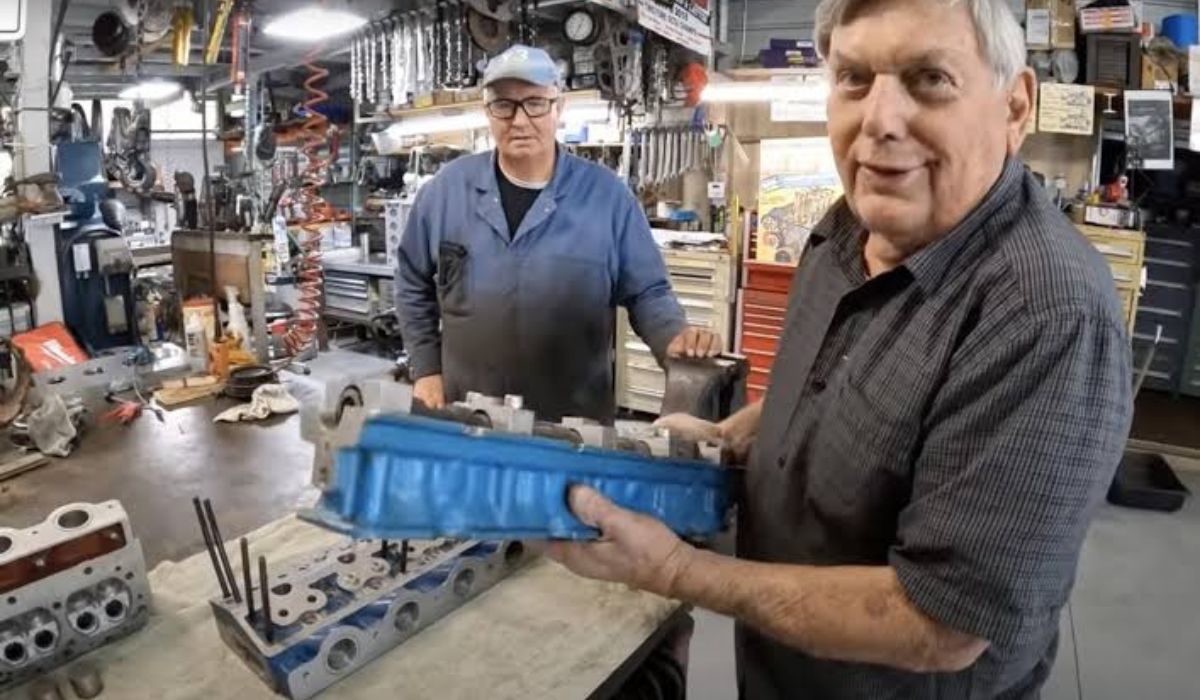
Braun analyzed old engines used in categories like NASCAR and IndyCar, dismantled parts, and compared solutions applied in these assemblies.
From this process, he and Aardema developed their own design for the V12, using 3D printing in the creation of models and molds.
Nitrous oxide boosted the power of the V12
The performance evolution occurred with the adoption of nitrous oxide.
According to Road & Track, the V12 received a system described as a “300 shot” of nitro, a feature that raised the estimated power to about 1,200 hp, a value close to 1,200 cv as the data usually appears in international automotive texts.
With this addition, the car surpassed the intermediate target of 259 mph and reached 267 mph at El Mirage.
The same publication reported that the nitro started to act around 180 mph, or about 289 km/h, when the vehicle was already at high speed on a compacted silt track.
The type of surface helps explain the complexity of the attempt.
At El Mirage, the surface does not offer the same grip conditions as a paved track.
The driver needs to manage the car’s stability, available traction, and terrain variations, factors that gain weight as the speed approaches 430 km/h.
Handcrafted Lakester was tested at El Mirage
The vehicle used in the project is a lakester, a type of traditional car in land speed races.
Unlike a street car, it is designed for a specific function: to reduce air resistance and maintain directional control at speeds far above those observed on conventional roads.
The structure received a custom tubular chassis, long wheelbase, and sequential manual transmission.
This configuration allows exploring the V12’s rev range but also requires precise tuning of suspension, aerodynamics, tires, and gear ratios so that the setup can convert power into speed in a controlled manner.
In a car of this type, performance does not depend solely on the engine.
Weight distribution, straight-line behavior, and the ability to maintain stability during acceleration directly influence the result.
Therefore, each new attempt usually generates data for new adjustments in the workshop.
The trajectory of Aardema and Braun is not limited to this 6.0-liter V12.
The site Engine Swap Depot recorded that the duo also presented, in 2025, another handcrafted 4.96-liter V12, developed for the Bonneville class D, with cylinder heads formed from Oldsmobile Aurora V8 engine parts used in IndyCar.
Project combines independent workshop and competition engineering
The interest in Aardema and Braun’s V12 is linked to the combination of independent construction, high power, and application in an extreme speed category.
In a sector where many advances go through large engineering centers, computer simulation, and high budgets, the project shows a path based on self-manufacturing, successive testing, and accumulated workshop knowledge.
This approach, however, does not turn the work into improvisation.
The block, heads, crankshaft, and other components were custom-made for the engine.


An architecture of 12 cylinders requires rigorous control of vibration, fueling, cooling, lubrication, and mechanical resistance, especially when operating at speeds close to 10,000 rpm.
The story also connects to the culture of land speed racing in the United States.
Places like Bonneville and El Mirage have gathered independent builders, small teams, and experimental projects for decades, where the pursuit of records involves both technical capability and successive stages of on-track validation.
Record at El Mirage came after gradual evolution
The first significant milestone of the project, in the range of 244 mph, put Aardema and Braun’s V12 in the spotlight among specialized publications.
At that time, according to The Drive, the team was still working to add nitro and try to reach 259 mph, a goal that was surpassed when the car hit 267 mph at El Mirage.
The sequence follows a common logic in this type of competition.
A successful run reveals information about temperature, pressure, traction, stability, and engine response.
After the attempt, the team can review data, identify limitations, and reinforce parts before a new trip to the dry lake or salt flats.
Video records published later also showed that the project faced mechanical problems in more aggressive attempts, including damage associated with detonation and lean mixture, according to technical descriptions related to the material.
This type of occurrence is compatible with the level of demand of high-power engines, where small variations in fuel, ignition, and temperature can affect reliability.

Getting close to 430 km/h requires more than power
Upon reaching 267 mph, the car begins to face a set of limitations that go beyond acceleration.
Air resistance increases significantly as speed rises, which requires much more power for increasingly smaller gains.
At this point, aerodynamics, stability, and mechanical safety become as relevant as the horsepower.
The available space at El Mirage also imposes restrictions.
Road & Track cites a stretch of 1.3 miles, about 2.1 km, distance in which the car needs to accelerate, maintain trajectory, and complete the pass.
For a vehicle approaching 430 km/h, this interval requires that the engine, transmission, and driver operate within a narrow margin.
The case of Aardema and Braun remains relevant because it combines traditional mechanical construction techniques with modern tools, such as 3D printing for molds and prototyping.
The result is a handcrafted V12 that came out of an independent workshop and reached speeds normally associated with large-scale industrial projects.

The continuity of the work indicates that the goal was not just to record an isolated pass.
Each attempt began to function as a development stage, with new readings on the behavior of the car and engine under extreme conditions.





Be the first to react!