Portuguese
  Spanish


Study published in Frontiers in Psychology links microgravity, brain, and astronauts’ reports on Earth seen from space, in an analysis that brings together neuroscience, consciousness, and human adaptation outside the terrestrial environment.
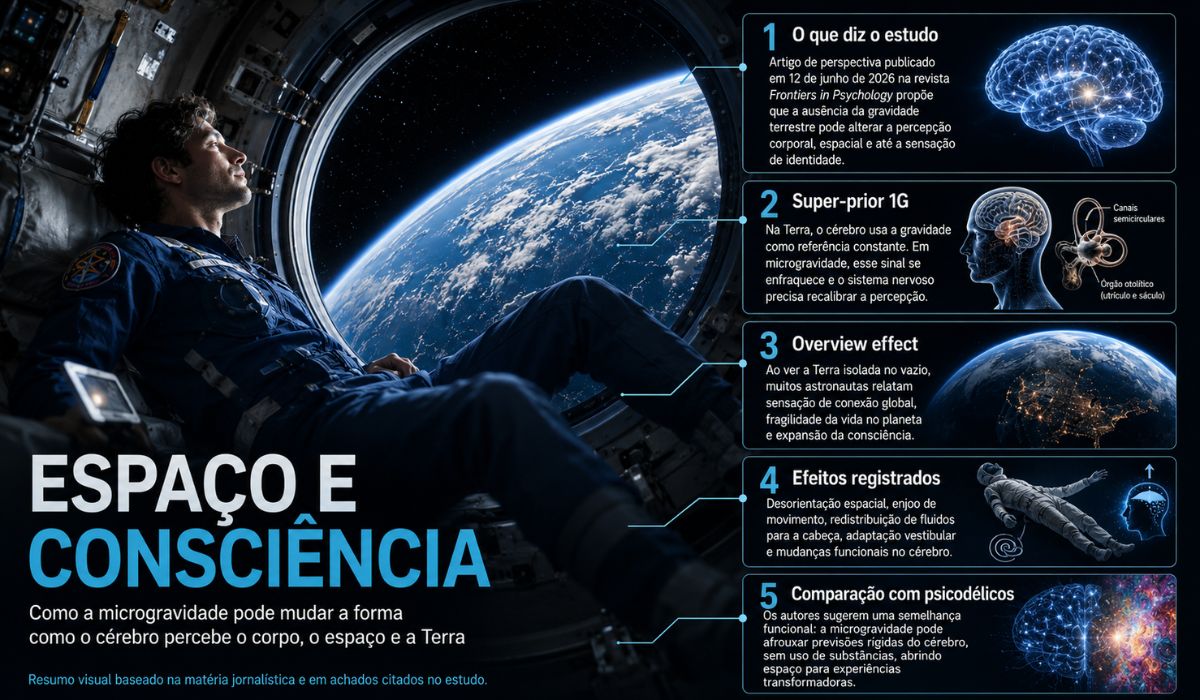
Microgravity can alter more than just the physical balance of astronauts, according to a perspective article published on June 12, 2026, in the scientific journal Frontiers in Psychology.
The text proposes that the absence of Earth’s gravity interferes with references used by the brain to organize the perception of the body, space, and self-identity.
This hypothesis may help explain some of the experiences reported by crew members when observing Earth from space.
-
Iraq floats and sinks under an arm of the Euphrates 10 giant concrete boxes of 46,000 tons and 125 meters each to assemble a 2.4 km submerged tunnel and open a new land route between Asia and Europe.

-
Scientists use more than 20,000 artificial birds and solar speakers to “trick” seabirds, reactivate nesting routes, and revive a colony on an island that seemed abandoned.

-
She spent 73 years breathing inside an iron lung, survived the aftereffects of polio, and became the last woman in the United States dependent on the equipment before dying at 78 years old.
-
Brazilian students created a $1 filter using pine bark, cotton, and 3D-printed parts to clean cassava wastewater, reduce the toxicity of a hazardous waste, and transform contaminated water into biofertilizer.




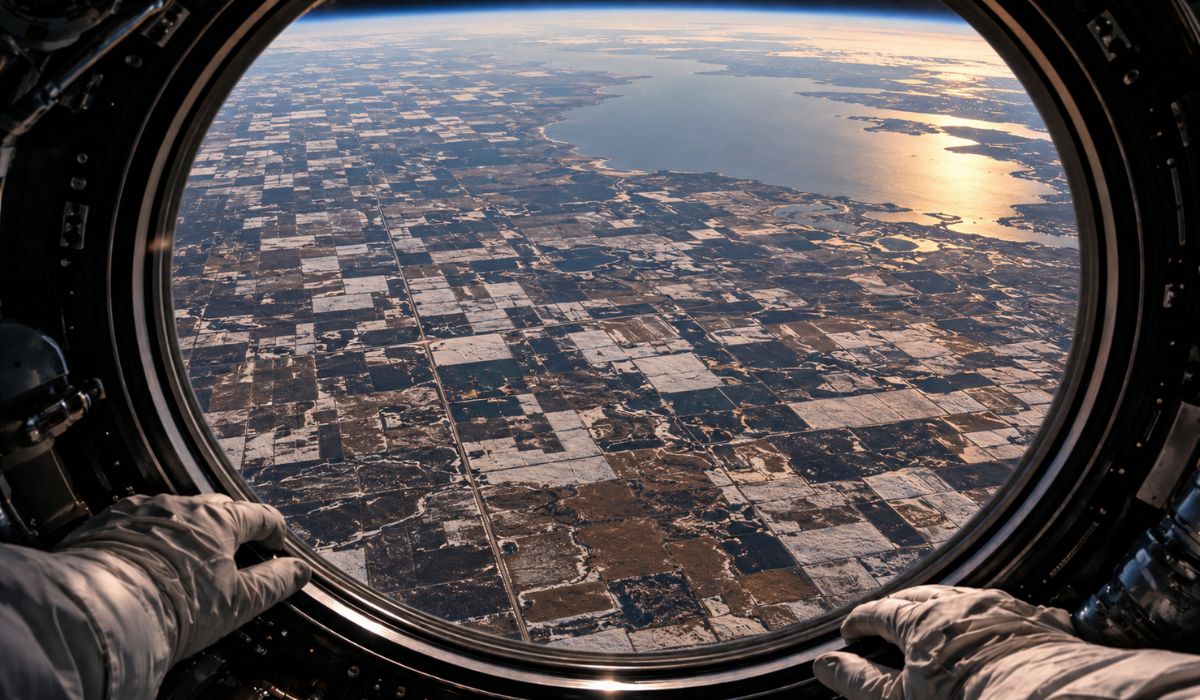
The topic was also addressed by National Geographic, which treated microgravity as a possible rupture of the “anchor” used by the human mind to interpret the environment.
This phenomenon is known as the overview effect.
The expression describes the change in perception that many astronauts report when seeing the planet isolated against the darkness of space.
In general, the testimonies mention a sense of global connection, increased environmental awareness, and perception of the fragility of terrestrial life.
The term was popularized by writer Frank White in the book “The Overview Effect: Space Exploration and Human Evolution,” published in 1987.
Since then, such reports have been analyzed mainly by psychology, philosophy, and studies on transformative experiences.
The new analysis does not eliminate this emotional component.
What the article proposes is a complementary reading, based on neuroscience.
According to the authors’ interpretation, part of the experience may be linked to a physiological rupture caused by the loss of a constant signal.
Throughout evolution, the human brain has been organized under permanent gravity and uses this reference to interpret the environment.
Earth’s gravity functions as a reference for the brain
On Earth, gravity functions as a continuous point of reference for the nervous system.
Even without conscious attention, the body uses this information to identify where the ground is, the position of the head, how objects move, and how the organism occupies space.
The article describes this reference as a “super-prior 1G”, an expression associated with predictive models of the brain.
In straightforward language, it is a stable internal expectation, built over a lifetime, that helps maintain coherent perception and action in an environment where gravity is always present.
This information reaches the brain mainly through the vestibular system, located in the inner ear.
The semicircular canals and otolithic organs detect acceleration, head position, and orientation in relation to the environment.
Then, these signals are combined with visual, tactile, and proprioceptive information to form a representation of the body in space.
In microgravity, this reference ceases to operate in the same way.
The brain continues to receive data from the eyes, muscles, and joints, but the gravitational signal loses the function it exercises on the Earth’s surface.
This change requires a phase of sensory and motor adaptation.
Microgravity and Disorientation in Space
Spatial disorientation and motion sickness are effects recorded in manned missions since the first space flights.
These symptoms indicate that the nervous system needs to recalibrate predictions in an environment that does not follow the physical rules experienced by the body since birth.
The analysis published in Frontiers in Psychology expands this interpretation.
According to the authors, microgravity does not only affect motor coordination and balance.
It can also modify perceptual boundaries associated with body location, continuity of experience, and the distinction between the individual and the environment.
This hypothesis offers a possible explanation for reports from astronauts who describe mental expansion, disconnection, intense introspection, or a change in the way they perceive personal values.
Instead of treating these experiences merely as poetic or religious language, the study proposes that they may also be related to the reorganization of brain processing in extreme conditions.
Astronaut Edgar Mitchell, from the Apollo 14 mission, became one of the names most associated with this type of report.
When observing the Earth from the Moon, he described a sensation of global consciousness and stated that, seen from that distance, international politics seemed smaller.
The article cites this example as part of the set of testimonies related to space flight.
Artemis II enters as context of the discussion
The Artemis II mission, by NASA, appears as a recent context in the discussion about the human experience outside low Earth orbit.
According to NASA, the crew was composed of astronauts Reid Wiseman, Victor Glover, and Christina Koch from the American agency, along with Jeremy Hansen from the Canadian Space Agency.
The agency reported, in a statement about the launch, that Artemis II was planned as a mission of approximately ten days to test life support systems, Orion spacecraft performance, and crewed operations in deep space.
The flight did not aim to land on the Moon.
The mission’s proposal was to perform a lunar flyby trajectory and gather data for later stages of the Artemis program, aimed at returning astronauts to the lunar surface.


In a note published on April 10, 2026, NASA reported that the crew returned to Earth after splashdown in the Pacific Ocean, with support from agency teams and United States military personnel.
The correction of this section is important because data such as launch date, exact duration, landing location, and maximum distance traveled depend on a specific and verifiable source.
Therefore, the article treats Artemis II only as context confirmed by NASA, without turning operational details into the central axis of the report.
During the mission, Christina Koch commented on the difference between seeing Earth from low orbit and observing it from a lunar trajectory, according to a report published by the specialized press.
The astronaut associated the view of the planet with the perception that Earth stands out amidst the darkness of space.
The statement approaches the core of the overview effect: the perception that humanity depends on the same planet and shares a common condition.
Even so, the account of astronauts describes a subjective experience.
The scientific article presents a model to interpret part of this experience based on neurocognitive mechanisms.
The study does not claim that all space travelers will have the same experience nor that the effect is inevitable.
Brain Changes After Space Flights
Research on space flights has already documented changes in the brain and behavior after periods in microgravity.
Scientific reviews point to two processes that may occur simultaneously.
One involves dysfunctions related to adaptation to the space environment.
The other is related to plasticity, which is the brain’s ability to reorganize functions in response to new conditions.
Among the changes described in the scientific literature are the redistribution of body fluids towards the head, structural changes in brain areas, dilation of the ventricles, and reorganization of networks related to motor control.

The intensity of these effects varies according to the mission’s duration, the individual characteristics of the crew members, and the protocols used in each study.
In the functional field, studies with electroencephalograms also investigate changes in brain rhythms during or after exposure to microgravity.
The perspective article uses this body of evidence to argue that Earth’s gravity is involved in broader processes than just maintaining posture and balance.
Even so, the study’s own limitations require caution.
The text published in Frontiers in Psychology is a perspective article, not an experiment designed to prove, on its own, a cause-and-effect relationship between microgravity and transformative states of consciousness.
Its main contribution is to gather previous studies and propose an explanatory model to guide new research.
Comparison with Psychedelics and Human Consciousness
One of the points discussed in the article is the comparison between microgravity and states induced by psychedelic substances, such as LSD and psilocybin.
The proposed similarity is not in the immediate biological origin of the phenomenon.
It appears in a possible pattern of brain functioning: the temporary reduction of the strength of rigid predictions used by the brain to organize experience.
According to the authors, both microgravity and psychedelics can loosen internal processing hierarchies and enhance integration between brain networks.
In the case of space, however, the disturbance is not pharmacological.
It occurs by the removal or alteration of a constant physical signal that accompanies human life from birth.
This comparison does not mean that traveling to space is equivalent to the use of psychedelics.
The immediate mechanisms are different, and the space experience involves its own physical, emotional, operational, and environmental factors.
The analogy serves, according to the article, to discuss how changes in the brain’s predictions can influence the way consciousness organizes the body and the world.
The authors also mention the possibility of studying simulations of gravitational variations, including in virtual reality, as a research tool.
The proposal is to investigate whether controlled environments could help understand states of consciousness and, in the future, guide therapeutic interventions in conditions marked by rigid mental patterns, such as depression.

The expansion of commercial space tourism makes this debate more relevant for space medicine.
If people without the extensive training of professional astronauts begin to experience microgravity and observe Earth from space, medical and psychological teams will need to better understand the physical and subjective effects of this environment.
The topic, therefore, involves more than the impact of space on the body.
The question posed by the article is how the absence of a constant physical reference can modify perception, identity, and belonging.