Portuguese
  Spanish


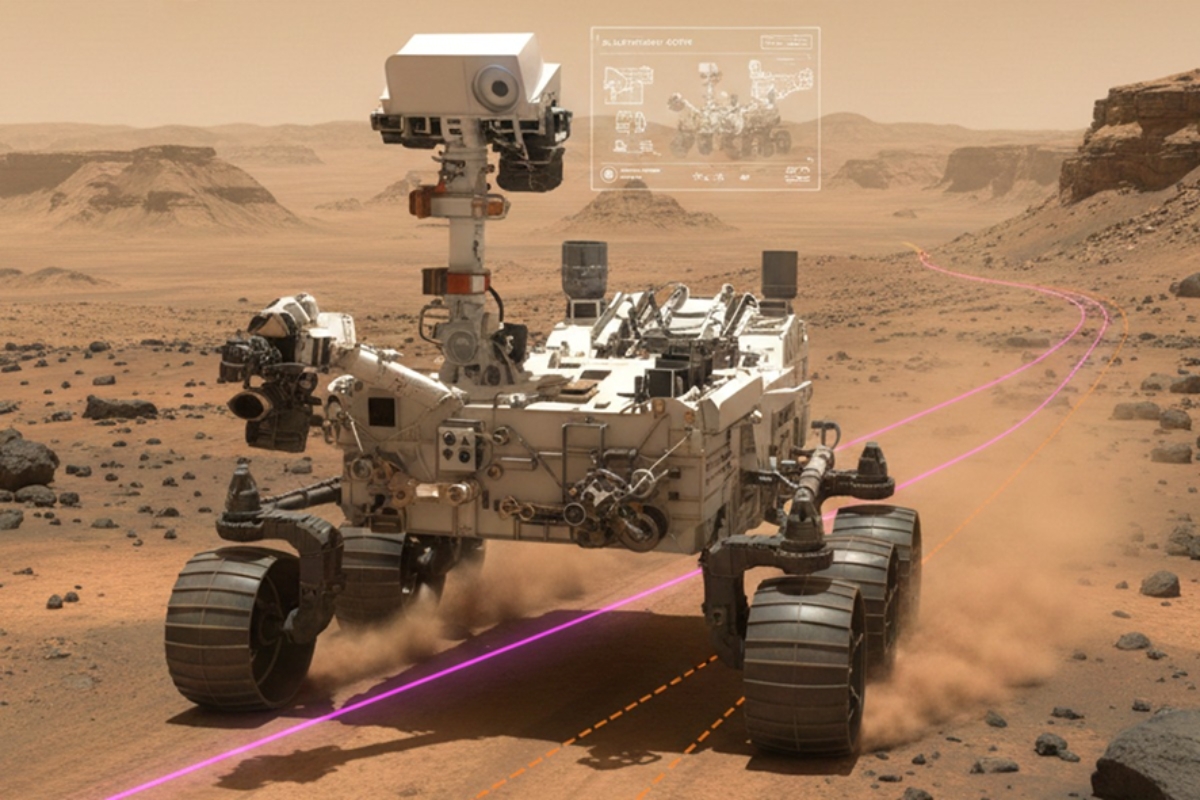


NASA Successfully Tested AI-Controlled Autonomous Navigation on the Perseverance Rover on Mars. Learn How Artificial Intelligence is Overcoming Communication Delays and Revolutionizing Space Exploration.
In a historic milestone for space exploration, NASA allowed artificial intelligence to take full control of the Perseverance rover for two days of its mission on Martian soil. The test, conducted in December 2025, demonstrated that autonomous navigation is not just a technological convenience, but a strategic necessity to overcome the challenges imposed by the vast distance between Earth and Mars.
By traveling 456 meters without any human intervention, the robot proved that artificial intelligence can optimize the exploration of other worlds, adapting to complex terrains in real time.

The Challenge of Distance and the Solution of Artificial Intelligence on Mars
Exploring Mars presents an insurmountable physical obstacle: communication delay. With a lag of about 25 minutes for the round trip signal, traditional remote control is slow and limited. Traditionally, operators on Earth program waypoints that do not exceed 100 meters.
-
16-Year-Old from Brazil’s Sertão Wins Young Scientist Award for AI Predicting Rainfall with 94.5% Accuracy to Aid Farmers

-
Netherlands Reports First Child Euthanasia Case Since Rule Expansion for Minors

-
Brazilian Innovator Survives Homemade Submarine Dive in Paraty Despite Hatch Leak and False Oxygen Alarm
-
China Develops Custom 140-Ton Electric Mining Truck with 770 kWh Swappable Battery, Deploys 290 Units in Xinjiang’s Largest Zinc Mine



However, in this demonstration, an AI based on Anthropic’s Claude model analyzed images from the Mars Reconnaissance Orbiter to identify hazards such as sandbanks and rocks, charting safe routes independently.
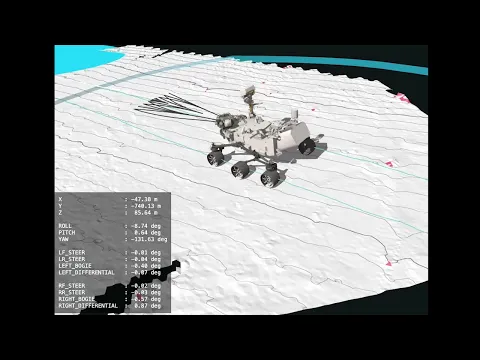

Process Comparison: Human vs. AI
| Stage | Traditional Planning (Human) | AI Planning |
| Terrain Analysis | Operators study photos and elevation | AI processes HiRISE images and digital models |
| Waypoint | Average limit of 100 meters | Ability for longer and continuous routes |
| Response Time | Depends on communication cycle (25 min+) | Local and immediate processing on the rover |
| Safety | Strict manual verification | Previously tested on the “twin” VSTB on Earth |
VSTB: The Terrestrial Twin of Autonomous Navigation
Before any lines of AI-generated code were sent to Perseverance, NASA used the Vehicle System Test Bed (VSTB), a full-scale engineering model located at the Jet Propulsion Laboratory (JPL). This physical “twin” allows engineers to validate artificial intelligence decisions in a controlled environment, ensuring that the autonomous navigation system can locate itself and plan paths without jeopardizing the billion-dollar hardware on Mars.

Reducing Uncertainty in Deep Space
One of the biggest obstacles to total autonomy is “positional uncertainty.” As the rover travels without GPS, small calculation errors accumulate, causing it to “wander” slightly from the official map. Currently, repositioning requires humans to compare ground photos with orbital images. NASA’s next frontier is to train the AI to perform this visual matching autonomously, allowing for kilometers of travel without interruptions to “ask for directions” from Earth.
The Future of Planetary Exploration
The success of these tests paves the way for even bolder missions. The Dragonfly mission, aimed at Saturn’s moon Titan, and future concepts of flying drone swarms on Mars will rely entirely on intelligent systems. NASA’s vision is to establish an infrastructure where autonomous navigation enables a permanent human presence on the Moon and eventually leads humanity to Mars, transforming exploring robots into independent and highly efficient partners in the quest for scientific discoveries.