Portuguese
  Spanish


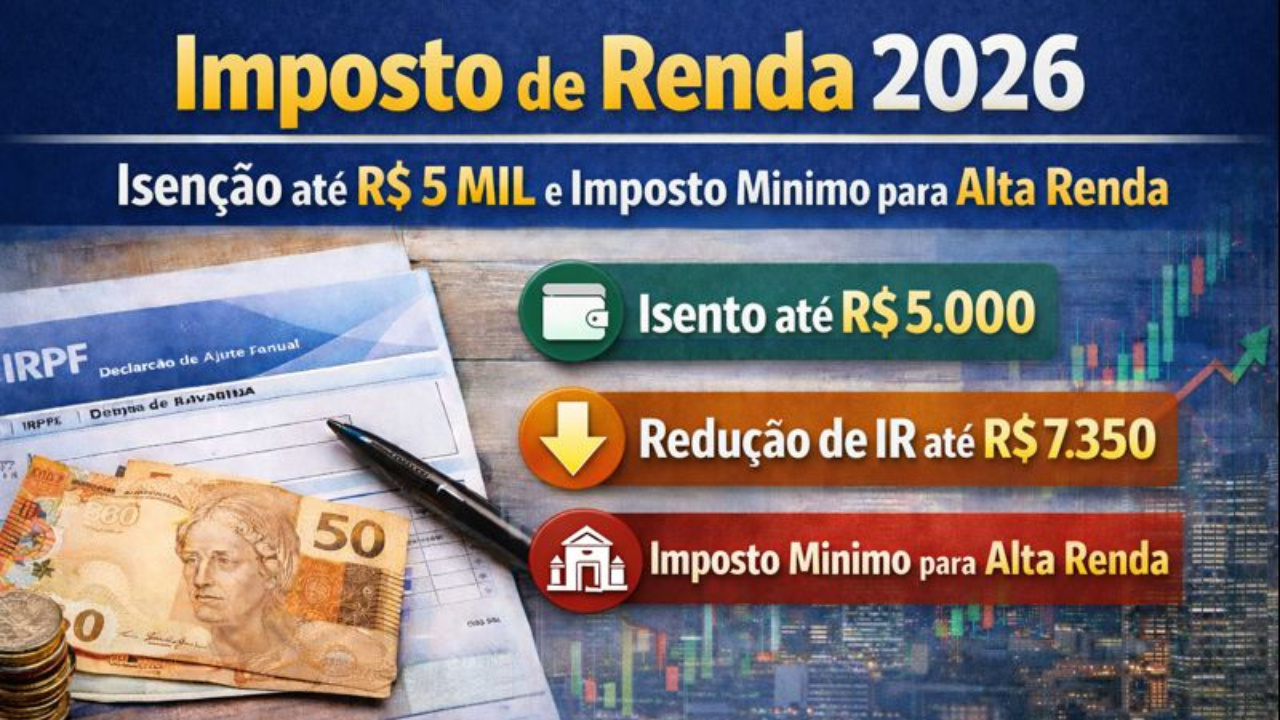


With The Income Tax 2026, Who Earns Up to R$ 5 Thousand Is Exempt and Higher Incomes Begin to Pay Minimum Tax and Dividend Taxation.
The Income Tax 2026 came into effect on January 1st, bringing structural changes that directly affect workers, retirees, public servants, and high-income taxpayers across Brazil.
The new rules apply to salaries paid from January, with practical impact reflected in February paychecks, and they reflect a broad tax reform focused on fiscal justice.
The main change is the exemption up to R$ 5 thousand monthly, accompanied by the reduction of the tax up to R$ 7,350, in addition to the creation of a minimum tax for high income and the taxation of high dividends.
-
At 14 years old, she worked in a factory in Hong Kong, studied economics abroad, and then entered the Chinese real estate market, which helped change the landscape of Beijing.

-
While NATO secured more than $10 billion in missiles and space surveillance at a single forum, Brazil still spends 1.1% of its GDP on defense and is stalling its own anti-aircraft system.

-
Corn ethanol attracts R$ 23 billion in 21 new plants and prepares for a nearly 50% jump in Brazilian production by 2027, even with high interest rates.
-
A newly opened terminal in the middle of the Amazon has begun transporting soy and corn through Amapá, eyeing the queue of ships that is congesting the ports in the South.


The measures were adopted to relieve the tax burden on the middle class and compensate for the loss of revenue with new mechanisms aimed at the wealthiest.
Meanwhile, the traditional income tax table remains the same as in 2025.
The difference lies in the additional reducers, created by the Federal Revenue Service to ensure the new tax benefit without formally changing the existing brackets.
Exemption Up to R$ 5 Thousand Benefits Millions of Brazilians
With the new rules of the Income Tax 2026, taxpayers whose total monthly income does not exceed R$ 5 thousand become fully exempt from the tax.
The benefit applies to:
workers with formal contracts;
public servants;
retirees and pensioners from INSS or other specific regimes.
However, those who have more than one source of income should be cautious.
Even if each individual income is below the limit, it may be necessary to pay additional tax on the annual return if the total exceeds the exemption ceiling.
Reduction of the Tax Up to R$ 7,350 Works Gradually
In addition to the total exemption, the reduction of the tax up to R$ 7,350 creates a progressive discount for intermediate incomes. In this range, the tax decreases proportionately:
the closer the income is to R$ 5 thousand, the greater the discount;
as the amount approaches R$ 7,350, the benefit decreases;
above this limit, there is no additional reduction.
This rule also applies to the 13th salary, ensuring additional tax relief for workers throughout the year.
How The Annual Assessment Of The Income Tax 2026 Works
In the annual calculation, the Federal Revenue Service will also apply the new reducers.
Thus, the following are anticipated:
annual exemption for income up to R$ 60 thousand in 2026;
gradual reduction of the tax for incomes between R$ 60,000.01 and R$ 88.2 thousand;
absence of additional discount above this value.
The annual reducer is limited to the tax due.
Therefore, it does not generate negative tax nor automatic extra refunds.
Minimum Tax For High Income Comes Into Play In 2027
To compensate for the tax renunciation, the reform establishes the minimum tax for high income, officially called the Minimum Personal Income Tax (MIRPT).
Thus, the measure affects taxpayers with high incomes:
annual income above R$ 600 thousand: progressive rate of up to 10%;
income above R$ 1.2 million per year: minimum effective rate of 10%.
According to the government, about 141 thousand taxpayers will be impacted. The assessment will occur only in the 2027 tax return, referring to income from 2026.
The calculation includes salaries, profits, dividends, and taxable financial investments.
Incentivized investments, inheritances, donations, compensations for serious illnesses, and judicial incomes are excluded from the base.
Dividend Taxation Changes Historical Logic
Another relevant change in the Income Tax 2026 is the taxation of dividends at the source. The rule states:
withholding of 10% on dividends;
only when they exceed R$ 50 thousand per month;
paid by a single company to the individual.
Most investors will not be affected.
The measure targets large partners and entrepreneurs who received high amounts without taxation.
Points Of Attention And Deductions Maintained
Dividends related to profits calculated until 2025 remain exempt only if the distribution was approved by December 31, 2025.
Then specialists warn of possible legal disputes, especially regarding any retroactive effect of the rule.
On the other hand, nothing changes in the traditional deductions, such as dependents, education, and simplified deduction, which remain valid.
Fiscal Impact And Number Of Beneficiaries
The estimated cost is R$ 31.2 billion, offset by the minimum tax for high income and the new taxation of high dividends.
Thus, the Income Tax 2026 marks one of the largest recent changes in Brazilian tax policy, redistributing the fiscal burden and profoundly altering the relationship between income, tax, and social justice.