






 Portuguese
  Spanish


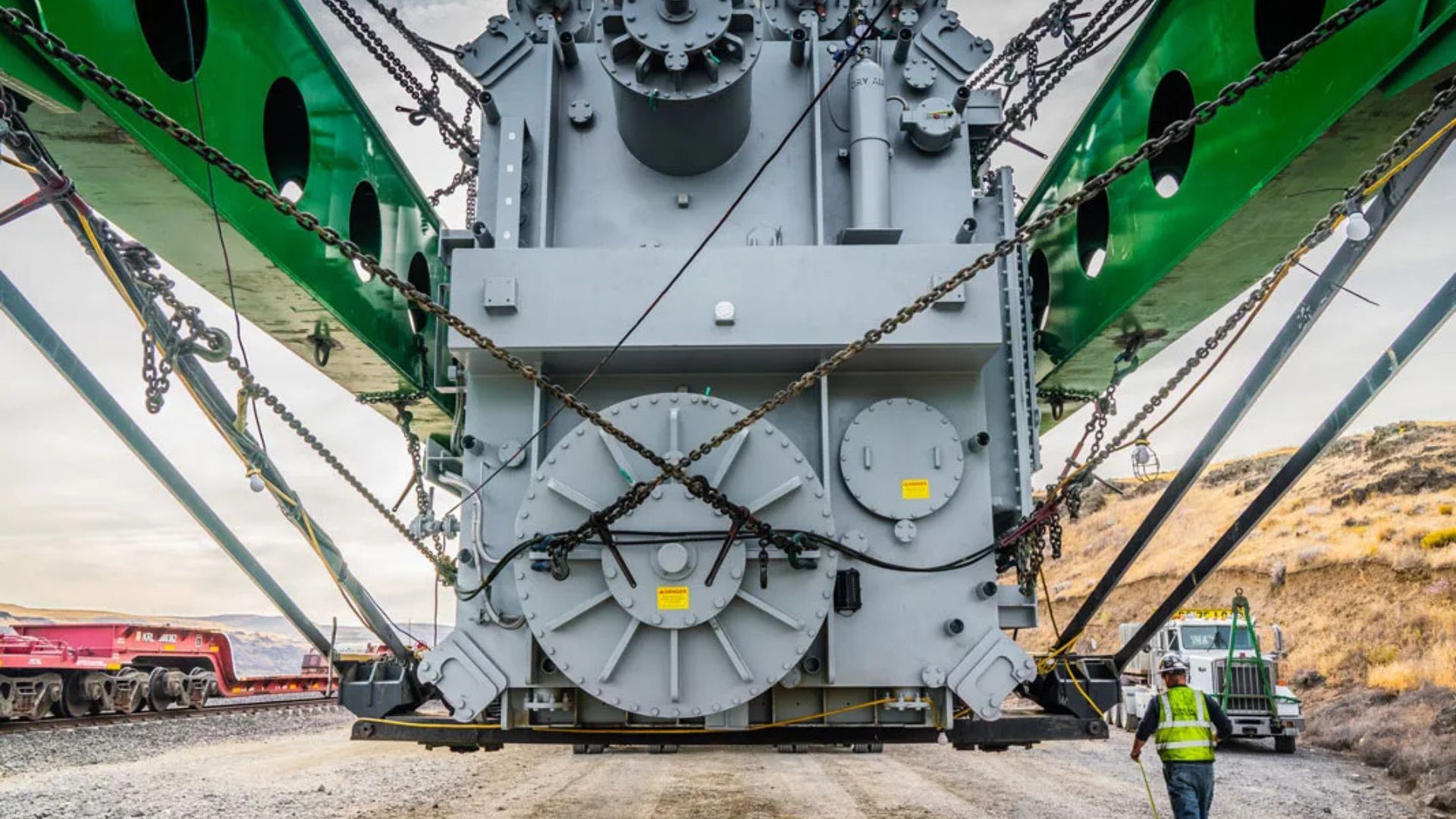


209-ton Transformer Required 48 Axles, Three Trucks, and Two 72-foot Trailers to Travel 80 km in the USA and Expose Bottleneck in the Power Grid.
According to Omega Morgan, the American specialized transportation company was hired to move a 460,000-pound power transformer, equivalent to 209 tons, for nearly 80 km in the interior of Washington State, near the Oregon border. The equipment would be used to connect the region’s wind farms to the power grid. The central problem was simple but without an obvious solution: no common trailer could safely distribute the 209-ton weight over bridges, highways, and pavement. To solve this, the team designed an unprecedented solution for that stretch: two 72-foot trailers linked in series, forming a 144-foot platform with 48 axles.
The assembly was pulled by a Kenworth C500 truck loaded with concrete blocks to increase traction and pushed by two C800 trucks at the rear, each with 550 hp. In total, the operation amounted to 944,800 pounds, about 428 tons, crossing state highways 14 and Highway 97 over two consecutive nights at 15 mph.
209-ton Transformer Transport Required 48 Axles and Three Trucks in the USA
The operation in Klickitat County required months of planning, permits from multiple state agencies, structural inspection of each bridge, and coordination with the Washington Department of Transportation. It was not just a heavy load, but a mobile engineering operation.
-
Bruno Guimarães, 28, Misses Crucial Penalty Against Norway in World Cup After Replacing Vinicius Jr.

-
Inspired by a school lesson on Africa’s water crisis, a young boy raised money through chores to fund a well that transformed a Ugandan community.

-
Brazilian Construction Worker Moves to France, Earns Up to €2,500 Monthly with Home Renovations, Gains Social Media Attention

-
US Navy Sinks USS Oriskany with 230 kg of C-4, Creating World’s Largest Artificial Reef in 37 Minutes






The transformer needed to arrive intact at its destination, without damaging bridges, pavement, or public networks. Therefore, each section of the route was studied in advance, considering weight per axle, curves, inclines, lane width, shoulders, and critical points of Highway 97.
At the destination, the equipment became part of the network that connects hundreds of wind turbines in the county to the electrical grid. The case shows how the energy transition depends not only on turbines and solar parks but also on giant equipment that few logistical systems can move.
Large Transformer is a Critical Piece for Connecting Plants to the Power Grid
A large transformer, called in the United States a Large Power Transformer, or LPT, is the equipment responsible for converting high voltage electricity generated in plants to levels compatible with transmission lines and substations.
Without this equipment, a plant cannot deliver energy to the grid, and the grid cannot distribute electricity to cities, industries, or regional systems. The transformer functions as a physical link between generation, transmission, and consumption.
This type of equipment is essential in wind farms, solar, hydroelectric, thermal plants, industrial substations, and large transmission networks. When an LPT fails or is delayed, it is not just a missing piece: it is an entire part of the electrical infrastructure that can come to a halt.
LPT Transformers are not mass-produced and can take years to be replaced
What differentiates LPTs from other electrical equipment is that they are not mass-produced. Each unit is designed to the exact specifications of the substation where it will be installed, considering input voltage, output voltage, capacity in MVA, impedance, and local conditions.

A transformer made for a substation in Texas cannot simply be installed in Washington without adaptations. When such equipment fails, the replacement process starts almost from scratch: specification, design, manufacturing, testing, and transportation.
According to data cited in the base text, the North American Electric Reliability Corporation measured an average lead time of 120 weeks in 2024 for new LPTs, with the largest models reaching 210 weeks. This means that some critical transformers can take about four years between order and delivery.
Transformer supply chain depends on few global manufacturers
The global production of large transformers is dominated by a few manufacturers. In the United States, about 80% of large transformers have historically been imported from countries like Mexico, China, and Thailand.
The bottleneck also appears in the materials. Critical components, such as the grain-oriented electrical steel used in the magnetic core, have domestic production concentrated in a few suppliers, notably Cleveland-Cliffs in plants in Pennsylvania and Ohio.
This concentration makes the electrical grid vulnerable to delays, trade disputes, demand shocks, and industrial interruptions. The most critical equipment to expand the electrical grid depends on a narrow, expensive, and slow production chain.
Lack of Specialized Wagons Adds Months to Energy Projects in the United States
With only about 10 Schnabel platforms available nationwide, any project relying on this type of transport may face a waiting line. According to the Department of Energy, logistics alone can add months to the schedule for replacing a transformer.
In locations without adequate rail access, such as Klickitat County, the alternative is special road transport. That’s exactly what Omega Morgan executed: 48 axles, three trucks, highways closed at night, reduced speed, and months of preparation.
When the railway does not reach the destination, road transport ceases to be simple travel and becomes an engineering operation. A distance that a regular truck would cover in a few hours may require weeks of planning and two entire nights of controlled execution.
428-Ton Superload Required Analysis of Bridges, Pavement, and Subbase of Highway 97
Omega Morgan classified the operation as a superload, a term used for loads that exceed legal weight and dimension limits to the point of requiring specific engineering for each section of the route. The complete set weighed 428 tons.

The first challenge was the route’s pavement. Klickitat County has sections of precarious subbase, with soil beneath the asphalt poorly compacted and not designed to support vertical loads of this magnitude.
Even with 48 axles distributing the weight, the pressure per axle needed to be calculated to avoid deformation or collapse of the pavement. At a critical point, the team identified inadequate subbase and planned the passage with reduced speed and real-time monitoring.
Two Concrete Bridges Required Structural Inspection Before Load Passage
The second major challenge was two concrete bridges along Highway 97. Each was inspected by structural engineers before the operation.
The calculations considered remaining load capacity, current state of the concrete, usage history, and weight distribution created by the trailers linked in series. Bridge approval was a mandatory condition for the issuance of state permits.
If one of the bridges was not approved, the entire route would have to be redesigned through a longer alternative path. Both supported the passage without documented damage, but only after detailed structural analysis and execution at controlled speed.
Transformer became a strategic bottleneck for wind farms, solar parks, and transmission lines
The case of Klickitat is not an isolated exception. It represents a growing pattern in the expansion of wind farms, solar parks, and transmission lines in the United States.
The energy transition does not only depend on manufacturing turbines, solar panels, or batteries. These systems need to be connected to the grid by substations and large transformers, which often take years to be manufactured, tested, and transported.

The Department of Energy warned, in a report to Congress in July 2024, that more than half of the 60 to 80 million distribution and high-voltage transformers in service in the U.S. are over 33 years old. The power grid has aged while the demand for new renewable projects has accelerated.
209-ton transformer shows that the energy transition also depends on heavy logistics
The transformer that crossed Highway 97 in two nights highlights several vulnerabilities of the modern power grid: manufacturing by few suppliers, concentrated strategic steel, transportation dependent on rare equipment, and slow replacement in case of failure.
For the Klickitat County wind farm, the operation worked. The load reached its destination, the bridges held up, the pavement was preserved, and the equipment became part of the infrastructure that connects turbines to the grid.
But for the energy sector as a system, the case leaves a clear message. Clean energy may originate from turbines and solar panels, but it only reaches the consumer when giant transformers can cross highways, bridges, and logistical bottlenecks that still seem to belong to another industrial era.





