Portuguese
  Spanish


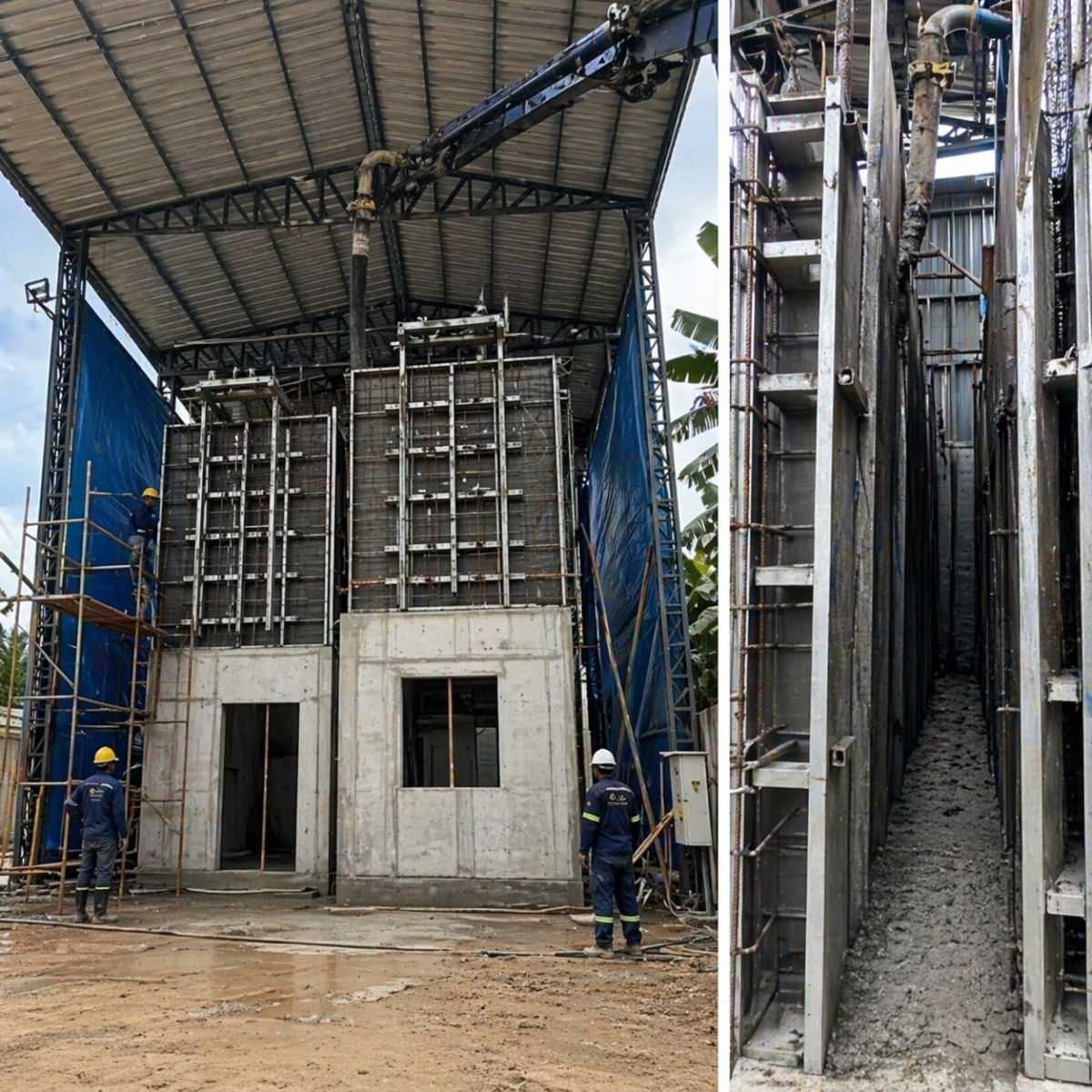

Pará native André Souza developed the SC01 Xingô, a 12-ton, 9-meter-tall construction robot with 100% Brazilian technology that erects the walls of a house in 24 hours using integral reinforced concrete molding. The first unit has already been financed by Caixa Econômica Federal, and the company Raic Builders is negotiating the construction of over 1,000 homes throughout Brazil.
While the world bets on concrete 3D printers to try to revolutionize civil construction, an inventor from Pará created a completely different technology. The construction robot SC01 Xingô, developed by Raic Builders in Altamira, does not deposit layers of material like a printer. It ejects reinforced concrete into forms and raises all the walls of a house at once, in a process the team calls integral molding. The result is a monolithic structure, full of steel, that is ready for finishing in just 24 hours, compared to the 45 days the traditional method would take.
The technology was born from a real problem. André Souza, an engineer with experience in civil construction and mechatronics, faced delays, a lack of qualified labor, and quality problems in the works he executed. He researched solutions in the national and international markets, found nothing that solved the issues, and decided to develop his own system. The project took four years to develop, had a patent applied for in 2022, and was selected by FINEP among the eight main national initiatives in advanced robotics. The first house built by the construction robot has already been sold and financed by Caixa Econômica Federal with at least 20% savings for the buyer.
How the construction robot works and why it’s not a 3D printer

According to information released by the portal SBT Altamira – TV Vale do Xingu, the difference between the SC01 Xingô and the concrete 3D printers that appear in international news is fundamental. 3D printers deposit material layer by layer, which can create points of fragility between the concrete strips. The Pará construction robot uses an opposite method: it assembles forms around the perimeter of the house and ejects reinforced concrete into them, filling all the walls at once. The result is a monolithic panel, structurally reinforced and with a more uniform finish.
-
Cost of Installing Electric Fences in 2026: Price Per Meter and Factors Affecting Installation

-
Retired Builder Constructs House Using Over 4,000 Milk Cartons in Brazil, Engineer Estimates Structure Could Last 100 Years

-
Concrete-filled PVC homes could be cheaper than traditional masonry, UPF research finds; with ready modular panels, less waste, and faster construction, the Concrete-PVC system aims to cut costs and transform affordable housing in Brazil.
-
Brazilian House Built with 32.8 Tons of Construction Debris Offers Affordable Housing Solution


The equipment weighs 12 tons and is 9 meters tall, but it was designed to be modular and disassemblable. It can be transported on a flatbed truck and assembled on any terrain, functioning as what the team calls an itinerant mobile industry. This portability solves a problem that other industrial solutions face: manufacturing walls in a factory and transporting them to the construction site increases logistics costs. With the construction robot operating on the site itself, transportation costs practically disappear.
The numbers that stand out: 24 hours, 50% less labor, 20% savings

The impact of the construction robot translates into three concrete facts. The walls of a house are ready in 24 hours, compared to 45 days with the conventional method. The need for labor is reduced by half, and the final construction cost drops by at least 20% compared to the traditional model. For those financing a property, this saving can represent tens of thousands of reais less in the total value.
The reduction in labor does not mean unemployment, according to André Souza. What changes is the worker’s profile: instead of bricklayers carrying cement on their backs, the construction site now demands building technicians who operate the equipment and supervise the process. Raic Builders states that this transformation attracts young people and women to a sector that has historically struggled to renew its workforce, while also solving the chronic shortage of qualified bricklayers that Brazil faces.
The first house financed by Caixa and what it proves about technology

A milestone for the credibility of the **construction robot** was the approval of the first **house** built by it under the financing system of **Caixa** Econômica Federal. **Caixa engineers visited the property in Altamira, conducted a complete inspection, and approved the structure like any other conventional house.** The housing loan was granted normally to the buyer, without additional requirements or restrictions due to it being a **construction** made by a robot.
This approval is significant because **Caixa** is the main housing finance agent in Brazil, and its technical criteria are a benchmark for the market. **If the bank accepted the house as collateral, it means that the technology underwent structural, safety, and compliance evaluations with Brazilian construction standards.** For those who still distrust a **house** built in 24 **hours**, Caixa’s endorsement acts as a quality seal that no advertising campaign could replicate.
The inventor from Pará who created something unique on the planet
André Souza is from Castanhal, in **Pará**, and developed the **construction robot** in Altamira, in the Amazon. **The project has no equivalent in the world, according to the team, because it combines robotics, artificial intelligence, and integral molding of reinforced concrete** in a modular system that can be assembled and disassembled anywhere. The technology was accepted at Latin America’s largest technology center for acceleration and gained space at the Technological Innovation Park of São José dos Campos, in São Paulo.
Souza admits he faced what he calls the “stray dog syndrome” for being an Amazonian inventor competing for space in a sector dominated by companies from the Southeast and abroad. **But the results speak for themselves: patent pending, selection by FINEP, bank approval, and ongoing negotiations for over 1,000 units** in different states of Brazil. Raic Builders is in talks with city halls, construction companies, and developers from Brasília to São Paulo, and the next challenge is to multiply the number of robots to meet the demand that grows with each demonstration.
What the construction robot can mean for civil construction in Brazil


Brazil has a housing deficit of millions of units and a civil **construction** sector that faces rising costs, **labor** shortages, and deadlines that are rarely met. **If the construction robot proves to work at scale, the technology can transform how housing programs like Minha Casa Minha Vida are executed**, reducing delivery times and costs per unit without compromising structural quality.
The path from proof of concept to industrial production still requires steps. **Negotiations with city halls and construction companies need to convert into contracts, new robots need to be manufactured, and operators trained in different regions of the country.** But the fact that an inventor from **Pará** has already built, sold, and financed a **house** made by a **construction robot** in Altamira demonstrates that Brazilian innovation in civil **construction** can come from where it’s least expected, and deliver results that the conventional market cannot match.
Would you live in a house built by a robot in 24 hours, or do you prefer to trust traditional construction methods? Tell us in the comments what you thought of this technology from Pará and if you believe the construction robot can solve Brazil’s housing problem.