Portuguese
  Spanish


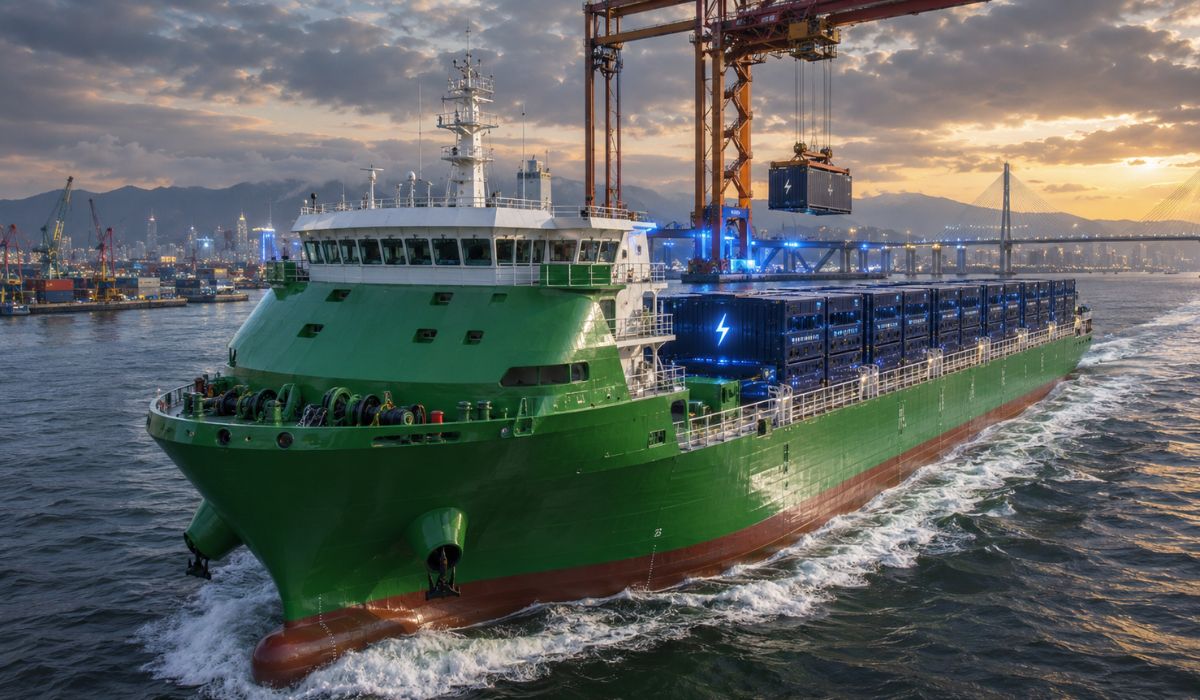

Chinese electric ship of almost 128 meters combines containerized batteries, intelligent navigation, and commercial operation on a coastal route, expanding the debate on electrification in maritime freight transport on an industrial scale.
Largest electric ship in its category began operation in China
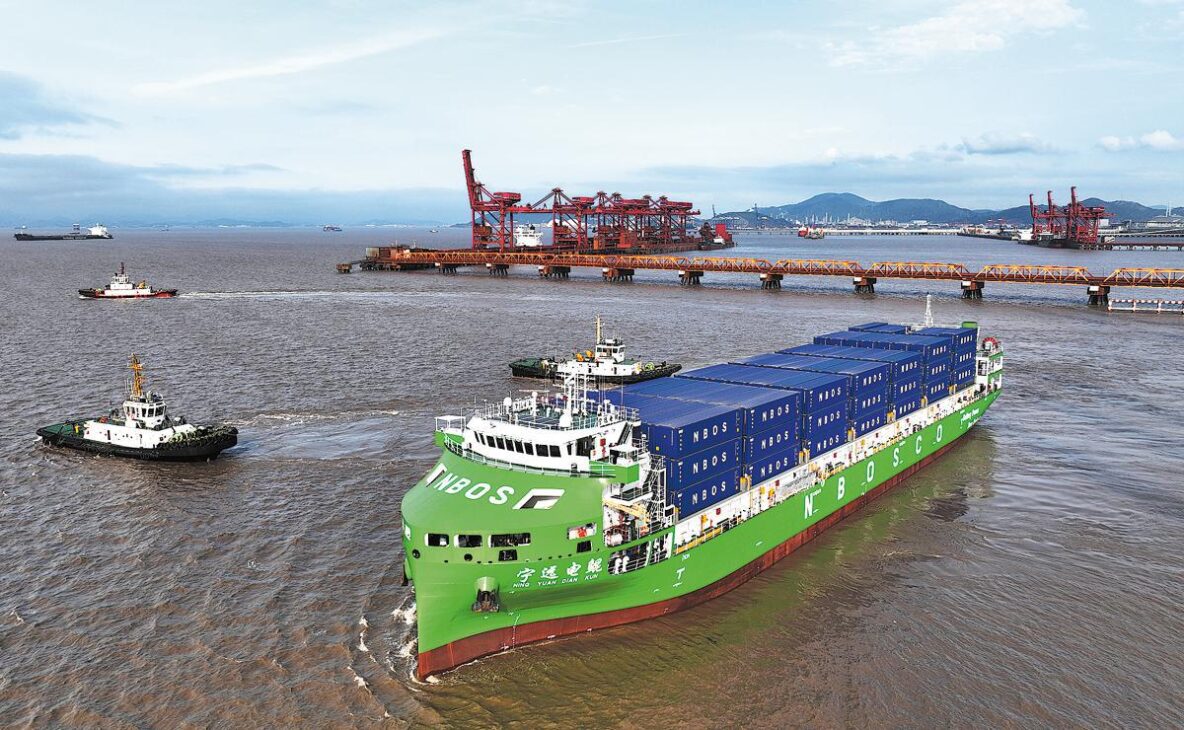
The Ning Yuan Dian Kun, presented by the Chinese state press as the world’s largest fully electric intelligent container ship in its category, began commercial operation on April 15, 2026, in Zhejiang province, eastern China.
The vessel departed from the Ningbo-Zhoushan port, in the Beilun port district, heading to the Jiaxing port, on a coastal route aimed at regional container transport, according to the Xinhua agency.
The size of the ship is one of the central elements of the project.
-
Netherlands Builds Giant 240-Meter Inflatable Barrier That Rises to Protect Cities from Storm Surges

-
Brazilian Submarine Robot “FlatFish” Operates Independently at 3,000 Meters Depth to Inspect Seafloor Pipelines Without Support Vessels
-
Eufy Unveils Omni S2: Advanced Robot Vacuum with 30,000 Pa Suction, Self-Cleaning Mop, AI Obstacle Avoidance, 12-in-1 Station, and Built-In Fragrance Dispenser

-
Swiss Glaciers Lose 10% of Volume in Two Years as Europe’s Largest “Water Tower” Dries Up; Scientists Use “Smart Stones” in the Alps to Gauge Remaining Water Supply for 170 Million People



At 127.8 meters in length and 21.6 meters in width, it is larger than an American football field, including the two end zones.
The capacity reported by Xinhua is up to 742 TEUs, a measure used in maritime transport for standard 20-foot containers.
In practice, the scale distances the vessel from the more common image associated with electric vehicles, such as cars, SUVs, and urban buses.
Instead of a compact battery installed under the floor, the Ning Yuan Dian Kun uses 10 container-shaped energy units, with a total reported capacity of about 20,000 kWh, or approximately 20 MWh.
How the Ning Yuan Dian Kun electric ship works
The propulsion system consists of two permanent magnet synchronous motors of 875 kW each, according to data released by Xinhua.
The maximum reported speed is 11.5 knots, a feature compatible with the proposal to operate on coastal and short-distance routes.
Before entering operation, the ship underwent sea trials in early 2026.
The stage evaluated the battery-powered electrical supply, propulsion performance, and intelligent navigation systems, according to information published by specialized maritime sector outlets.
The technical proposal is not limited to replacing conventional fuel with electricity.
The vessel can receive power through high-voltage shore connection and was also designed to allow the exchange of containerized batteries for pre-charged units.
The system also includes photovoltaic panels intended for providing auxiliary power on board, according to the China Classification Society and specialized publications.
This model depends on port infrastructure prepared for charging, module handling, and operation during docking windows.
On fixed routes, such as the connection between Ningbo-Zhoushan and Jiaxing, operational predictability tends to facilitate this type of logistical arrangement, although practical results depend on usage routine and availability of systems on land.
Intelligent Navigation and Automation in Maritime Transport
The Ning Yuan Dian Kun was also developed as a platform for intelligent navigation.
According to the China Classification Society, the vessel received certification after construction inspection and was described by the entity as the world’s largest fully electric intelligent maritime ship and the first in China in this category.
Automation appears in features such as assisted navigation, route planning, operational monitoring, and intelligent systems associated with the engine room.
These features do not mean the absence of human supervision but indicate the incorporation of digital technologies in a commercial cargo vessel.
The record from the China Classification Society states that the ship received certification in April 2026.


The Chinese entity also highlighted that the project uses containerized batteries, quick energy exchange capability, and connection with shore power supply.
In the hull design and operation, the project adopts solutions aimed at energy efficiency.
Industry publications cite an open-top configuration, without traditional hatch covers, and a structural arrangement adapted for regional container transport.
Electric propulsion and the use of removable batteries were highlighted by the CCS as part of the ship’s core features.
Coastal route and regular operation in Zhejiang province
The route between Ningbo-Zhoushan and Jiaxing functions as a feeder service, connecting regional cargo to one of China’s main port complexes.
The journey links two ports in Zhejiang province and was chosen for the ship’s first commercial operation, according to information released by Xinhua and CGTN.
This type of use helps explain the choice for an electric vessel.
In coastal routes, with defined origin and destination, the planning of recharging, battery swapping, and autonomy control can be organized with greater predictability than in long and variable routes.
The operation also has associated environmental goals.
Xinhua reported that the ship is expected to reduce carbon dioxide emissions by 1,462 tons per year.
The estimate considers the electric operation of the vessel and was disclosed in the context of the freighter’s entry into service.
The China Classification Society also cited the same annual CO₂ reduction projection and pointed out the use of ten containerized batteries as one of the project’s foundations.
As with any electric vessel, the total environmental impact also depends on the source of the energy used to charge the batteries, a detail not specified in the consulted sources.
Chinese companies involved in the project
The construction and development involved companies linked to China State Shipbuilding Corp.
According to China Daily, the project was developed by the Shanghai Merchant Ship Design and Research Institute, while the electric propulsion system was provided by the Shanghai Marine Equipment Research Institute.
The vessel was made for Ningbo Ocean Shipping.
The same publication reported a capacity of 740 TEUs, while Xinhua cited 742 TEUs.
The difference appears in the consulted sources and may be related to different rounding or presentation criteria of the capacity.
In the text, the data of 742 TEUs was maintained as it appears in the state agency Xinhua, with the discrepancy noted in the final note.
The sister ship, called Ning Yuan Dian Peng, appears in Chinese publications and records associated with the same series of electric vessels.
However, the public confirmation of its commercial operation after entering class was not securely found in the sources consulted, so the text avoids stating that it is already on a regular route.
The repercussion of the Ning Yuan Dian Kun occurs because the project combines cargo ship size, large capacity batteries, commercial use, and digital navigation systems.
For the public accustomed to associating electrification mainly with land vehicles, the case shows the application of technology in a less visible area in daily life but relevant for cargo transportation.
The evaluation of the ship’s performance will depend on operational data accumulated over time.
Among the points to monitor are the durability of the batteries, the effective time for module exchange, the availability of charging on land, the cost per trip, and the reliability of intelligent systems in commercial operation.