Portuguese
  Spanish


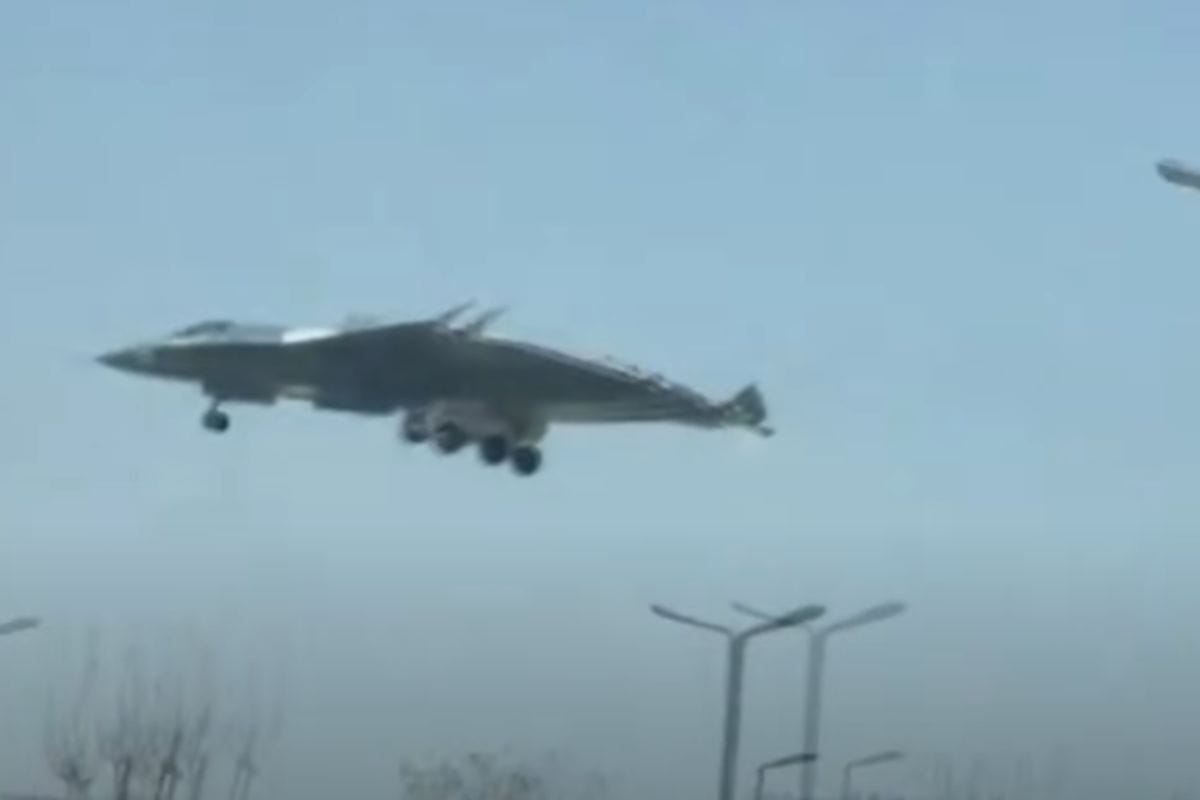

Beijing Is About To Put The World On Alert With China’s J-50! Tail-less Stealth Fighter Emerges With Hidden Weapon Compartments, Radical Design, And Technology That Rivals The Most Advanced American Fighters. And Now?
It’s official: China is no longer just trying to catch up. It wants to lead.
In recent weeks, unprecedented images of a jet with an absolutely out-of-the-ordinary appearance have emerged. This is the J-50 from China, a possible sixth-generation fighter that may be under development alongside the already mysterious J-36 — both featuring stealth architecture, tail-less design, and a total focus on multidimensional air dominance.
But what is this J-50 from China, and why is it troubling the West?
A Ghost In The Skies: The Design Of China’s J-50 Impresses
The newly revealed image shows, for the first time, technical details of China’s J-50 with surprising clarity. The fuselage lacks vertical stabilizers, which reduces the radar signature — a design trick reminiscent of the B-2 Spirit and B-21 Raider bombers from the United States.
-
U.S. Navy’s Ticonderoga-class Cruiser Becomes a 9,800-Ton Missile Fortress with Advanced Aegis System Capable of Tracking Hundreds of Targets

-
France’s Charles de Gaulle: The Sole Nuclear-Powered Aircraft Carrier Outside the US, Weighing 42,500 Tons and Equipped with Two Atomic Reactors

-
The military spaceplane that almost took the Cold War into orbit: Boeing X-20 Dyna-Soar was designed to re-enter above Mach 20, fly for up to 40 hours, land like a plane, and transform Titan rockets into a gateway to a new era of orbital warfare.
-
FAB bets on national drones and increases investments to strengthen the Brazilian aerospace industry





The internal weapon compartment has an angular shape similar to that of the F-22 and the Chinese J-20 fighter, clearly indicating that the goal of China’s J-50 is to be invisible to radar and deadly in attack.
Another point that caught attention? A bulge under the nose, seemingly dedicated to electro-optical systems, similar to the F-35’s EOTS. This reinforces what experts already suspect: China is aiming for technological supremacy and integration of next-generation sensors.
Manned Fighter Or Advanced Drone? The Mystery Continues
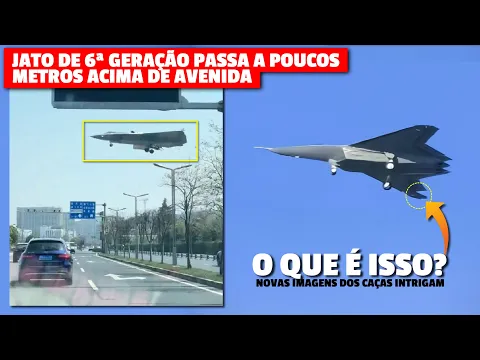

The canopy (the cockpit bubble) does not appear in the image, raising questions about whether the J-50 from China is manned or unmanned. However, sources close to the defense sector indicate that there are clear signs that the J-50 will be operated by a pilot — at least in the initial versions.
What also stands out are the articulated wingtips visible in the latest image. This could indicate an adaptive capability: more discreet wings in stealth mode and, when necessary, greater lift for take-offs and landings — something similar to what is seen in the most advanced Western fighters.
Thrust Vectoring And Extreme Maneuverability
Another technical detail that didn’t go unnoticed was the presence of bidimensional exhausts, which could indicate 2D thrust vectoring — a technology used in the F-22 Raptor to allow extreme maneuvers and high-performance aerial combat.
If confirmed, the J-50 from China will not only be stealthy but also extremely agile and dangerous in close combat.
A Step Ahead In The Sixth-Generation Fighter Race?
China has yet to make any official statement about the J-50, but the simple fact that there are already such detailed images indicates that the program is advanced — and real.
The J-50 from China could be the direct response to American projects like NGAD (Next Generation Air Dominance) and the F/A-XX from the U.S. Navy.
And the world is watching this happen in real-time.
With two tail-less stealth projects — the J-36 and J-50 from China — Beijing shows that it is all-in on a new generation of fighters.
Is the West prepared for this? Or has American air superiority finally begun to be challenged on equal footing?