Portuguese
  Spanish


The Ambition Strikes record shows the couple drilling through the barge floor until they find the lake, the 7-gallon-per-minute pump that cost 60 dollars, the three filters in series, and the winter of 14 degrees below zero that tested the system
Drawing potable water directly from a lake through a hole in the house floor seems like a survivalist thing, but it became a family routine. According to the channel Ambition Strikes, in a record published in January 2026, the couple Riley and Courtney finished making the retired U.S. Navy research barge off-grid, transforming it into a floating home on a lake in northern Idaho, and the final step was a homemade water filtration that draws liquid from the lake.
The heart of the project is this water autonomy. The water filtration draws liquid from the lake through a pump, passes through a sediment filter, a heavy metals filter, and a charcoal filter, and ends with an ultraviolet light that sterilizes the water before it reaches the faucets, as detailed by Ambition Strikes. With solar energy and batteries already installed the previous fall, this water system was the last piece for the barge to be self-sufficient in energy and water.
From Navy research barge to floating home of 55 cells
The origin of the structure is already unusual. According to Ambition Strikes, the floating home was built on a decommissioned Navy research barge, consisting of 55 independent flotation cells, with the perimeter gaps filled and a construction on top that became the family’s residence.
-
Brazilian Military Police Officer Turns Family Farm into Internationally Certified Guava Producer, Eyes Exports to UK, Portugal, and Canada After Cooperative Boosts Sales by 580%

-
Man Builds Entire Treehouse in 21 Days Without Spending a Cent, Using Free Wood Collected from the Forest, and Creates a Structure That Slowly Rotates Around Its Own Trunk

-
Latin America’s Largest Treated Water Reservoir Hidden Beneath São Paulo’s Coastal Hills Holds 110 Million Liters in Sugarloaf-like Rock Formation
-
Japanese Fisherman Spends 18 Hours Alone at Sea in a Portable Floating Shelter, Launches Limited Edition Model via Crowdfunding



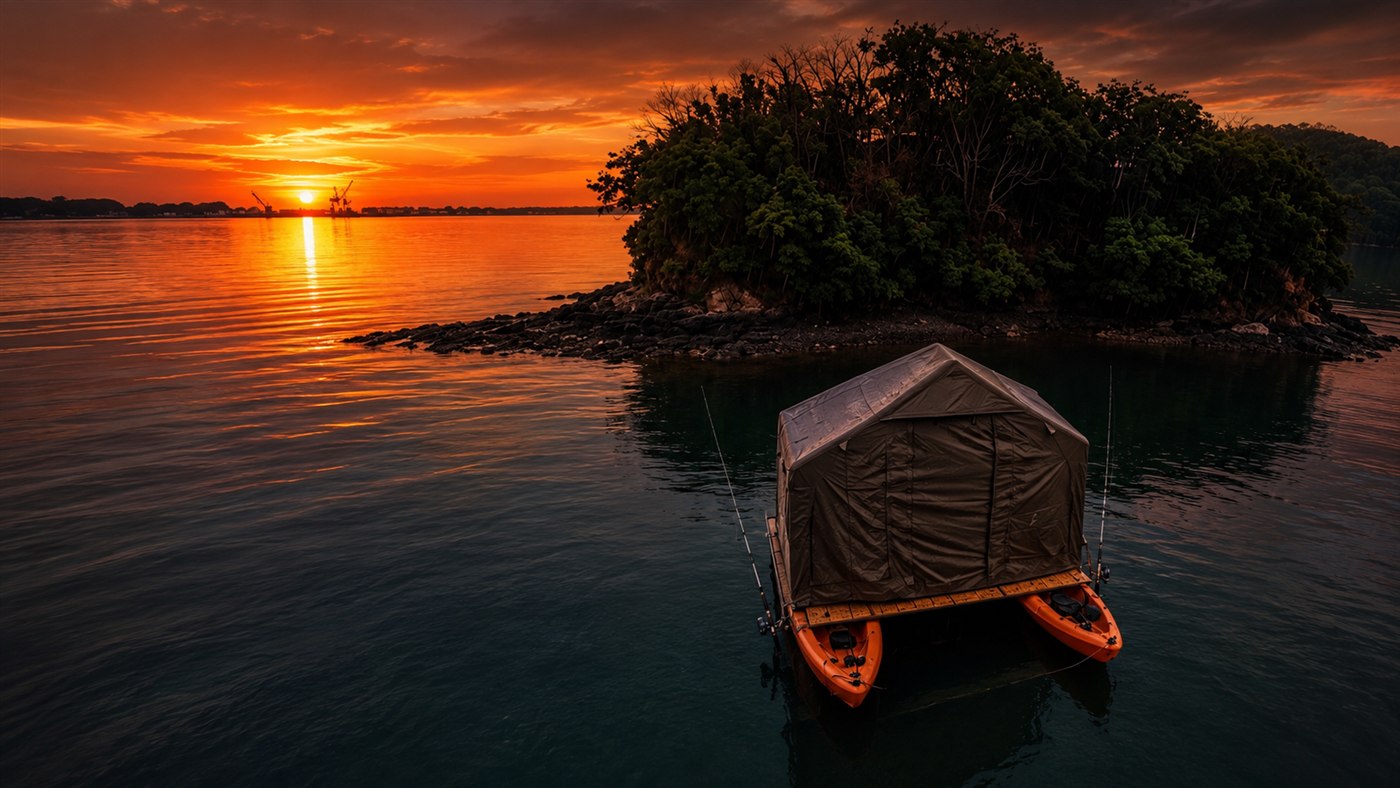
This cell architecture brings both advantage and complication. The 55 cells provide ample flotation and safety against sinking, but also create hidden beams and gaps under the floor, which turned the seemingly simple task of drilling to the lake into a puzzle of trial and error, as shown by Ambition Strikes. Before the water, the couple also powered the space with solar energy and a battery bank, the off-grid base that the water system would complete.
Why switch marina water for lake water

The reason for the project is practical and seasonal. According to Ambition Strikes, until then the barge drew water from the marina lines that supply the houseboats via the piers, but every year, when winter arrives and the temperature drops, the marina closes and drains the system, leaving the residents without water.
This is what happened and became the trigger. Without the marina’s water at the end of autumn, the couple resorted to dipping pots into the lake and boiling the water on the stove, and decided to make the barge independent with an off-grid system that draws its own water from the lake, as Ambition Strikes reports. The idea copied a system they had been using for years on an off-grid mountain property, which even drew dirty water directly from the ground.
The “straw” that descends through the floor to the lake
The biggest challenge was finding the lake beneath the house. According to Ambition Strikes, the plan was to drill the floor in a perpendicular gap between the cells, away from the steel beams, but the first drills only encountered metal and structure, until, by lifting a piece of the floor and drilling on the other side of a beam, water finally appeared.
The solution to lower the pipe was homemade engineering. The couple passed a 3/4 inch electrical conduit as a sleeve for the PEX pipe to descend firmly to the water, creating a “straw” that draws the lake inside, and protected everything against freezing by making the section pass through a technical cabinet heated by the residual heat from the water heater, as Ambition Strikes explains. This thermal detail allows the system to keep functioning even with the lake freezing outside.
Pump, 3 filters, and ultraviolet light: the path of clean water

The core of the water filtration is a simple and cheap sequence. According to Ambition Strikes, a diaphragm pump with a pressure switch, which cost about 60 dollars, is self-priming and pressurizes the system up to 7 gallons per minute, enough for the shower, dishwasher, and two sinks to operate simultaneously, and the pressure switch turns off the pump automatically when the pressure rises.
After the pump comes the series treatment. The water passes through a sediment filter, which removes sand and dirt, a composite filter for heavy metals, and a carbon filter for taste, and only then enters the ultraviolet light, which needs to be the last step because it breaks the cell walls of bacteria and viruses and requires already clean and transparent water to function, as the Ambition Strikes channel on YouTube describes. A green light on the equipment indicates that the ultraviolet light is active, and the couple only turns it on with the system full to avoid burning the bulb dry.
Surviving the winter: 80 mph winds and pipes that don’t freeze
The system was born in the middle of a brutal winter. According to Ambition Strikes, a storm recorded gusts of 80 miles per hour at the nearby naval base, with waves crashing over the barge deck, power cut in the region for hours, and even the kitchen’s concrete countertop cracked by the movement.
Even so, the water withstood the test. With temperatures dropping to 14 degrees Fahrenheit below zero and several days in the 20-degree range, the off-grid system never froze, as long as the air conditioners remain in freeze protection mode and the interior never drops below 40 degrees Fahrenheit, as Ambition Strikes records. It was proof that the water filtration, with the critical section passing through the heated cabinet, delivers running water all winter long.
The gas heater that works without power
The weak link of the off-grid is precisely the extreme cold. According to Ambition Strikes, the batteries only sustain the heat pumps for about 2 to 3 hours, which is risky in a prolonged blackout, so the couple installed a direct vent gas heater that does not rely on electricity to operate.
This redundancy protects the house and the water system. The heater uses a piezoelectric igniter and a thermostat, does not need power or a fan, and keeps the space above freezing even without light, which prevents burst pipes and protects the pump and filters of the system, as Ambition Strikes shows. It’s the same logic for those living off-grid: every essential piece needs a plan B that works when solar power isn’t enough.
What homemade water filtration teaches rural Brazil


The contraption communicates directly with the reality of the Brazilian countryside. In Brazil, millions of people in farms, islands, and riverside communities treat river, pond, or well water with the same logic of sediment filter, charcoal, and disinfection, whether by chlorine or ultraviolet light, to have safe water away from the public network.
The technology is accessible and replicable. The set of pump, filters in series, and ultraviolet light that the couple assembled is sold in Brazil for rural properties and isolated houses, and the same water filtration that cleans the water of a lake in Idaho is what treats the water of a river in the Amazon or a pond in the semi-arid, a notable parallel for the Brazilian rural reader. From the American lake to the Amazon river, the equation is the same: those who treat their own water gain autonomy without relying on water trucks or utility companies.
The video covers the drilling from the floor to the lake, the assembly of the pump, the three filters, the ultraviolet light, and the testing of the system in the harsh winter.
The off-grid barge from Idaho proves that it’s possible to draw and treat water from a lake at home with simple and cheap parts. Tell us in the comments: would you trust a homemade water filtration system to drink water from the lake or river?