






 Portuguese
  Spanish


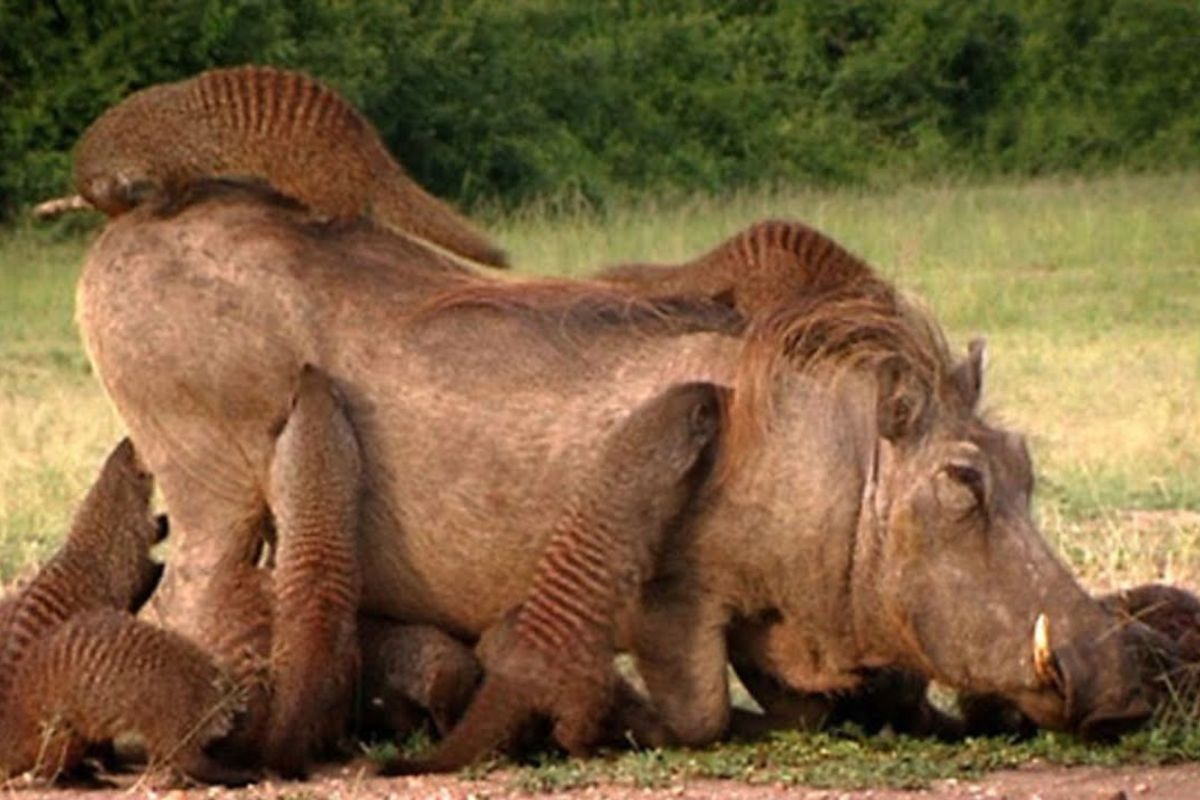


In Mweya, In The African Savanna, An Adult African Warthog Approaches Banded Mongooses And Becomes A Client Of A Natural Spa. It Tolerates Climbing On Its Body While Ticks Are Removed. In Exchange, The Mongooses Get Protein. The Scene Shows Symbiosis, Real Risk, And Collective Discipline Among Lethal Prey And Predators
The African warthog is a common presence in the African savanna, but no one confuses its appearance with docility. The tusks are described as formidable weaponry, capable of repelling predators like lions and also of settling disputes among the warthogs themselves.
Even so, in Mweya, an adult male walks deliberately toward a group of banded mongooses and, instead of initiating conflict, accepts a ritual of approach, physical contact, and grooming, transforming tension into a direct exchange of survival.
An Encounter That Seems Like Confrontation But Turns Into A Tolerance Protocol

The initial movement of the African warthog is calculated: it advances, and the mongooses do not retreat.
-
Crab Trapped in Plastic Bottle for 62 Days Near Okinawa Highlights Little-Known Impact of Marine Pollution on Small Animals

-
Esperanza’s Bamboo Barrier in Oaxaca Redirects River and Reduces Erosion by 85% in Five Years

-
Family Builds Homemade Wind Turbine to Power Off-Grid Home, Video Reaches 555,000 Views on Ngô Thị Huyền’s Channel
-
Indian Brand Creates Sneakers from Recycled PET Bottles and Discarded Tires, Repurposing Over 1 Million Bottles and Raising $4 Million for Expansion




The scene carries an obvious risk because a mongoose can injure itself severely with a single blow, and even a minor injury can spell the end for a small animal that depends on agility and physical integrity.
The immediate reading would be of threat, but the observed behavior points to another logic: the group stands firm because there is predictability.
It is not courage without calculation.
It is a pattern repeated enough to create operational trust, even under real danger.
Lethal Prey, Small Predators, And The Exact Limit Of “Not Attacking”

The African warthog is not presented as a passive animal.
It is described as powerful and dangerous, someone with defensive and offensive capabilities.
What stands out in Mweya is the choice not to trigger this potential against the mongooses.
For the African warthog, self-control has practical value.
To attack would mean interrupting a cleaning service that removes ticks from the body. For the mongooses, provoking the animal would be suicidal.
The balance arises because both operate on the limit of necessity: the African warthog tolerates, the mongooses work quickly, and contact ends before it turns into an accident.
The Wild Spa In Mweya And The Logic Of A Cleaning Business
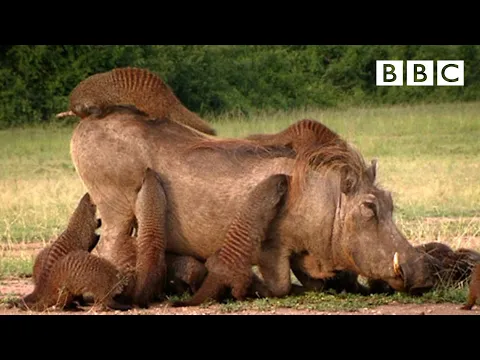

The ritual in Mweya is described as a type of cleaning business.
The mongooses climb all over the body of the African warthog, looking for ticks as their primary target.
The African warthog, in turn, allows this traffic to occur without reacting as it would to a larger predator.
The mongooses’ gain is direct and immediate.
Ticks become a meal, described as protein-rich.
The gain for the African warthog is also direct: fewer parasites mean less discomfort, less energy loss, and a lower burden of invisible aggression that parasites impose in the daily life of a large animal in a competitive environment.
The Economy Of Risk For Banded Mongooses
For the mongooses, the risk is not theoretical.
Proximity to a large African warthog places the group in front of a mistake that can be fatal.
Thus, the execution is reported as quick. Speed Becomes A Survival Strategy.
The group must keep attention even to an unexpected detail: pigs weighing around 100 kg may fall from time to time. The phrase reveals the physical nature of the encounter.
It’s not just about prey. A sudden movement of a heavy body can crush, hit, or disorganize a small predator, reinforcing why collective coordination matters.
Symbiosis In Raw State: Two Gains, A Simple Rule
The relationship is described as symbiotic, unique among two species of mammals, and beneficial for both parties.
The simple rule is clear: the African warthog receives tick cleaning, and the mongooses receive food.
What sustains this type of unlikely alliance is the repetition of a positive result.
Over time, the African warthog learns that contact does not mean immediate threat.
The mongooses learn that the approach works if they respect limits, posture, and timing.
Life in the African savanna rewards agreements that save energy and reduce harm without requiring absolute trust.
The End Of The Service And The Return To The Predator Environment
After the work, the mongooses finish the cleaning, and the African warthog leaves the wild “spa.”
The closure is part of the mechanism: the animal is not left exposed indefinitely, and the group does not stretch the risk to the breaking point.
The final result is a simple scene, but with deep implications: in a landscape where prey and predators face each other every day, there is room for functional alliances when the benefit is clear, and behavior is disciplined.
Do you think the African warthog accepts this “spa” out of learning and repetition, or out of an immediate need to relieve ticks when the pressure from parasites gets high?


