






 Portuguese
  Spanish


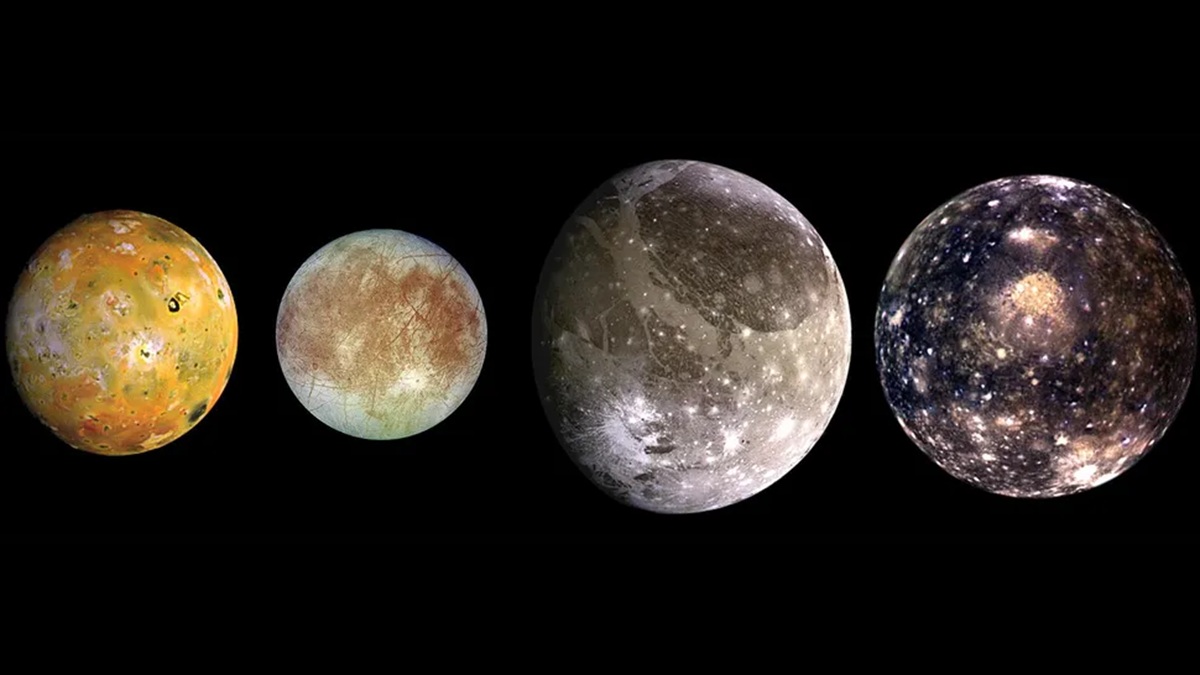

Even with more than 280 known moons, Saturn did not form a group of giant satellites like Jupiter, which has more than 100 moons and houses Io, Europa, Ganymede, and Callisto; study published on April 2 relates this difference to the strength of the magnetic field of the two planets
Jupiter and Saturn host the two largest moon systems in the Solar System, but the distribution of these satellites follows very different patterns. Although Saturn has more than 280 known moons, Jupiter has four large moons – Io, Europa, Ganymede, and Callisto – and houses Ganymede, the largest moon ever identified in the Solar System.
The difference has caught the attention of astronomers because both planets are gas giants and, in principle, had similar formation trajectories. Still, while Jupiter’s satellite system features several large moons, Saturn is dominated by Titan, the second-largest moon in the Solar System, without an equivalent set to that observed around the neighboring planet.
To investigate this discrepancy, researchers from China and Japan developed a physically consistent model capable of explaining more than one satellite system.
-
Switzerland Maps Light Patterns to Track Snowmelt and Forest Microclimates with 10-Meter Precision

-
Scientists Race to Harness Vast Underground Energy for Clean Electricity
-
23andMe Convinced 15 Million to Share Genetic Data, Went Bankrupt in 2025, and Auctioned DNA Database for $305 Million

-
Firefly Aerospace Becomes First Private Company to Successfully Land Lunar Module Upright on the Moon


The study pointed out that magnetic accretion and the formation of a magnetospheric cavity in the accretion disk of a young gas giant may clarify why Jupiter and Saturn ended up with such distinct structures.
Magnetic field helps explain the differences
The research was led by Yuri I. Fujii from the Graduate School of Human and Environmental Studies at Kyoto University and the Graduate School of Science at Nagoya University. The team also included associate professor Masahiro Ogihara, affiliated with Shanghai Jiao Tong University and the Tokyo Institute of Technology, and associate professor Yasunori Hori from Okayama University and the Astrobiology Center in Mitaka, Japan.
The article with the results was published on April 2 in the journal Nature Astronomy. The work started from a question that remained open despite the general similarities between Jupiter and Saturn as gas giants.
In recent years, the formation of satellites has been reevaluated with greater attention to the role of magnetic fields. In this process, a planet’s magnetic field directly interferes with how the material around it falls and organizes structures during the initial development phase.
Fujii stated that testing the theory of planet formation is difficult because the Solar System is the only available reference.
At the same time, he noted that nearby satellite systems offer multiple examples with detailed characteristics that can be observed.
Simulations showed distinct trajectories
To understand how the thermal properties and magnetic fields of Jupiter and Saturn changed over time, the researchers conducted numerical simulations of the internal structures of young gas giants. The team also simulated circumplanetary disks around the two planets, as well as satellite formation and orbital migration.
These calculations were made with the support of the computer cluster at the Computational Astrophysics Center of the National Astronomical Observatory of Japan.
The combination of the simulations allowed tracking how the physical conditions of each planet could directly influence the type of moon system formed.
The results indicated that the intensity of the magnetic fields was decisive for the separation between the two scenarios. In the case of Jupiter, the extremely strong magnetic field favored the creation of a magnetospheric cavity in the circumplanetary disk.
This field, described as the strongest in the Solar System, reaches 417 microteslas. The resulting cavity likely captured Io, Europa, and Ganymede, preserving these moons during the system’s evolutionary process.
In Saturn, the situation was different. The planet’s magnetic field, estimated at 21 microteslas, was too weak to form a similar cavity, which prevented the survival of migrating moons within the disk.
What this reveals about Jupiter and other systems
The proposal also offers an explanation for another important characteristic of Jupiter’s system. Callisto does not share the 1:2:4 orbital resonance observed among Io, Europa, and Ganymede, and the model helps to understand why this moon remained outside of that arrangement.
In addition to clarifying the current structure of Jupiter’s and Saturn’s satellites, the study opens up avenues for future research on exoplanets. The conclusions may serve as a basis for interpreting observations of exomoons and circumplanetary disks around young gas giants.
The researchers indicated that gas giants with a mass similar to or greater than Jupiter tend to develop compact systems with multiple moons. In contrast, planets similar to Saturn are more likely to form one or two large moons accompanied by several smaller moons.
The team also hopes to extend the theory to other satellite systems in the Solar System. Among the next targets are Uranus, Neptune, and possible exomoon systems identified in future observations.
The study reinforces that the total number of moons is not the only relevant factor in understanding the architecture of these systems. In the case of Jupiter, the presence of several large moons seems to be linked to specific magnetic conditions that shaped its formation from the early stages, decisively distinguishing the planet from Saturn.
Further reading: Kyoto University


