






 Portuguese
  Spanish


Made of Engineered Wood, CLT Slabs Gain Space in Civil Works, Reduce Weight, Accelerate Timelines, and Decrease Carbon Footprint.
For over a century, concrete has reigned supreme in civil works. Symbol of strength and durability, it has become the foundation of practically all modern infrastructure. However, in recent years, a material once limited to sustainable architecture projects has gained global prominence: Cross-Laminated Timber (CLT), a type of slab and structural panel that challenges traditional concrete with unparalleled technical performance, lightness, and speed.
According to the Food and Agriculture Organization (FAO) and the World Green Building Council, the use of structural wood can reduce CO₂ emissions by up to 60% associated with construction, making it one of the most efficient solutions to decarbonize the sector responsible for about 8% of global emissions.
What Is CLT Wood and Why Does It ‘Challenge’ Concrete?
CLT is made up of cross-laminated layers of laminated wood boards, bonded together by pressure and high-strength industrial adhesives. The crossing of fibers, with each layer positioned perpendicular to the previous one — creates an extremely rigid, stable, and deformation-resistant structural panel.
-
Goodbye to old tiles: renovation technique without construction transforms bathrooms in a few hours, eliminates debris, and reduces costs with coverings using special paints, high-resistance adhesives, and modern finishes that completely renew the space.

-
Goodbye to the traditional clay brick: Indian startup transforms burnt straw into a carbon-negative brick that costs half, insulates better, and even removes CO2 from the air.

-
A Japanese governor single-handedly stalled the construction of the world’s fastest train for nine years, and only now has he agreed to allow a tunnel excavated at a depth of 1,400 meters.

-
A 180-meter ship with a deck the size of a football field was christened to carry 25,000 tons of giant energy modules around the world.


In practice, this means that CLT slabs and walls can support loads similar to reinforced concrete, but with a weight up to five times less. This characteristic drastically reduces the strain on foundations and columns, which in turn decreases the use of steel and cement, two of the most polluting materials in the modern industry.
Moreover, the pieces arrive factory-ready, with precise fittings and openings planned for electrical and plumbing installations, allowing for a clean, quiet assembly that is up to 70% faster than traditional methods.
Europe Leads the Wood Slab Revolution
CLT technology emerged in Austria and Germany in the 1990s and quickly expanded to countries such as Switzerland, Norway, Canada, and Japan. Today, it is used in residential buildings, schools, bridges, and even skyscrapers.
One of the landmarks of this revolution is Mjøstårnet, in Norway, an 18-story building entirely made of engineered wood. The project, completed in 2019, reduced construction time by nearly half and saved hundreds of tons of concrete and steel.
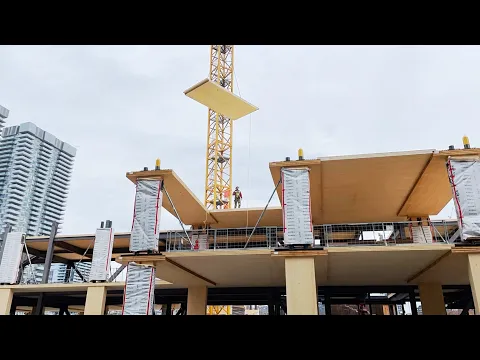

Engineering companies point out that the use of CLT not only accelerates timelines but also improves thermal and acoustic comfort of buildings. As a natural and insulating material, wood maintains more stable indoor temperatures, reducing the need for air conditioning and heating.
CLT Wood Begins to Gain Ground in Brazil
In Brazil, the technology is in a phase of expansion and is already attracting the interest of construction companies and investors. The first national CLT factory, Crosslam Brasil, was inaugurated in Paraná in 2020, and since then the country has seen the emergence of new projects in São Paulo, Santa Catarina, and Rio Grande do Sul.
UFMG, USP, and UFPR are conducting research on the structural behavior of CLT in different biomes, especially with native reforested woods like pine and eucalyptus. These species perform well mechanically and are widely available, which reduces logistics costs and makes the process more competitive.

According to data from the Brazilian Association of Mechanically Processed Wood Industry (ABIMCI), the cost of a CLT slab in Brazil is already up to 25% lower than that of a conventional reinforced concrete slab in mid-size projects, considering savings in labor, time, and transport.
Sustainability and Environmental Certifications Drive the Sector
The growth of engineered wood is directly linked to the pressure for low-carbon buildings. CLT is considered a “carbon negative” material because it stores CO₂ throughout its lifecycle instead of emitting it — an essential factor for companies seeking certifications like LEED, AQUA, and EDGE.
In addition, the wood used comes from FSC-certified planted forests (Forest Stewardship Council), ensuring sustainable origin and traceability. This way, CLT slabs and panels fit perfectly into the ESG (environmental, social, and governance) goals of construction companies and developers operating in the high-end corporate and residential market.
Challenges and Perspectives for Large-Scale Adoption
Although technically mature, CLT still faces challenges in Brazil, such as lack of normative standardization, initial import costs for inputs, and cultural resistance from parts of the sector accustomed to working with concrete. However, the scenario is changing rapidly.
The Technological Research Institute (IPT) is developing specific guidelines for the use of engineered wood in vertical structures. Meanwhile, construction companies and engineering startups are already beginning to adopt hybrid systems — combinations of concrete and CLT — that leverage the best of each material, balancing performance and cost.
Experts project that by 2030, Brazil could triple the number of CLT projects, driven by energy efficiency policies and incentives for the green economy.
A New Paradigm in Civil Engineering
CLT wood slabs symbolize more than a technical innovation — they represent a shift in mindset. In a sector historically dependent on concrete, wood returns as a symbol of modernity, lightness, and sustainability.
With gains in productivity, comfort, and minimal environmental impact, CLT points towards the future of civil construction: a future modular, clean, and renewable, where every square meter built helps to reduce emissions rather than increase them.
If concrete shaped the 20th century, engineered wood might be the raw material that will build the 21st century.


