






 Portuguese
  Spanish
  4 min of reading
  0 comments


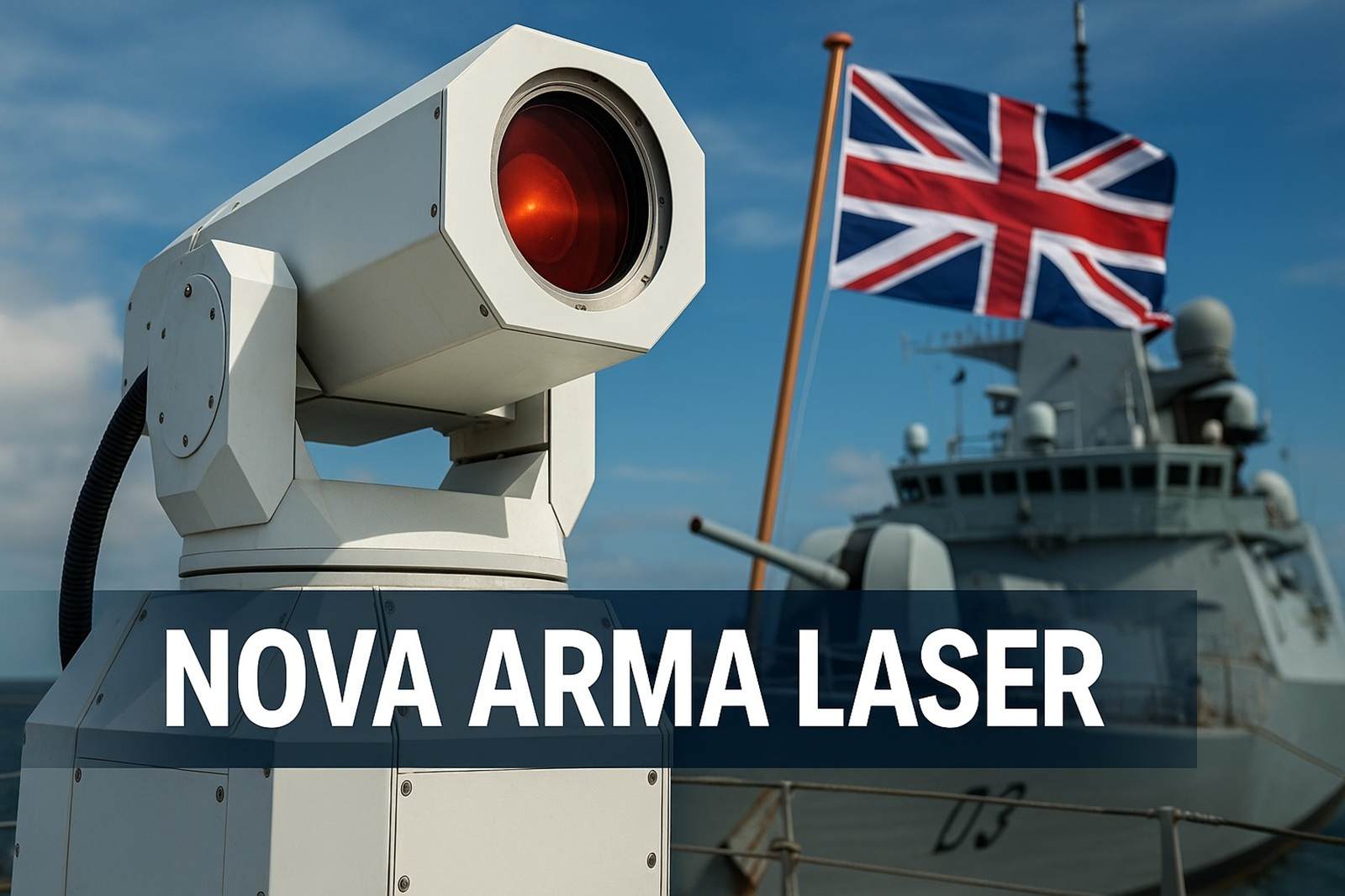
British Laser Weapon Demonstrates Unprecedented Capability to Take Down High-Speed Drones, Hit Coin Precision at One Kilometer and Offer Shots at Only £10, Reinforcing the Royal Navy’s Accelerated Defense Strategy
The British Ministry of Defence reported that the DragonFire laser weapon achieved new results by taking down high-speed drones during a series of recent tests. The technology received a £316 million contract to be integrated into the Royal Navy starting in 2027, as part of an accelerated procurement plan.
Tests on Drones Up to 650 km/h
The trials were conducted at the Hebrides Testing Area in Scotland, where drones reached speeds of up to 650 km/h, nearly double the maximum speed of a Formula 1 car. Authorities confirmed that this was the first time the system successfully tracked, directed, and engaged such drones beyond the horizon in the UK.
The officials stated that these results reinforce the operational capability of the weapon, which has been developed to operate in rapid response scenarios. The assessment of the targets’ high-speed movements allowed validation of the laser’s performance in challenging conditions.
-
Helicopter Drops 180 Tons of Sand and Gravel on Swedish River to Revive Ecosystem Damaged by Decades of Exploitation

-
Brazilian Company Launches Retro Smartphone with 48 MP Camera, T9 Keyboard, and Privacy Features for Social Media-Free Use

-
Self-Taught Chinese Farmer Builds 5-Ton Submarine from Scrap, Launches It in Anhui River
-
Invisible Induction Technology Enables Wireless Power for Blenders, Coffee Makers, and Air Fryers, Reducing Countertop Cables





Reduced Cost Per Shot
The DragonFire stands out for its approximate cost of £10, equivalent to about US$13 per shot. This figure contrasts with the price of air defense missiles, which can reach hundreds of thousands of pounds in a single engagement.
According to the Ministry of Defence, the system’s precision is sufficient to hit a 1-dollar coin at a distance of one kilometer. This feature is cited as essential for operations requiring pinpoint neutralization of threats.
The current plan envisions the laser being installed on a Type 45 destroyer by 2027, five years earlier than initially projected.
Components and Technology Used
The demonstrator used in the tests integrates a 50-kilowatt laser developed by QinetiQ, a high-precision beam director from Leonardo, and a command and control system from MBDA, which utilizes advanced image processing.
The engineers stated that the setup proved capable of stabilizing and controlling high-energy light over long distances. The system also demonstrated the ability to focus the laser on a specific point without compromising operator safety.
Economic Impact and Job Creation
Defense authorities highlighted that the investment in the weapon will create 590 jobs in the UK. Among them, 200 positions will be in Scotland, 185 in the southwest of England, and 75 in the east of the country.
The government points to DragonFire as part of an effort to boost the national defense industry, reinforcing the sector’s growth strategy.
Defence and Industry Minister Luke Pollard stated that the system will position the Royal Navy at the forefront of innovation within NATO. He emphasized that the country is delivering advanced technology in a landscape of new forms of threat.
Considered Revolutionary Weapon
The Scottish Secretary, Douglas Alexander, declared that the tests reinforce Scotland’s role as a center of excellence in defense, especially since much of the engineering and testing operations occur in Scottish territory.
The DragonFire is noted as the first high-powered laser weapon set to enter operation in a European nation. It is also described as one of the most advanced directed energy programs within NATO.
The Strategic Defence Review allocated nearly £1 billion for the development of directed energy weapons during this parliament. The production process will be led by MBDA, in partnership with QinetiQ and Leonardo.
Accelerated Production and Next Steps
The companies involved stated that the timeline, nearly five years faster than traditional cycles, represents a shift towards the rapid delivery of capabilities. The planning includes continuous updates after the operational start.
Chris Allam, Managing Director of MBDA UK, declared that the new contract marks another significant advance, indicating that the tests demonstrate the delivery of a system considered revolutionary. QinetiQ’s CEO, Steve Wadey, stated that the program shows how government and industry can implement disruptive technologies swiftly.
Mark Stead, a representative from Leonardo, highlighted that the beam director derives from decades of research. He noted that the contract reflects the recent progress achieved by the team.
Authorities concluded that DragonFire will enhance the UK’s protection against drone threats, enabling the confrontation of hostile unmanned aircraft at a significantly lower cost than traditional interceptors.





Be the first to react!