






 Portuguese
  Spanish
  4 min of reading
  1 comment


The Artificial River Project of Libya Is the Most Impressive Engineering Ever Seen in Humanity.
Works of the largest artificial river in the world: Libya, located in the north of the African continent between Egypt and Algeria, is a country shadowed by civil wars and much violence. But despite this sad part of the country’s history, it has been announced that the Libyan Desert is undertaking one of the most impressive engineering projects ever seen in human history: the Great Man-Made River of Libya. This incredible and monumental undertaking will span 2,820 km. The main objective of this endeavor is to meet the water needs of the country, as water scarcity is a significant challenge for its inhabitants.
The Libyan Desert Will Have the Largest Artificial River in the World
More than 90% of Libya’s territory is composed of arid deserts, marked by water scarcity, with areas that have not recorded rainfall for centuries, literally. Furthermore, Libya is the only country on the African continent and one of the few countries in the world that has no natural river, a reality that poses a significant challenge to the development and well-being of its population.

But something surprising happened: while searching for new oil reserves, the Libyans discovered that there were vast underground aquifers, remnants of the last ice age, estimated to contain around 35,000 km³ of water, which is more than the amount of water found in all the Great Lakes of North America.
-
Bolivian Female Construction Workers Form Association to Combat Discrimination and 38% Pay Gap in the Industry

-
Near Amsterdam, residents buy land and discover they must also build streets, manage drainage, handle waste, and grow food on half their plot.
-
Brazil’s WEG to Open New Factory in China by 2027, Expanding Production of Large Rotating Electric Machines and Low to Medium Voltage Motors in Rugao

-
Chinese Shipyard Secures $1 Billion in Orders for Low-Carbon Container Ships Amid Global Fleet Renewal Efforts


With this discovery, the Libyans understood that they were facing an invaluable treasure for the Libyan Desert, paving the way for a large and audacious project to be undertaken at the site.
Phases of the Artificial River Project of Libya
Following the Libyans’ discovery, the Libyan Government initiated the construction of the Great Man-Made River of Libya for the benefit of its population. With several phases to be carried out, the Libyan government’s project involved everything from drilling hundreds of wells in water fields to installing kilometers of pipes to transport water to the main cities of Libya.
Phase 1: The Beginning of the System
Known as GM1 or Phase 1, the first stage of the project began in 1983, with water being conducted from wells located in eastern Libya to the cities of Sirte and Benghazi. In this phase, the two-way piping system managed to transport 2 million cubic meters of water daily over approximately 1,600 km of pipelines.
Phase 2: Expansion of Reach
The second stage of the project occurred in 1996, aimed at supplying Tripoli, the capital of Libya, with water coming from three wells in the Jabal al Rauana region in western Libya.
Phase 3: Integration of the System
The third phase was divided into two parts: the first extended Phase 1, adding an additional 700 km of new pipelines and water pumping stations, increasing the total supply capacity to 13.68 million cubic meters. In the second part, more than 138,000 cubic meters of water daily were added for the city of Tobruk in the northeastern region of the country.
Next Phases of the Project
The project also includes two more phases, which involve the extensions of the Phase 1 system to the southern region of the country, reaching fields in the Al Kufrah area. Once all phases are completed, the total capacity of the system will be approximately 6.5 million cubic meters of water daily, distributed through more than 4,000 km of pipelines.
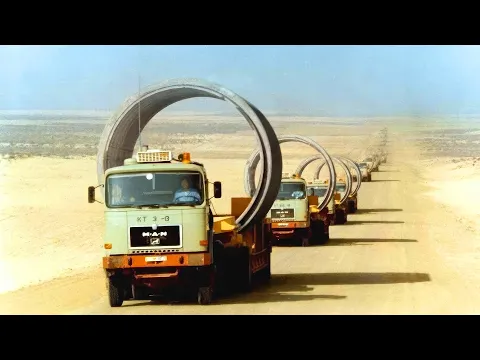
The construction of the largest artificial river in the world in the Libyan Desert is a spectacular engineering feat. The installed pipe sections, measuring 4 meters in diameter and 7 meters in length, are considered the largest in the world. The pipes were manufactured in Libya, made of reinforced concrete and buried 7 meters deep.
Transformative Work in the Libyan Desert
The great project of the largest artificial river in the world has had a transformative impact on the country in the African continent. In total, more than 135 thousand hectares of land are being irrigated, resulting in a production of 270 thousand tons of grains, in addition to 760 thousand tons of annual fodder for animal feed. The country also sees its lands abundant with fruits, vegetables, and legumes cultivated by its people.
In the future, the reach of the artificial river of Libya will extend with new tributaries, with the expectation of reaching all the villages and communities in the country. Undoubtedly, the Great Man-Made River of Libya is an example of how well-applied engineering can overcome seemingly insurmountable challenges.
The project of the largest artificial river in the world has transformed the reality of a country marked by water scarcity, providing well-being and improving the quality of life for the people of Libya. Moreover, the country has demonstrated that, even in the face of adversity, it is possible to achieve feats of such magnitude that change the course of its own history.





Não seria melhor, levar a água em grandes tubulões, com derivação onde fosse necessário? Através de canais vai se perder mais de 50% pela evaporação do grande deserto.