






 Portuguese
  Spanish
  5 min of reading
  0 comments


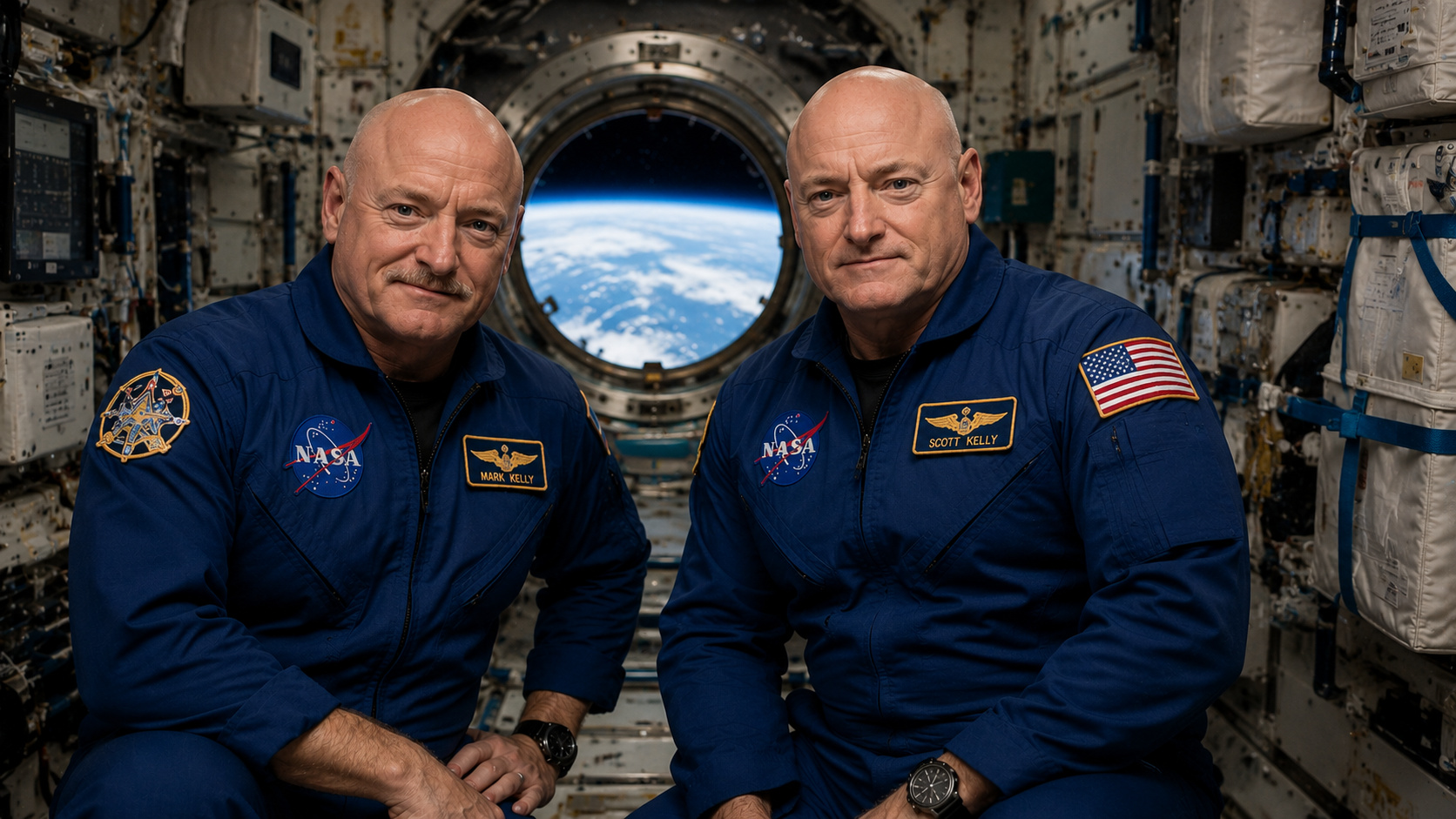
NASA study with Scott and Mark Kelly revealed changes in telomeres, genes, immunity, and cognition after 340 days on the ISS.
In March 2015, NASA implemented one of the most important experiments ever conducted on the effects of space on the human body. Astronaut Scott Kelly spent 340 consecutive days aboard the International Space Station, while his identical twin brother, Mark Kelly, remained on Earth as a control group. The integrated results of the so-called Twins Study were published in 2019 in the journal Science, making the experiment a reference in modern space medicine.
The central point of the study was not to prove a definitive mutation of the human organism, but to show that prolonged stay in space produces real and measurable changes in crucial biological processes.
According to NASA, there were changes in telomeres, gene expression, immunity, gut microbiome, and cognitive performance, with some of these responses returning to the previous pattern after landing and others remaining altered for a longer time.
-
China and Japan create a brain implant thinner than a hair, with 128 channels and data density ten times greater than any previous hydrogel, which operated for 550 days in rabbits without causing inflammation or scarring.

-
Coffee grounds turn into fuel in just 90 seconds, eliminating the need for drying, removing sulfur compounds, and generating biochar with energy similar to anthracite coal in a process created by scientists in South Korea.
-
Black Hawk transported 300 whole logs with roots in 3 days to return wood to degraded rivers, crossing 8 km per flight and using loads of up to 7,500 pounds in an operation planned to rebuild natural structures lost to industrial exploitation.

-
While Brazilian highways struggle with an excess of trucks, a company removed 82,000 trailers from the roads of Santa Catarina in one year by transporting 6,700 tons per day by sea from São Francisco do Sul.


Scott Kelly in space and Mark Kelly on Earth created one of the most valuable biological controls in space medicine
The scientific strength of the experiment was precisely in the comparison between two brothers with practically the same genetic material. According to NASA, this design allowed for much more precise observation of what was the effect of the space environment and what could be just normal biological variation between different individuals.
The study brought together 10 research teams and integrated physiological, molecular, and cognitive analyses into a single observation base.

This model elevated the Twins Study to a rare level within biomedical research applied to space flight. Instead of measuring only isolated effects, researchers were able to compare body responses at multiple levels, from gene activity to cognition, using an almost ideal biological control.
Therefore, the experiment has come to be regarded as a milestone for the planning of long missions, especially those aimed at the Moon and Mars.
Telomeres changed in space and debunked simplistic explanations about aging outside Earth
One of the most striking findings involved telomeres, structures that protect the ends of chromosomes and are usually associated with cellular aging.


According to NASA, Scott Kelly showed a significant change in telomere length dynamics during the flight and also in the days immediately following his return. This data surprised researchers because it showed that cell biology in microgravity does not follow a simple or linear behavior.
The result does not warrant the hasty conclusion that space “rejuvenates” the human body. What the study showed was a temporary and complex disorganization of this biological marker, followed by rapid adjustments after returning to Earth.
NASA itself included the dynamics of telomeres among the few factors that remained altered at the end of the monitoring, which reinforces the importance of this finding for future long-duration missions.
Gene expression under stress revealed intense adaptation of the organism to the space environment
Another decisive core of the study was the analysis of gene expression, that is, how the organism activates or reduces the activity of certain genes in response to the environment.
NASA reports that samples collected before, during, and after the mission showed significant changes in Scott Kelly, while Mark Kelly exhibited only changes within the range considered normal on Earth.
The majority of these changes, about 91.3%, returned to baseline levels after the return, but a small subset remained different even after six months.

These changes were connected to other signals observed in the study, including response to DNA damage, regulation of telomeres, bone formation, and immune stress.
NASA also states that part of the observed DNA damage was likely linked to radiation exposure, one of the central risks of prolonged space flight. In practical terms, the result shows that the body does not “shut down” in space: it enters a continuous adaptation mode, redesigning internal processes to withstand an extreme environment.
Immune system remained functional and the gut microbiome changed profoundly
In the field of immunology, the study brought relevant news for future expeditions. According to NASA, Scott Kelly received three flu vaccines at different times, including one application in space, and the body responded adequately.
This result gave the agency more confidence to consider that the immune system can remain functional even on prolonged missions, something crucial for crews that will be away from Earth for months.
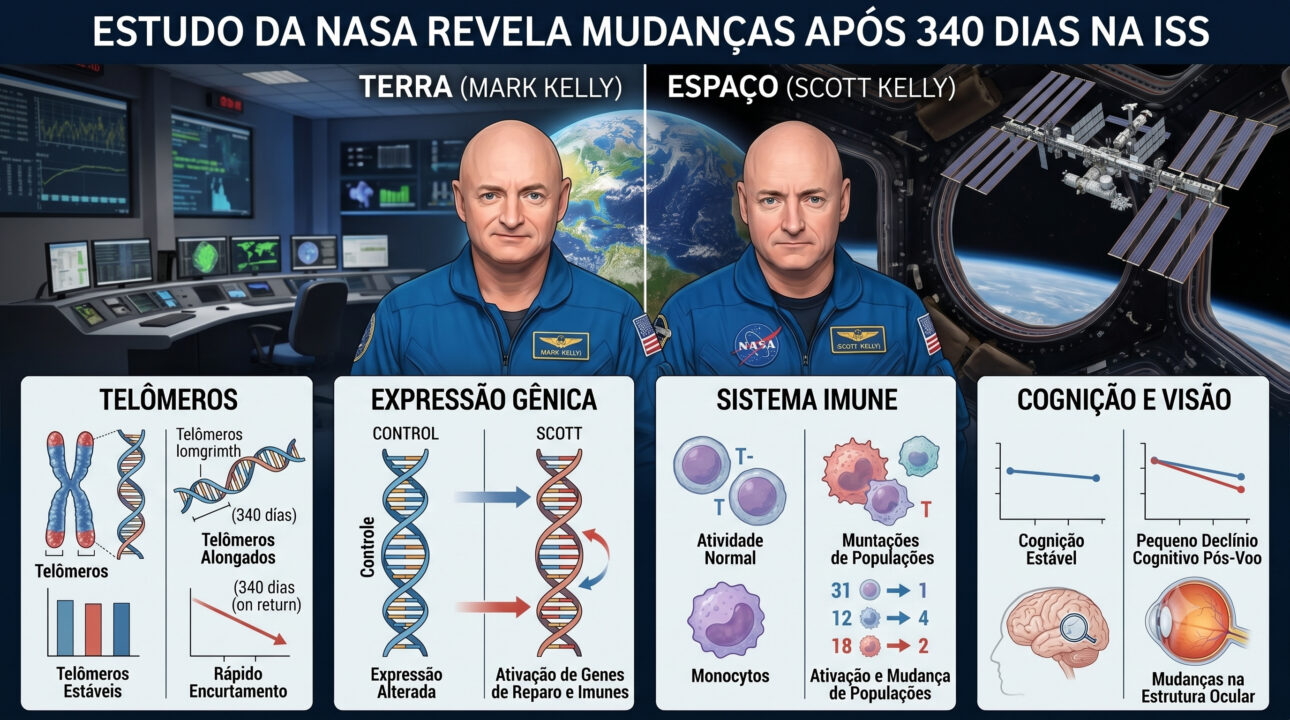
At the same time, Scott’s gut microbiome became profoundly different during the flight compared to the pre-mission period. NASA attributes this change possibly to the station’s diet and other specific factors of the space environment.
After returning, the gut flora returned to its pre-flight state, which was seen as an encouraging sign. Still, the study reinforced that space affects not only human tissues and organs but also the microscopic ecosystem that helps regulate digestion, metabolism, and immunity.
Cognitive decline appeared mainly after landing and raised an alert for long missions
One of the most important results for future operations appeared in the cognitive part. NASA reports that, with few exceptions, Scott Kelly’s mental performance remained largely stable during the mission, including in alertness, spatial orientation, and emotional recognition tests.
The strongest issue arose after landing, when there was a more pronounced decline in speed and accuracy of some tasks, persisting for about six months.

This detail changes the way the theme is usually summarized. The main cognitive risk pointed out by the Twins Study was not exactly a continuous degradation throughout the flight, but a more marked difficulty in the readaptation to Earth’s gravity and the period immediately after the mission.
For manned exploration programs, this is decisive: astronauts who need to land and perform complex tasks right after months in space may require more robust recovery and reconditioning protocols.
NASA study became a central piece in the debate about the Moon, Mars, and biological limits of human exploration
NASA itself describes Scott Kelly’s mission as a scientific step for even longer journeys, including expeditions to Mars, which may take years between going, staying, and returning. The value of the Twins Study lies precisely in showing that the human body can adapt to space, but not without biological cost.
Several systems returned to the previous pattern, but others left persistent signs that require monitoring, medical countermeasures, and much more sophisticated operational planning.
In the final balance, the study neither supports easy alarmism nor naive optimism. What it delivers is something more useful and more serious: a concrete map of the adjustments the human body needs to make to endure months in orbit.
For manned deep space exploration, this means that navigation and propulsion technology alone will not suffice. The frontier will also be biological, and the Twins Study showed, with real data, where this challenge begins.






Be the first to react!