






 Portuguese
  Spanish
  4 min of reading
  0 comments


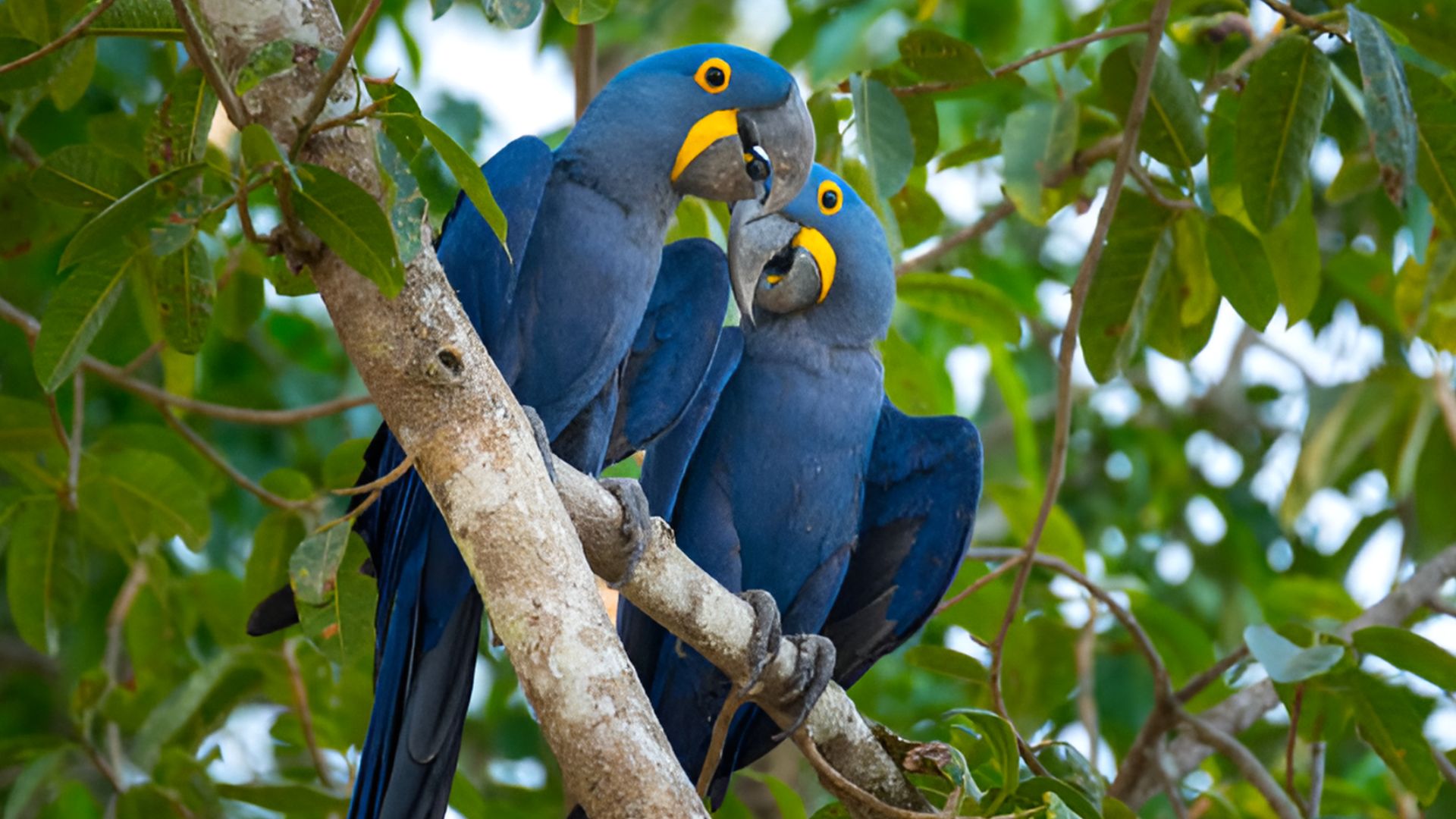
With Intense Blue Plumage and Unique Social Behavior, Giant Bird Inhabits the Pantanal and Reveals Essential Role in Environmental Regeneration. Brazilian Project Is a World Reference in the Preservation of This Emblematic Species.
The hyacinth macaw (Anodorhynchus hyacinthinus), measuring up to 1 meter in length and boasting cobalt blue plumage, is celebrated as the largest macaw in the world — and can be found in Brazil, particularly in the Pantanal of Mato Grosso do Sul, where a significant portion of its population is concentrated.
The species lives in monogamous pairs that share all stages of parental care, from nest building to chick supervision — an organized leadership that, nonetheless, does not prevent a low reproductive success rate, with an average of only one chick surviving among two eggs laid.
In the last 30 years, thanks to the efforts of the Hyacinth Macaw Institute, led by biologist Neiva Maria Robaldo Guedes, the population in the Pantanal increased from around 1,500 to approximately 6,000 individuals.
-
Brazilian mechanic invented a lamp made from a PET bottle during the 2001 blackout, the idea turned into an NGO present in 30 countries and has already illuminated 40,000 people in 200 communities without electricity in Brazil.

-
Centuries-old mystery gains new chapters in Greece after excavations reveal a possible lost temple of Poseidon, hidden among ancient lagoons, monumental remains, ritual objects, and an architectural plan that surprised even the experts.

-
2-month-old baby says “I love you” to parents and the video froze the internet: doctors say most babies only speak after the first year of life
-
At 98 years old, Priscilla Sitienei returned to school in uniform, sits next to children, and has a new dream: to become a doctor, after decades of working as a midwife in rural Kenya.



Characteristics of the Hyacinth Macaw
The hyacinth macaw is imposing both in size and coloration.
Measuring around 1 m from beak to tail, with a wingspan of up to 1.2 m and an average weight of 1.3 kg, it is the largest bird in the Psittacidae family.
Its intense blue varies in shade from the chest to the tail feathers, sharply contrasted by the bare yellow skin around its eyes and the base of its beak — this robust structure allows it to crack the hardest seeds.
The tongue, dark with yellow stripes, serves as a tool for consuming fruits.
Natural Habitat and Geographical Distribution
Native to South America, the species occurs in the Pantanal of Brazil, Bolivia, and Paraguay, as well as in specific areas of the Cerrado and the Amazon.
In Brazil, in addition to the Pantanal, there are records in states such as Amazonas, Pará, and in the region known as Matopiba (Maranhão, Tocantins, Piauí, and Bahia).
In the Pantanal, hyacinth macaws prevail in open areas and forest edges with palms — acuri, bocaiuva, tucum, piaçava, iajá, and catolé — as they depend on these fruits for nourishment.
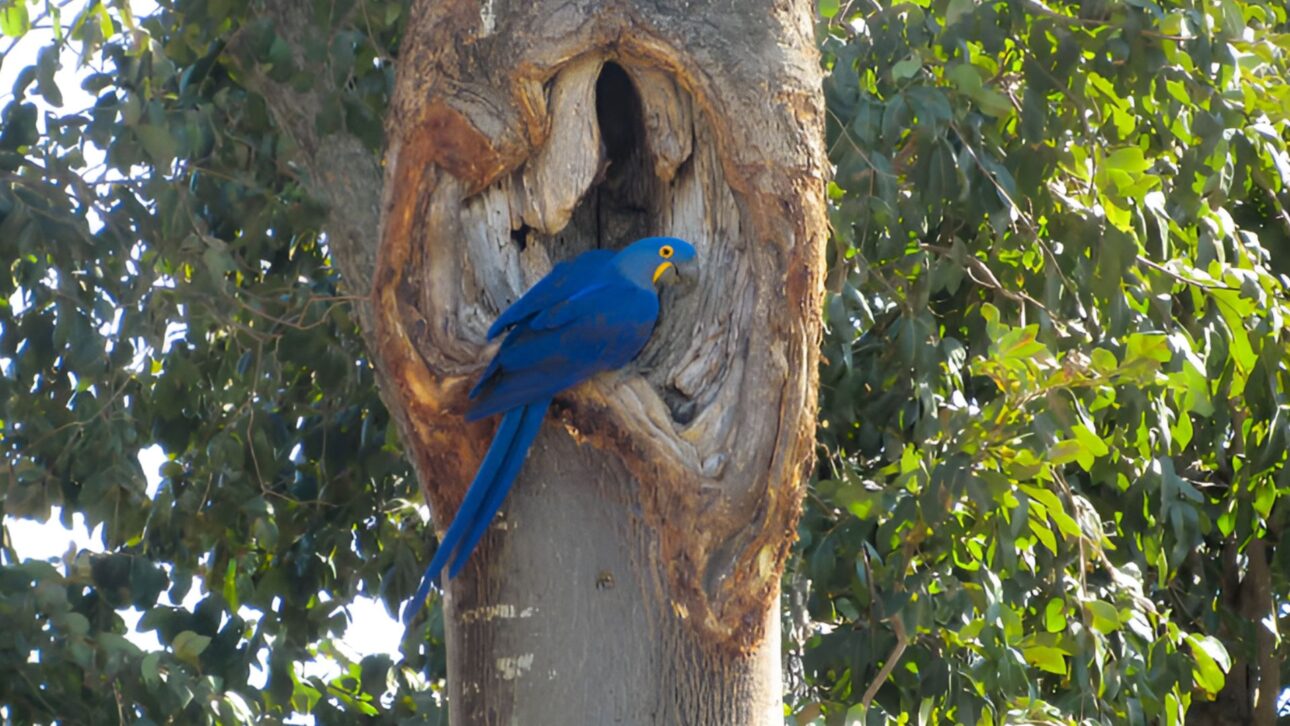
About 90% of nests are located in hollows of manduvi trees (Sterculia apetala).
Social Behavior and Diet
The bird forms family groups with a complex social structure.
They fly in pairs or small groups, taking turns in vigilance, mate exclusively with the same partner (until one member passes away), and collectively care for chicks — often even adopting juveniles from other pairs.
The diet is based on palm seeds, especially acuri and bocaiuva in the Pantanal, or piaçava, catolé, and buriti in other regions.
To crack these seeds, they use their powerful beak and tongue as a hammer — sometimes even using pieces of wood as tools.
This practice contributes to seed dispersion and forest regeneration, playing the role of “environmental engineer.”
Reproduction and Chick Development
Sexual maturity occurs between 3 and 7 years.
The female typically lays two eggs per season (July to December), but usually only one chick survives due to natural competition.
The incubation lasts about 30 days, and the chicks remain in the nest for approximately 90 days, following their parents for about 18 months.
The low reproductive rate is exacerbated by the scarcity of natural cavities, typically found only in trees over 60 years old.
Threats to Species Survival
The greatest threats to the hyacinth macaw are:
- Habitat loss, especially due to cattle ranching, mechanized agriculture, hydroelectric dams, and burning for pasture renewal.
- Wildfires that destroy nests and reduce the availability of palms.
- Wildlife trafficking, due to beauty and rarity.
- Low genetic diversity, potentially exacerbating population vulnerability, although habitat loss has a more significant impact.
The species is considered “vulnerable” by the IUCN since 2014, and although it has been removed from the Brazilian Red List, it still faces significant environmental risks.
Conservation and Recovery Efforts
Founded in 2003, the Hyacinth Macaw Institute has been operating in the Pantanal since then — especially in Mato Grosso do Sul — covering about 400 thousand hectares across more than 57 farms.
Among the actions taken, the following stand out:
- Nest monitoring, with over 600 natural cavities registered and around 200 artificial nests installed, contributing to the increase in reproduction.
- Installation of artificial nests, which mitigate the lack of mature trees — a solution conceived by Neiva Guedes after research identified the scarcity of cavities as a barrier.
- Environmental education projects, engaging rural landowners and institutional partnerships, including research and legal advocacy for the species.
- Expansion of activities beyond the Pantanal, with recent efforts in Pará to study Amazonian populations.

Positive Impacts and Upcoming Challenges
In the mid-1980s, there were fewer than 1,500 hyacinth macaws in the Pantanal.
The latest estimate suggests around 6,000 individuals in the same region, a clear result of ecological restoration and conservation efforts.
Despite this growth, the species remains in a vulnerable situation.
Dry spells and fires persist in the Pantanal, threatening recovery and possibly reversing population gains.
The need to maintain and expand nesting cavities remains one of the main challenges.
Expanding into new areas such as Cerrado and Amazon requires research, governmental support, and legal coordination.
Sustainability of the Species in the Future
How to expand protection measures to ensure long-term sustainability for the hyacinth macaw — avoiding setbacks caused by drought, fires, and deforestation?


-

1 person reacted to this.