Portuguese
  Spanish


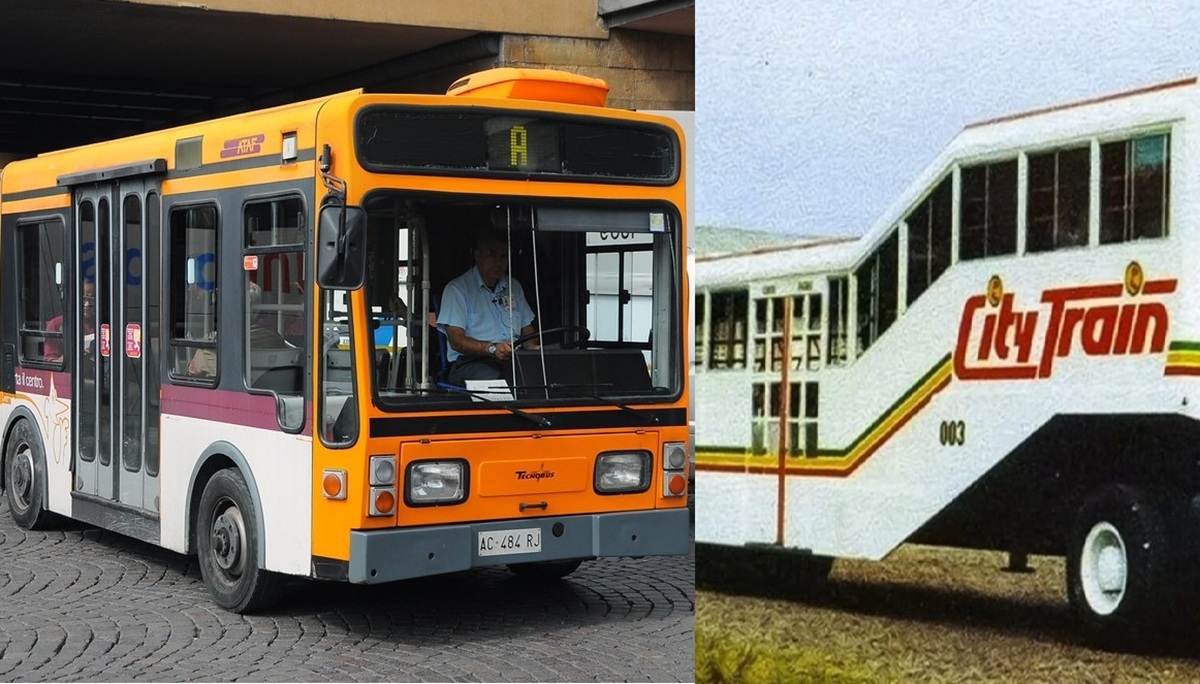


In A World Where Cities Face Opposite Challenges — From Overpopulation To Preservation Of Historic Centers — Two Extremes Have Emerged Redefining The Concept Of Urban Transportation. On One Side, The Colossus DAF Super CityTrain, Measuring 32 Meters Long And Carrying 350 Passengers. On The Other, The Tiny Tecnobus Gulliver U500, Measuring Just 5 Meters And Offering Space For 10 People, Proving That Mobility Can Be Grand Or Incredibly Compact.
In The World Of Urban Bus Transportation, Few Contrasts Are As Striking As The Extremes Represented By The DAF Super CityTrain And The Tecnobus Gulliver U500.
On One Side, A True Colossus On Wheels Measuring 32.2 Meters Long And Capable Of Carrying 350 Passengers. On The Other, A Tiny And Silent Electric Bus Measuring Just Over 5 Meters, Designed To Navigate Narrow Alleys Where Cars Can Barely Pass.
Although They Belong To Completely Distinct Worlds, Both Symbolize Bold Responses To Specific Urban Mobility Challenges — And Have Entered History For Their Unusual Dimensions.
-
Stingless Bee Honey from Brazil Can Cost Up to $120 a Liter, Surprises with Flavors of Wood, Citrus, and Even Cheese

-
Woman Claims to Have Spotted a Technical Pattern in Recent FIFA Tournaments, Predicts Possible World Cup Winner
-
Chevrolet Offers Chance to Win a 2026 Sonic RS for Free via WhatsApp
-
Earthquake vs. Tsunami: Which Causes More Destruction and Why One Can Be Even More Dangerous


The Giant DAF Super CityTrain
The DAF Super CityTrain Was Born In The Late 1980s In Kinshasa, The Capital Of Then Zaire (Now The Democratic Republic Of The Congo).
The City Faced A Collapse In Public Transportation, And The Solution Found Was To Create A Bus With Transport Capacity Equivalent To That Of A Short Train.
The Idea Was Simple And Bold: To Unite A DAF Mechanical Horse At The Front And A Huge Passenger Trailer At The Back, Forming An Articulated Set Capable Of Carrying Hundreds Of People Per Trip.
With About 32.2 Meters Long, 28 Tons In Weight, And A Capacity Of Up To 350 Passengers, The Super CityTrain Became The Largest Bus In The World In Regular Operation.
The Maximum Speed Was Limited To Approximately 41.8 Km/h To Ensure Safety, As Controlling A Vehicle Of This Size Required Special Skill. Due To Its Impressive Size, The Model Entered The Guinness Book As The Longest Bus Ever Built And Put Into Regular Urban Use.
A Bold Attempt To Solve Overcrowding
The Operation Of The Super CityTrain Mainly Took Place On Wide Avenues In Kinshasa, Where Space Allowed Safer Maneuvers. About 45 Units Were Built In Total, Assembled Locally By The Company Chanimetal With Chassis And Components From DAF.
However, Despite The Initially Positive Impact, The Giants Soon Faced Problems: Hard-To-Obtain Parts, High Maintenance Costs, And Accelerated Wear Due To Extreme Weight And Poor Local Asphalt Conditions.
As The Years Went By, Kinshasa Began To Invest Again In Smaller, More Agile Vehicles, And The Super CityTrain Were Gradually Retired.
Even So, They Remain In Memory As One Of The Boldest Creations In The History Of Urban Transportation — An Example Of Engineering That Impressed The World And Showed That Gigantic Solutions Can Arise From Necessity.
The Tiny Tecnobus Gulliver U500
At The Other End Of The Spectrum Is The Tecnobus Gulliver U500, One Of The Smallest Buses On The Planet. Developed In Italy In The 1990s, It Was Designed To Navigate Historic Urban Centers Where Narrow Streets And Tight Curves Prevent Larger Vehicles From Passing.
At Just 5.3 Meters Long And 2.2 Meters Wide, The Gulliver U500 Can Access Alleys Where Even Regular Cars Find It Difficult To Navigate.
Fully Electric, The Small Microbus Carries Between 7 And 10 Seated Passengers, Offering A Silent, Light, And Non-Polluting Alternative For Short Trips In High-Traffic Tourist Areas.
It Operates With Replaceable Batteries, Able To Run For Several Hours Before Needing To Recharge, And Requires Little Space For Parking Or Maneuvering In Tight Spots.
A Solution For European Historic Centers
The Success Of The Gulliver U500 Spread Quickly Through Italian Cities Such As Pisa, Siena, Venice, And Rome, Which Sought Ways To Preserve Their Historical Heritage Without Sacrificing Public Mobility.
Thanks To Its Small Size And Electric Operation, The Vehicle Became A Reference In Sustainable Urban Microtransport And Is Still Used For Short Routes, Often Replacing Taxis And Vans In Areas Where Conventional Vehicle Access Is Restricted.
The Contrast With The Super CityTrain Could Not Be Greater: While One Required Wide Avenues And Reinforced Pavement To Operate, The Other Was Designed For Streets Where Even Pedestrians Traverse Squeezed Together.
Each Was Born To Solve Opposite Problems — One Faced Extreme Overcrowding; The Other, The Challenge Of Historical Preservation In Hard-To-Access Areas.
Two Extremes That Tell A Lot About Cities
The DAF Super CityTrain And The Tecnobus Gulliver U500 Represent Two Fascinating Extremes Of Transportation Engineering.
One Shows How Far Technology Can Go To Move Masses Of People In Crisis Contexts.
The Other Proves That Sometimes The Best Way Is To Reduce Size And Impact To Protect Delicate Spaces. Both, In Their Own Way, Made Their Mark And Continue To Be Remembered As Symbols Of Innovation — One For Its Colossal Scale, The Other For Its Compact Delicacy.