Portuguese
  Spanish



Japan Drills 7,906 Meters into the Ocean to Investigate 2011 Earthquake, Revealing Unprecedented Data on Geological Faults and Extreme Tsunamis.
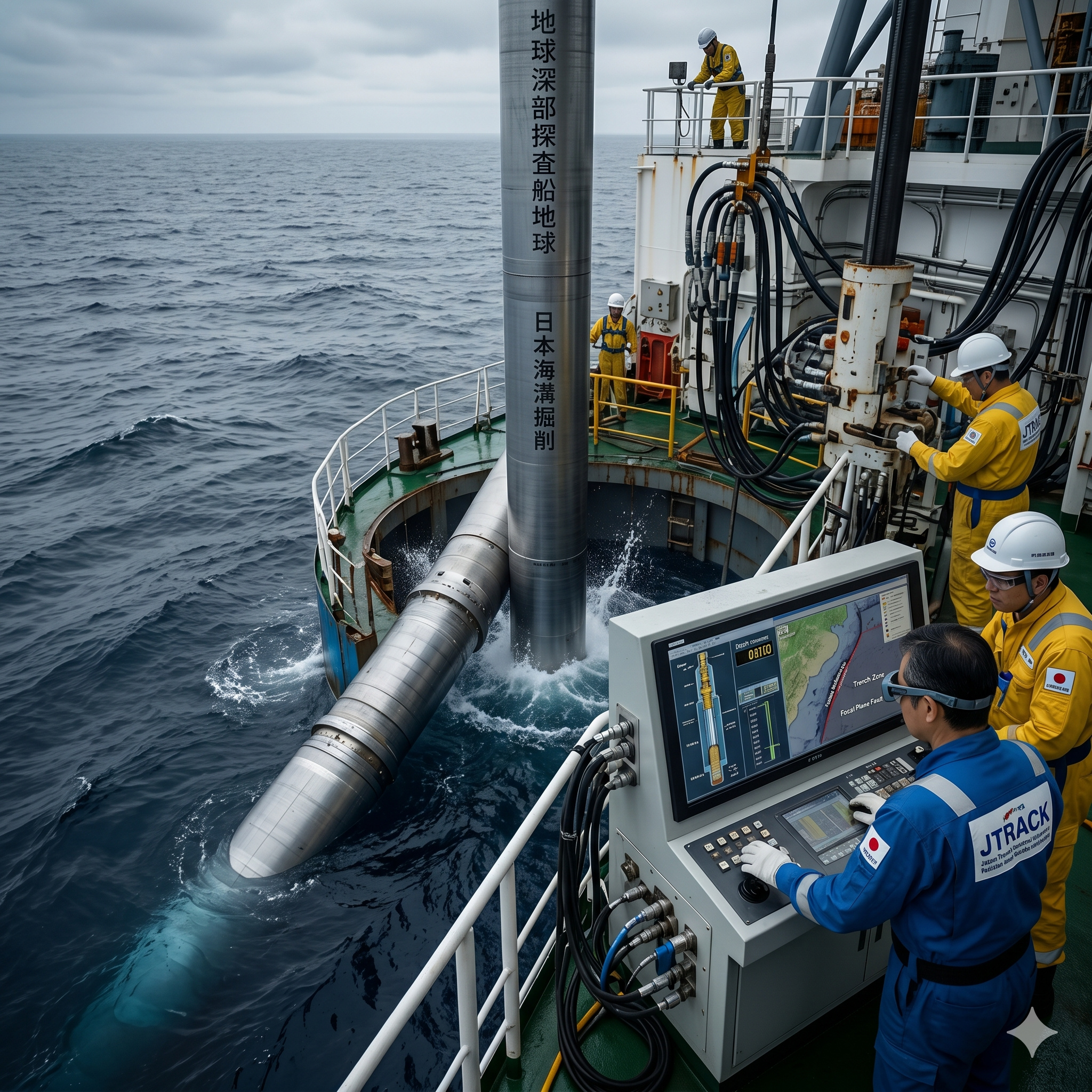
In September 2024, the Japan Agency for Marine-Earth Science and Technology announced an unprecedented milestone in geological science: a record-breaking deep-sea drilling operation of 7,906 meters below the ocean surface, using the scientific vessel Chikyu, to directly investigate the rupture zone of the 2011 Tohoku megathrust earthquake, which occurred off the northeast coast of Japan.
The operation was part of Expedition 405 of the International Ocean Discovery Program (IODP), conducted in the Pacific Ocean, near the Japan Trench, the region where the magnitude 9.0 earthquake occurred, generating a devastating tsunami and causing the Fukushima nuclear crisis. The central objective was to physically access the geological fault responsible for the event, something that had previously only been modeled using indirect data.


This drilling not only broke technical records but also opened an unprecedented window into understanding why the seismic rupture occurred so close to the seafloor surface, a factor considered crucial for the formation of large-scale tsunamis.
-
Thailand Converts 8 Tons of PET Bottles into 3,500 School Backpacks, Showcasing Circular Economy with Over 40 Factories Involved

-
Mysterious Bats Spotted in Paris’s Père Lachaise Cemetery, Drawing Tourists to the “Vampire Cemetery”

-
From Selling Street Food to Leading a $300 Million Construction Firm: The Journey of a Brazilian Entrepreneur

-
Abandoned Penthouse in Houston Reveals Million-Dollar Suite with 24-Karat Gold, Tiffany Crystals, and Opulence Even Elvis Might Have Snubbed




7,906-meter Depth Sets New Technical Limit in Ocean Drilling
The 7,906-meter mark refers to the so-called total drilling column, which includes the water depth plus the extent drilled into the seabed. This number represents one of the greatest challenges ever faced by scientific engineering.
To grasp the magnitude of this achievement, the drilling occurred under extreme conditions:
The water column in the region already exceeds several kilometers in depth, and from the ocean floor, the drill bit still had to penetrate highly unstable sedimentary and rocky layers. The entire drilling system was supported by an extremely long steel pipe, subjected to immense pressures, ocean currents, and thermal variations.
Any minimal misalignment could compromise the entire operation, making this type of mission one of the most complex ever undertaken in the field of geoscientific engineering.
What Scientists Wanted to Discover About the 2011 Earthquake Fault
The Tohoku earthquake in March 2011 was one of the most studied seismic events in modern history. However, one specific point always caught the attention of experts:
The fault rupture occurred very close to the oceanic trench, meaning in a shallower region than expected for earthquakes of this magnitude.
This behavior is considered unusual. In many large earthquakes, the rupture occurs at greater depths, with energy dissipating before reaching the surface. In the case of Tohoku, however, the fault slipped into shallow areas, displacing large volumes of water and generating an extremely powerful tsunami.

The big scientific question was to understand why this rupture behaved in such a way.
Drilling Revealed Critical Fault Properties Explaining the Tsunami
The drilling allowed for the collection of direct samples from the fault zone, something extremely rare in geology. These materials provided fundamental data on the physical properties of the region.
Among the most important findings are:
The presence of materials with a low coefficient of friction, which means the fault can slip more easily. This type of characteristic facilitates larger displacements during an earthquake.
Furthermore, scientists identified high levels of fluid pressure within the fault, which further reduces resistance to movement. This factor is considered crucial to explain how the rupture managed to propagate to shallow regions.
These combined conditions help explain why the earthquake generated such a large displacement of the seabed, a central element for tsunami formation.
The role of the Chikyu vessel in the largest scientific ocean drilling
The Chikyu vessel is one of the most advanced scientific platforms in the world. Designed specifically for deep-water drilling, it is capable of operating in extreme conditions that other vessels could not withstand.

Among its main capabilities are:
- Dynamic positioning system that keeps the vessel stable even in the open sea
- Drilling equipment capable of reaching extreme depths
- Onboard laboratories for initial sample analysis
- Pressure control to prevent drilling collapses
Without this structure, the mission simply would not be possible. The Chikyu had already participated in other important expeditions, but the operation in the Tohoku earthquake zone represents one of its greatest achievements.
Why the rupture near the trench generated such a destructive tsunami
The position of the rupture was decisive for the earthquake’s impact. When a fault ruptures at depth, part of the seismic energy dissipates before reaching the seabed. In the case of Tohoku, however, the rupture reached regions very close to the ocean surface.
This caused an abrupt vertical displacement of the seabed, displacing enormous volumes of water. This type of movement is the main mechanism for tsunami generation.
The result was a wave that hit the Japanese coast with heights exceeding 10 meters in several regions, causing large-scale destruction and directly affecting the Fukushima nuclear power plant.
Discoveries help improve tsunami prediction models
One of the main scientific impacts of this drilling is the improvement of prediction models. Before this mission, many models underestimated the possibility of shallow ruptures in subduction zones. With the new data, scientists can recalibrate simulations to consider this type of behavior.
This allows for:
- Better estimation of tsunami height
- Greater accuracy in alert systems
- More effective evacuation planning
- Revision of risks in other regions of the world
This information has a direct impact on the safety of millions of people living in coastal areas.
What this discovery reveals about other seismic regions of the planet
The fault investigated in Japan is not an isolated case. There are several subduction zones around the world with similar characteristics, including regions in South America, North America, and Southeast Asia.
The discovery that ruptures can occur closer to the surface than previously imagined raises an important alert.
Other regions may be subject to similar events without this having been fully incorporated into current models. This reinforces the need for more in-depth studies of other oceanic faults, especially in densely populated areas.
Drilling engineering in extreme environments redefines the limits of science
In addition to geological discoveries, the mission also represents a significant advance in engineering. Drilling in deep ocean environments faces unique challenges:
- Extreme pressure
- Low temperature
- Geological instability
- Difficulty in equipment maintenance
Overcoming these obstacles requires highly sophisticated technologies and multidisciplinary teams. The mission’s success demonstrates that science is already capable of accessing regions previously considered unreachable, paving the way for new investigations in the future.
The impact of the 2011 earthquake still shapes scientific research today
The Tohoku earthquake left more than 18,000 dead or missing and caused one of the biggest nuclear disasters in recent history. Even more than a decade later, the event continues to be intensely studied.
The drilling carried out in 2024 shows that fundamental questions are still being investigated, especially regarding fault behavior and tsunami generation mechanisms. This type of research is not just academic, but essential for reducing future risks.
Given this advance, how far can science go in investigating the Earth’s interior
The 7,906-meter drilling in the ocean represents more than a technical record. It symbolizes an advance in human capacity to directly investigate geological processes that could previously only be inferred.
With increasingly advanced technologies, new questions are beginning to emerge:
- Will it be possible to drill even deeper into fault zones?
- Can other historical earthquakes be investigated in the same way?
- To what extent can these discoveries transform global alert systems?
The search for answers continues, and each new drilling brings science closer to better understanding the planet’s most powerful phenomena.
Given this scenario, a question remains open and gains increasing relevance: if we have already managed to directly access the zone of one of the greatest earthquakes in history, what else is hidden in the ocean depths that could completely change what we know about Earth’s behavior?