Portuguese
  Spanish




Unable to Find Suitable Machinery for the Crop, Farmer from Minas Gerais Creates His Own Solutions, Increases Productivity by 20% and Starts Exporting Agricultural Technology to Taiwan
The pineapple crop in Brazil still faces significant structural challenges, especially when it comes to agricultural mechanization. Although the country is a major producer of tropical fruits, many properties continue to depend on intense manual labor for planting and applying inputs. Consequently, operating costs rise, efficiency decreases, and reliance on labor—which is increasingly scarce in the field—becomes a constant bottleneck.
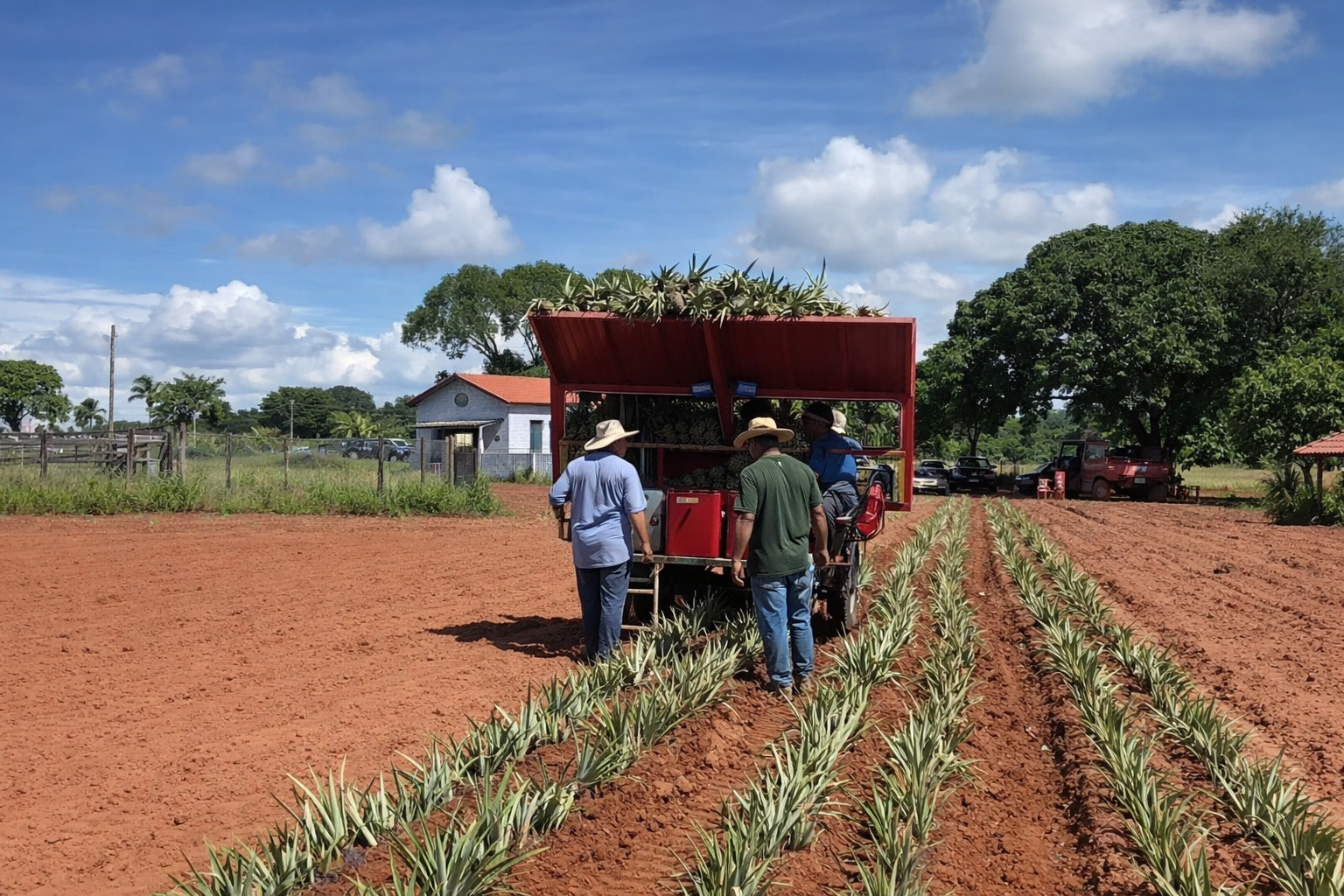
It was precisely in this scenario that farmer Wagner Guidi, from the district of Aparecida de Minas in Frutal (MG), decided to take action. Driven by a long-standing passion for growing pineapples and simultaneously frustrated by the lack of market machines suited to the realities of the crop, he made a bold decision: to build his own agricultural equipment.
The information was disclosed by “Compre Rural,” according to a report published on February 26, 2026, at 3:37 PM, updated the same day, highlighting how innovation in the field can arise from practical necessity and transform productive realities.
-
India’s Sugar Export Cuts and Ethanol Shift Amid El Niño Threat Could Impact Global Prices and Stocks

-
Quarantine Pest Threatening Palm Trees Puts Brazilian Authorities on Alert, Prompts Monitoring at University of Taubaté and Potential Control Measures Across São Paulo
-
Global Alert: Report Finds 159 Pesticides in Coffee Beans Sold in Europe, Posing Serious Risks to Millions of Farm Workers
-
Low-Demand Brazilian Beef Offal Gains Popularity Abroad: Indonesia Purchases $19.5 Million, Boosting Revenue and Reducing Waste



What began as an improvised solution in a barn on the farm, using repurposed parts and scrap accumulated over the years, gradually evolved into a small industry. Today, in addition to serving Brazilian producers, Wagner exports his agricultural machines to Taiwan, in Asia, consolidating a case of innovation in Brazilian agribusiness.
From Scrap to Hectare Per Hour: How the First Machine Was Born
The first challenge faced by Wagner was the application of inputs. Without sufficient capital to acquire sophisticated machinery, he decided to use old parts stored on the property and developed his first “gadget”: a machine capable of spraying up to one hectare per hour.
Moreover, the equipment applied fertilizer with precision, positioning the input close to the plant. This way, it not only sped up work in the field but also reduced waste and improved product distribution.
The result was immediate. Noting that efficiency increased and operating costs decreased, Wagner realized there was potential to expand the project. Thus, he began to invest time and energy in developing new solutions.
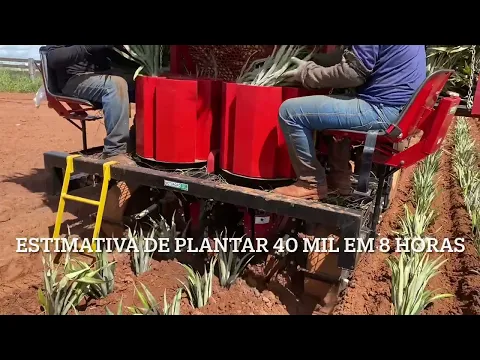
The second invention directly addressed another bottleneck in fruit farming: pineapple planting. The producer created a seed planter attached to the tractor, where two people position the seedlings in a system that deposits them directly into the ground, already lined up and properly aligned.
The productivity gain is impressive. With the machine, it is possible to plant 3,600 seedlings per hour. In contrast, in the traditional system, a worker could plant around 3,000 seedlings over a full day of work. Therefore, mechanization represented an exponential leap in field efficiency.
Five Years, Five Prototypes and 20% More Productivity

However, the journey to the current model was not simple. Wagner spent five years testing and developed five different prototypes before arriving at the ideal format. During this period, he faced technical adjustments, frustrating attempts, and constant mechanical challenges.
Nonetheless, persistence prevailed. The farmer himself recalls the decisive moment: when he was able to stand three seedlings upright with the machine, he was certain that the project was on the right track.
In addition to the speed of planting, the equipment brought relevant agronomic benefits. The more precise application of inputs reduced losses and improved the utilization of products. According to reports from producers who adopted the machines, such as Júlio, productivity increased by around 20% after the mechanization of the process.
This percentage, though it may seem modest at first glance, represents a strategic leap in a crop whose margins often face pressure from operating costs and market fluctuations.
From Rural Barn to Exporting to Taiwan
With technological advancement, what was once just a barn with repurposed parts has transformed into a small agricultural innovation hub. Currently, Wagner produces five machines per month, with a professionalized structure, laser cutting, pre-assembled parts, and industrial organization.
Consequently, the equipment gained technical finishing, standardization, and reliability. This opened doors to new markets, including international ones.
Today, the machines developed in Aparecida de Minas are already exported to Taiwan, an Asian territory with a tradition in intensive agriculture and high technology standards. The fact that a solution created in the interior of Minas Gerais has reached the Asian market demonstrates, therefore, the competitiveness and innovative capacity of Brazilian agribusiness.
More than an isolated case, Wagner’s trajectory reveals a growing trend: producers who cease to be merely consumers of technology and start to become developers of solutions tailored to local realities.
From the interior of the Triângulo Mineiro to Asia, his machines carry not only technology but also the proof that creativity, resilience, and practical field knowledge can revolutionize production systems and open new frontiers for Brazil in the global scenario.
Do you believe that more farmers should invest in developing their own technological solutions to reduce costs and increase productivity?