






 Portuguese
  Spanish


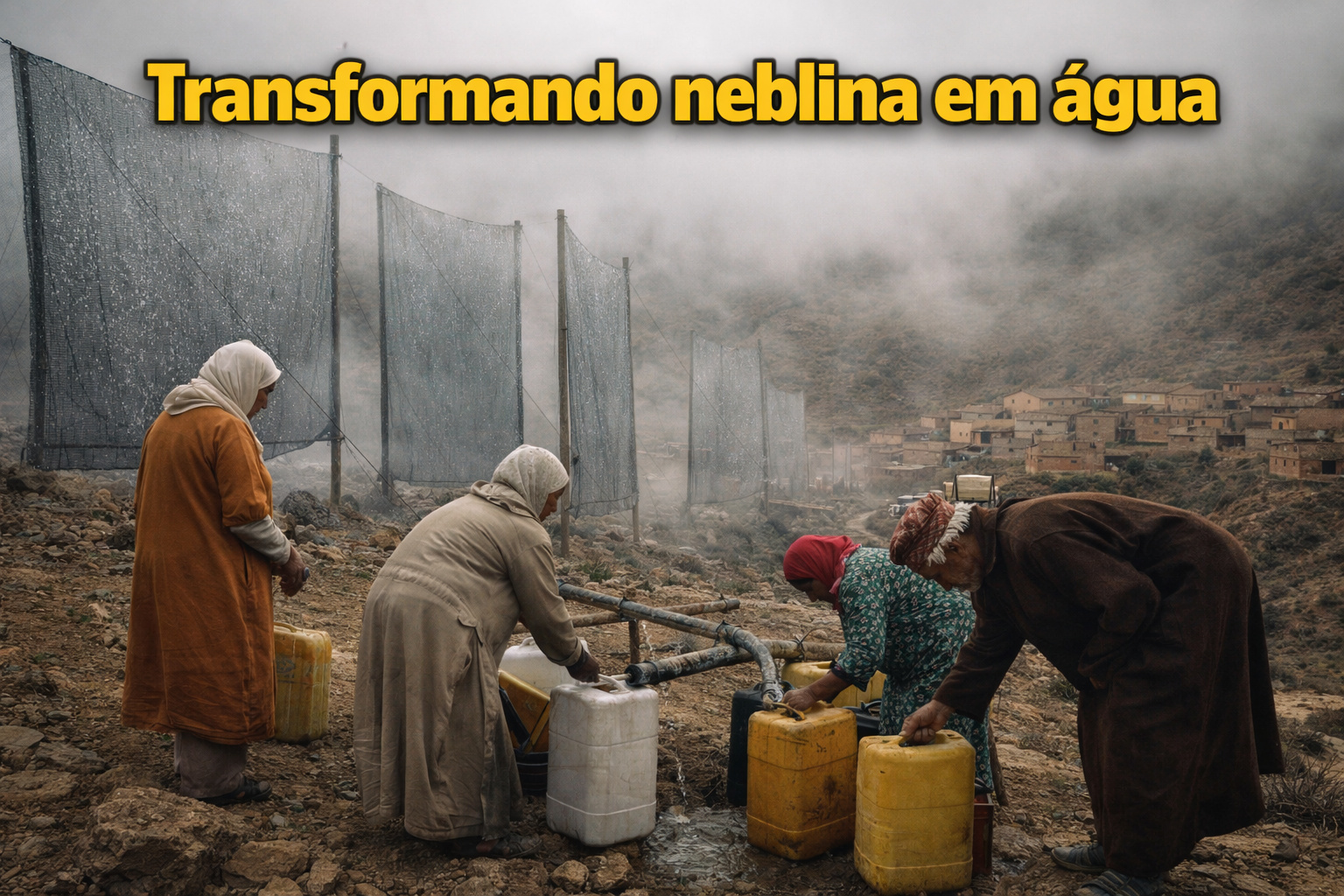


Fog Nets In Morocco Capture Up To 37 Thousand Liters/Day And Supply Villages Without Electricity, Creating Water Infrastructure In The Anti-Atlas.
In 2015, one of the world’s most ambitious atmospheric water capture projects began operating in southwestern Morocco. Instead of dams, heavy pipes, or desalination plants, the solution involved weaving large polymer nets and installing them on the slopes of the Anti-Atlas, where humid winds from the Atlantic bring dense fog in the morning.
The fog that often disappears without a trace has become a supply source. Today, on days of heavy fog, the system reaches peaks of approximately 37,000 liters of water per day, enough to supply hundreds of Berber residents spread across remote villages in the Aït Baamrane region — without pumps, without electricity, and without drilling aquifers.
The technical name for this net is CloudFisher, and it marks a rare moment in the global water history: transforming air into drinkable water continuously and at scale.
-
Xiaomi Unveils Smart Glasses in Brazil with 12MP Camera, 4K Video, and AI Features, Challenging Ray-Ban Meta

-
Volkswagen Unveils Bold Strategy to Compete with Chinese Automakers in Brazil, Featuring 5,000 Parts, 76% Localization, and a Surprising Turnaround
-
Three Teens Win Global Prize for Low-Cost AI Microscope Diagnosing Malaria Species in Seconds for Remote Villages
-
Xiaomi Unveils Revolutionary Fridge: Eliminates Odors in 3 Minutes, Sterilizes in 2, Offers 508 Liters in Compact Design, Operates at 31 dB, and Is Smartphone-Controlled.


Why Morocco Needed Such An Uncommon Solution
The southern region of Morocco is characterized by arid climate, low rainfall, and villages nestled between canyons and mountains. In many rural communities, women and children walked long distances daily to fetch water from intermittent sources. The alternative — digging wells — is not simple: the aquifers are deep and salinization is frequent.


Investing in desalination, while feasible, would be prohibitively expensive for remote areas. Rainwater harvesting is also insufficient, as the average annual precipitation in some areas is less than 200 mm per year. Against this water backdrop, when the Moroccan NGO Dar Si Hmad identified the potential of Atlantic fog, a rare opportunity was born: there’s water in the air, all that was needed was to capture it.
How The Technology That Transforms Fog Into Water Works
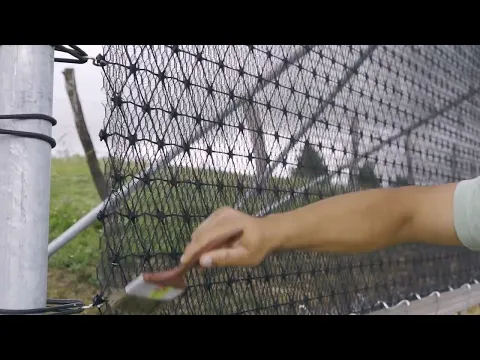
The CloudFisher technology is ingenious for being simple: it consists of a three-dimensional mesh made of polymers resistant to UV radiation and wind abrasion. The mesh has the right thickness to capture suspended microdroplets. When the fog passes through the net propelled by the wind, the particles collide with the threads, coalesce, and form larger droplets, which flow into troughs, descend by gravity, and are carried to reservoirs.
There are no motors, no electricity, and no pumps — the driving force is the wind. The efficiency depends on the orientation of the nets, airspeed, and fog density. In the Anti-Atlas, where Atlantic winds hit the mountains in the morning, the scenario is ideal.
The CloudFisher has surpassed previous models because it has one decisive feature: it can withstand winds of up to 120 km/h, allowing for a much larger capture area without being destroyed. Older systems broke easily, limiting their scale.
From Fog To Reservoir: The Path Of Drinkable Water
Once captured, the water goes to large storage tanks, where it is filtered and distributed through a network of underground pipes that spread for kilometers among the villages. This eliminates the need for long daily walks to fetch water — a profound social impact in Moroccan rural areas where domestic work and water transportation predominantly fall on women.
In some villages, the installation of community taps was seen as a milestone as significant as electrification or mobile phone service in the 1990s. Not only because it provided drinking water but also because it reduced female school dropout rates and returned time for economic activities.
What It Means To Produce Water “Without Rain”
From a scientific perspective, capturing fog is not capturing rain — it is capturing non-precipitated atmospheric water. The difference is huge: it does not depend on dense clouds or convective processes, only on microdroplets suspended in the air.
This type of capture is particularly useful in regions affected by aridity, climate change, recurrent droughts, aquifer failures, and soil salinization.
Morocco combines nearly all these factors. The strategy, therefore, is not only environmentally interesting: it is hydrologically coherent.
A Solution Without Electricity In A World That Depends On Energy
One detail makes this case especially intriguing for engineers and public policy planners: the system works without relying on external energy.
While desalination plants consume enormous amounts of electricity, and even pumping systems require constant power, the CloudFisher operates on wind and gravity. This creates a supply model with low operating costs and high resilience — two essential characteristics for arid and developing countries.
Additionally, it creates a paradigm that challenges the traditional logic of the water sector: water does not have to come only from underground or the sea, it can come from the air.
Social Impacts: What Changed In Berber Villages
Field reports indicate clear social transformations:
- reduction in the distance traveled to collect water;
- reduction in school dropout rates;
- increase in time dedicated to productive activities;
- improvement in domestic sanitation;
- reduction in the consumption of low-quality water.
In some communities, the water generated by the nets has begun to be used to create small gardens, something unthinkable a decade ago. This does not transform southern Morocco into the Nile Valley, but demonstrates how small daily amounts of water can change entire household economies.
Can It Be Replicated In Other Deserts?
Yes, and it is already happening. The same technology is starting to be tested in:
- Canaries
- Cape Verde
- Peru (coastal region)
- Chile (Atacama)
- Ethiopia
- Eritrea
The decisive factor is not just aridity but the presence of charged fog flow, something common in cold coastal deserts influenced by ocean currents.
This means that countries facing accelerated desertification, such as Chile and Peru, may have this technology as a cost-effective alternative for rural supply.
The Final Question: Does This Solve Global Water Crises?
No, it does not solve them alone. But it changes the map. Instead of relying solely on rivers, aquifers, and large hydraulic works, the fourth way emerges: non-precipitated atmospheric water.
In Morocco, this path already supplies entire villages and has been operating for years with very low maintenance, which leads many experts to see the project as a future complement for arid areas that cannot afford heavy infrastructure.
In an era of global warming, this is strategic: climate change affects not only rainfall volumes but also cloud patterns, winds, and coastal events — exactly the factors that the CloudFisher exploits.


