






 Portuguese
  Spanish
  3 min of reading
  0 comments


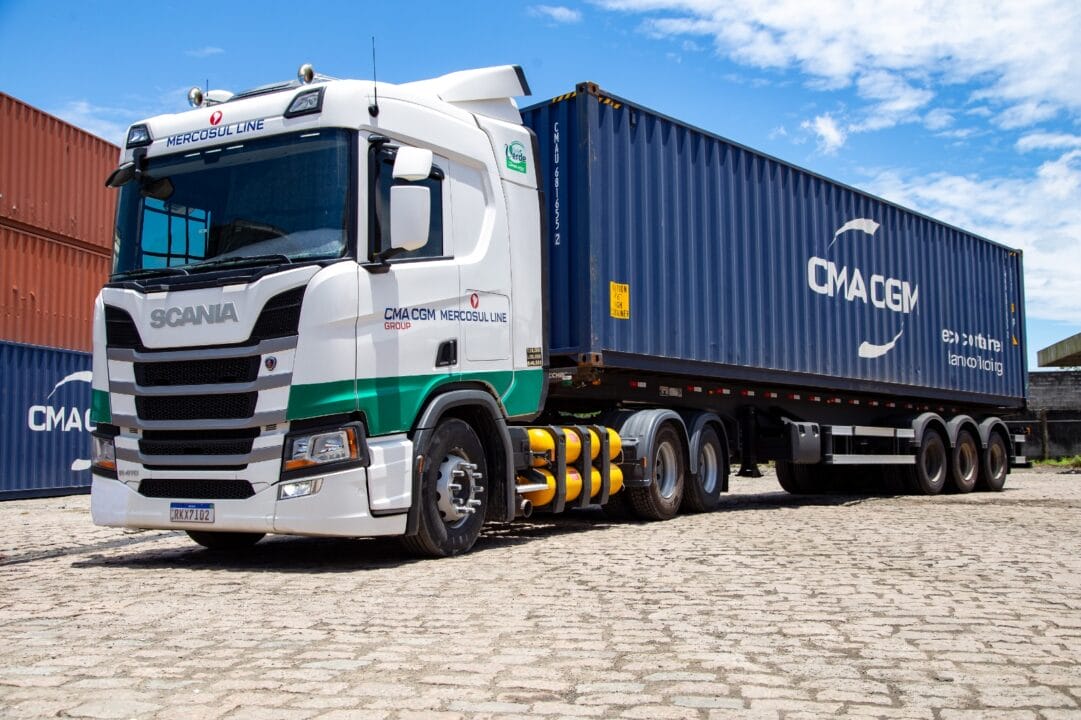
The Environmental Initiative Introduces Natural Gas-Powered Vehicles in Its Brazilian Fleet
In a pioneering move for corporate sustainability, Mercosul Line, part of the CMA CGM Group, is implementing a significant strategy to minimize its environmental impacts. The company will begin using Natural Gas Vehicles (NGV) in its Brazilian fleet, aligning with its commitment to achieve Net Zero Carbon by 2050.
Energy Transition in Logistics
Mercosul Line plans to integrate five new NGVs, chosen for their ability to reduce CO2 emissions by up to 15% compared to diesel vehicles, according to a study by the National Transport Confederation (CNT). This change not only supports the environmental strategy of the CMA CGM Group but also serves as a first step towards future use of biomethane, which can decrease emissions by up to 90%.
The adoption of NGVs, derived from petroleum, reflects an advancement in the company’s efforts to incorporate cleaner and more efficient fuels into its logistics operation. Distributed Generation with NGVs is a milestone in the transportation sector, contributing to greener and more sustainable logistics.
-
Oil production grows in Rio, but reserve replacement raises a warning sign

-
Petrobras is expected to complete the drilling of the Morpho well in the Foz do Amazonas in August 2026, the first well in the Equatorial Margin, an oil frontier that the ANP estimates at more than 30 billion barrels and could redraw the map of Brazil.

-
Oil returns to the center of concerns with tension between the US and Iran

-
Why can the crane operator only obey the correct signalman on the construction site: among dozens of workers, a hand raised by the wrong person can confuse the maneuver and turn a load of tons into an immediate risk.


Implementation and Operational Impact
The initial test with an NGV in the Mercosul Line fleet showed that the vehicle not only maintained an excellent level of customer service but also confirmed its payload capacity. Cristhian Silva, Inland Procurement Manager of the CMA CGM Group, emphasized the importance of this project for sustainability: “We will be the first carrier in Brazil to use a fleet with this configuration, demonstrating our group’s commitment to the environment and innovation.”
The operation with NGVs will be concentrated in the Southeast region, starting from the port of Santos, with possibilities for expansion into multimodal transport, combining road, rail, and maritime modes, depending on the routes. This strategy reaffirms Mercosul Line’s dedication to offering solutions that respect the environment and optimize energy resource use.
Gustavo Breder, Intermodal Manager of Mercosul Line, highlighted the challenges and achievements of the energy transition: “The transition to NGVs is a crucial step to maintain service excellence without increasing the fleet, reflecting our commitment to making our clients’ supply chains increasingly eco-friendly.”
Commitment to the Future
Nathaly Freitas, CEO of Mercosul Line, expressed pride in the company’s leadership in sustainable transportation solutions. “This initiative not only strengthens our leadership in environmental responsibility but also highlights our vision for the future to protect the planet.”
Mercosul Line, as a coastal shipping carrier and multimodal logistics provider, continues to be a key player in the CMA CGM Group’s strategy in Brazil, connecting major ports in South America and providing logistical solutions that ensure efficiency and sustainability. With this new initiative, the company reaffirms its commitment to sustainability and positions itself at the forefront of innovation in logistics and energy management.
Source: Marcelo Laguna.







Be the first to react!