





 Portuguese
  English
  Spanish
  4 min of reading
  2 comments


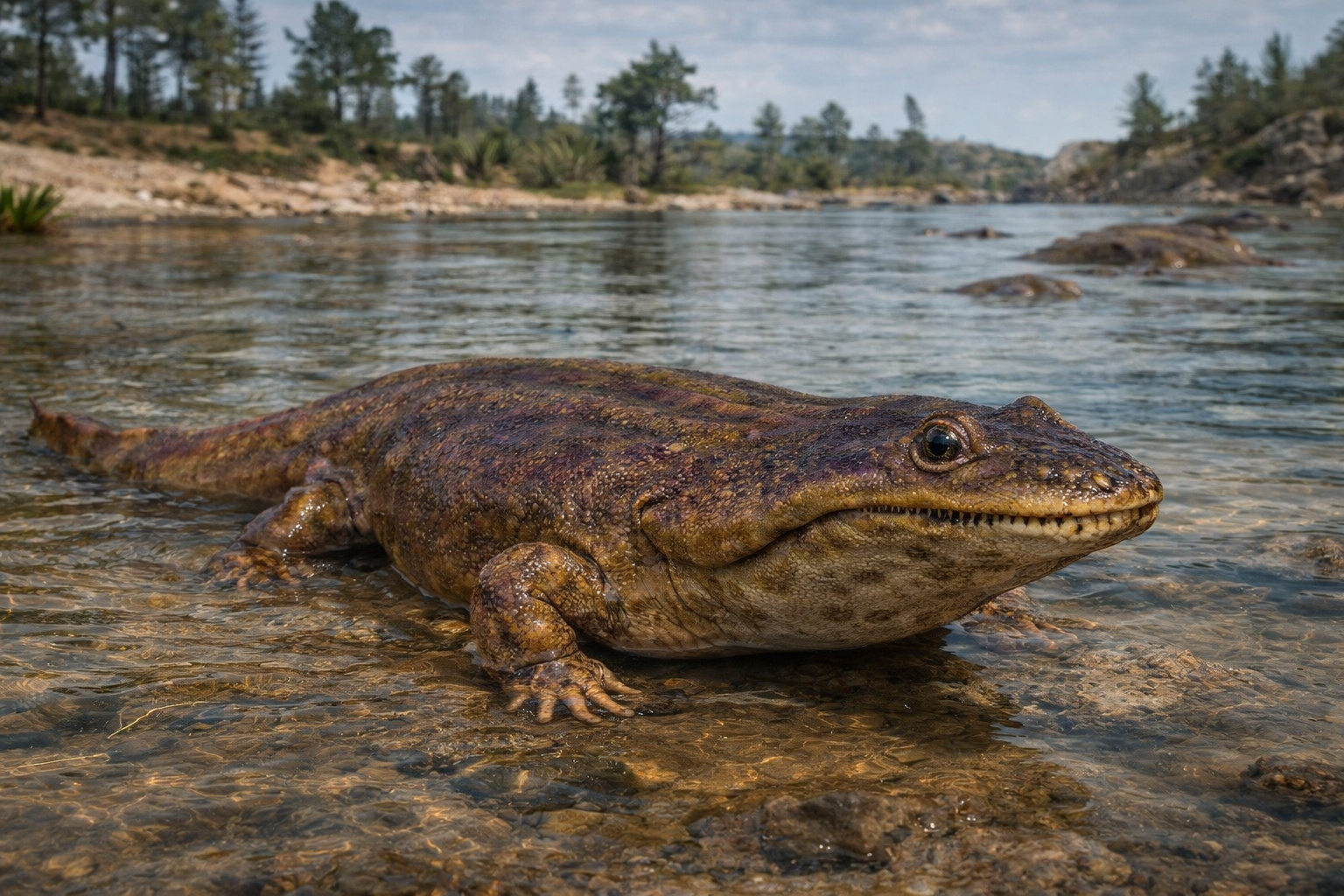


Metoposaurus algarvensis Was a 2-Meter Aquatic Predator With a Flattened Skull and Sharp Teeth That Dominated Triassic Lakes Like a Specialized “Crocodile.”
About 240 million years ago, during the Triassic Period, long before giant dinosaurs ruled the Earth, a large aquatic amphibian led the food chains of shallow lakes and swamps: Metoposaurus algarvensis. Well-preserved fossils found in the southern region of Portugal (in the Algarve geological formation) reveal a creature 2 meters long, with an extremely flattened skull and sharp teeth, capable of capturing fish with lethal efficiency.
Publications in journals such as the Journal of Vertebrate Paleontology and European paleontological studies show that, in the Upper Triassic lacustrine ecosystem, Metoposaurus was the main ambush predator, occupying an ecological role similar to that of modern crocodiles in freshwater habitats.
Anatomy of an Aquatic Predator
The physical form of Metoposaurus algarvensis is both impressive and functional:
-
China confirms the existence of a never-before-seen mineral, found in a deposit with a concentration 80 times above the global standard, which promises to reshape the battery industry and the global competition for strategic minerals.

-
Drone technology that lights up Alok’s shows will be used to launch 67 species of seeds from above and reforest two degraded areas of the Atlantic Forest in Barra Bonita.

-
Scientists believe they have discovered the origin of the river from the ‘Garden of Eden’: study reveals that the Euphrates emerged from the union of two giant rivers over 5 million years ago, including one larger than the Nile.
-
The grass for the 2026 World Cup did not come about by chance: U.S. universities spent 8 years creating an almost surgical turf, with pink lights, synthetic fibers, and agricultural technology to keep 104 games at the same standard.



Flattened and Wide Skull
The skull could exceed 60 cm in width, an enormous proportion relative to the body. This flattened structure, combined with eyes positioned on top of the head, indicates that the animal stayed partially submerged, hidden in the water, waiting for prey to approach.

Teeth Adapted for Catching Fish
The teeth of Metoposaurus were numerous, conical, and designed to grip slippery fish rather than crush. This shows that its diet was almost exclusively piscivorous — a rare specialization among modern amphibians but common in ancient aquatic tetrapods.
Robust Body and Short Limbs
Even with short limbs, its musculature was powerful enough to allow for rapid dragging movements and aquatic propulsion. In contrast to terrestrial forms, its limbs were not used for running, but rather for hydrodynamic stabilization while ambushing.
A Crocodile Before Crocodiles?
Although Metoposaurus is not a direct relative of modern crocodiles, its lifestyle closely resembles that of these semi-aquatic reptiles:
- Ambush habitat in shallow water;
- Flattened skull to remain hidden at the surface;
- Fish-based diet;
- Top predator with no significant direct competitors.
This ecological convergence is one of the most fascinating phenomena in evolution: unrelated species develop similar strategies when exposed to similar selective pressures.
Upper Triassic Environment
The Triassic was a period of great geological and biological transformations. After the mass extinction at the end of the Permian, ecosystems were reorganizing. In the lakes and swamps of Eurasia and Gondwana (the continent that included what is now Europe, Africa, and South America), aquatic forms diversified rapidly. Metoposaurus algarvensis thrived in these environments for millions of years, especially under conditions of:
- Stagnant or slow-flowing freshwater
- High productivity of fish and invertebrates
- Little competition from large terrestrial predators
Fossils found in clay and limestone matrices show that these lakes had a rich aquatic fauna, making it a perfect stage for the evolution of a specialized predator.

Fossils and Scientific Evidence
The first fossils of Metoposaurus were described in the 19th century, but the species and their regional variations continued to be the subject of study throughout the 20th and 21st centuries. The species Metoposaurus algarvensis in particular was defined based on well-preserved specimens from the Algarve region of Portugal, where researchers identified:
- Complete skulls
- Articulated vertebrae
- Parts of the appendicular skeleton
- Tooth marks and wear consistent with advanced predation
These findings solidified the understanding that this species was significantly different from other metoposaurs and warranted its own taxonomic distinction.
The Ecological Role of the “Triassic Crocodile”
Metoposaurus algarvensis was more than just a large amphibian; it was an ecosystem engineer. Its presence in the primitive lakes directly affected fish populations, altering behavior and distribution patterns. By controlling prey populations, it contributed to the trophic dynamics of the lake, impacting everything from invertebrates to other smaller predators.
This type of control generates cascading effects: by reducing excessive fish, Metoposaurus could increase the abundance of certain aquatic plants and influence the overall composition of the environment.
Comparisons with Modern Amphibians
Today, the largest living amphibians, such as the hellbender (Cryptobranchus alleganiensis) or the Japanese giant salamander (Andrias japonicus), rarely exceed 1 meter in length and have different lifestyles. None are ambush predators in the way Metoposaurus was.
This difference highlights a significant ecological variation between amphibians of the past and those today: while modern ones often face intense competition from fish and reptiles, in the Triassic, amphibians could occupy top niches without much competition.
Why Knowing About This Giant Matters Today
The story of Metoposaurus algarvensis reminds us that evolution fills ecological niches in surprising ways. An amphibian the size of a human can act as a top predator in aquatic systems when the geological and biological context favors such a way of life.
Furthermore, these fossils broaden our understanding of the Triassic, a period when life explored paths that, in many cases, did not leave direct survivors to this day but shaped the foundations of vertebrate diversification.





Isso que chamo de PERERECÃO 😍
Isso que chamo de um pererecão, tio