






 Portuguese
  Spanish


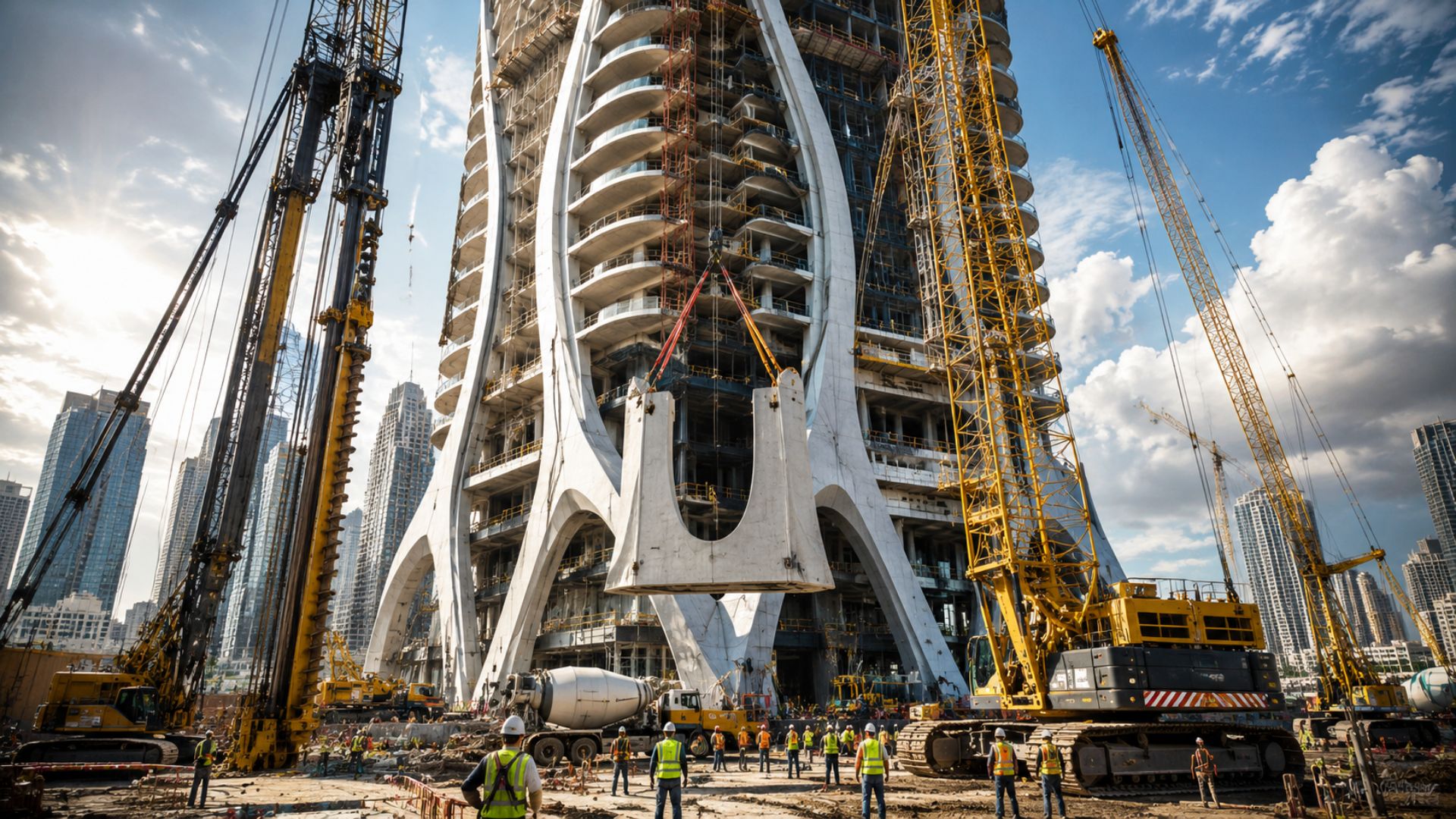


Zaha Hadid’s project in Miami combined deep foundations, thousands of panels produced in Dubai, and a curved reinforced concrete structure to erect one of the most complex skyscrapers in the United States, capable of withstanding the impacts of Hurricane Irma during the construction phase.
The One Thousand Museum, a residential tower designed by Zaha Hadid in Miami, has become one of the city’s most complex buildings by combining 62 floors, about 216 meters in height, and a structural exoskeleton of fiberglass-reinforced concrete.
The structure attracted international attention not only for its futuristic appearance but also for the technical difficulty involved in its execution.
From the beginning of the construction, engineers had to deal with curved geometries, millimetric tolerances, and a construction system considered unusual for high-rise residential buildings.
-
Man Converts Water Tank into $20,000 Luxury Boat, DIY Video Reaches 571,000 Views on World Tech Channel

-
Inventor Builds Amphibious Vehicle with Kayak and Electric Motors, Gains 223,000 Views on Quiet Nerd Channel
-
Former Yale Hospital Cleaner Returns as Resident Doctor After a Decade; Shay Taylor-Allen Transitions from Janitorial Duties to Medical Practice

-
Microsoft Submerges 855 Computers in Nitrogen-Filled Capsule 35 Meters Under the Scottish Sea, Records Eight Times Fewer Failures Than on Land After Two Years





The combination of concrete, steel, and special GFRC panels placed the development among the most challenging projects ever executed in Florida.
The design created by Zaha Hadid sought to transform the structure itself into a visual identity.
The external columns were positioned to create a kind of continuous exoskeleton, which rises along the facade with organic shapes and no exact repetition between the floors.
Besides the visual impact, the solution allowed for freeing up internal areas and expanding the panoramic views from the residences.
The proposal inverted the common logic of skyscrapers.
Instead of hiding pillars inside, the project brought part of the structural system to the facade, creating a curved mesh that envelops the building and freed up more space in the residential units.

This solution gave rise to the nickname “Scorpion Tower” due to the organic appearance of the exoskeleton.
The development includes 84 high-standard residences, with half-floor units, full floors, townhouses, and a duplex penthouse.
Exclusivity also appears in the common areas, which include an aquatic center, spa, sky lounge, and access to a helipad at the top of the tower.
The construction was completed in 2019, three years after the architect’s death, and is located at 1000 Biscayne Boulevard, in front of Museum Park.
The proposal inverted the common logic of skyscrapers.
Instead of hiding pillars inside, the project brought part of the structural system to the facade, creating a curved mesh that envelops the building and freed up more space in the residential units.
This solution gave rise to the nickname “Scorpion Tower,” due to the organic appearance of the exoskeleton.
The development includes 84 high-end residences, with half-floor units, full floors, townhouses, and duplex penthouses.
Exclusivity is also evident in the common areas, which include an aquatic center, spa, sky lounge, and access to a helipad at the top of the tower.
The interior areas also followed the organic language created by the architect.
Curved ceilings, integrated lighting, and custom finishes were used to complement the building’s structural design.
As there are no two floors exactly alike, interior teams had to adapt plumbing, electrical, and climate control systems individually on different levels of the tower.
The constant adjustments increased the complexity of the work and required precise coordination between architects, engineers, and suppliers.
Deep foundation became a historic challenge in Miami
Before the structure advanced over the city’s skyline, engineers had to tackle Miami’s subsoil, composed of porous limestone and subject to natural voids.
To support the building, 277 deep piles were executed, some over 54 meters, in a system designed to transfer loads to more stable layers.
The base received a large-scale continuous concrete pour.
About 7,600 cubic meters of concrete were poured in approximately 24 hours, an operation that required strict temperature control to reduce the risk of cracks during the material’s curing.

The concrete pour mobilized hundreds of workers and a long sequence of concrete mixer trucks operating without interruption.
According to technical reports released during the execution of the work, any variation above the established thermal limit led to the immediate rejection of the material.
The goal was to avoid internal stresses that could compromise the structural performance of the foundation over the years.
After the execution of the piles and the main slab, the tower began to gradually advance over downtown Miami.
The first floors used traditional methods of on-site cast concrete, with manually assembled wooden and steel formwork systems.
As the building rose, however, the process began to present increasing difficulties due to the variable curves of the exoskeleton.
GFRC Panels Manufactured in Dubai Changed Construction
In the first floors, the construction used conventional methods of on-site cast concrete.
However, as the tower advanced, the process became slow and expensive because the curves changed from one floor to another and required specific formwork in sequence.
The solution was to adopt GFRC panels, which stands for glass fiber reinforced concrete.
About 4,800 pieces were manufactured in Dubai and shipped to Miami, where they began to function as permanent formwork and exterior finish at the same time.
Each panel needed to fit the steel core and receive concrete inside.
Since small variations could accumulate on the upper floors, the assembly required constant measurements, comparison with digital models, and millimetric adjustments before final fixation.
The panels simultaneously functioned as an external finish and part of the structural system of the facade.
Once positioned by cranes, the pieces received an internal filling of high-strength concrete, creating an integrated set with the building’s metal core.
International transport also represented a significant logistical challenge.
The pieces produced in Dubai traveled thousands of kilometers by ship until they reached the port of Miami.
Each element needed to arrive without deformations or surface damage, as any minimal difference could compromise the fit on the upper floors.
During assembly, surveying teams began to use real-time digital monitoring systems.
The measurements were compared to the tower’s BIM model before the final fixation of the pieces.
The strategy helped reduce accumulated errors and accelerated the execution pace on the final floors.


Hurricane Irma Put the Structure to the Test
In September 2017, when the building was still under construction, Hurricane Irma passed through Florida and brought strong winds to Miami.
The construction suffered damage to temporary elements and in internal areas still exposed, but the main exoskeleton remained without reported structural collapse.
The episode reinforced attention on the tower’s performance in a hurricane-prone region.
The death of Zaha Hadid, on March 31, 2016, also changed the symbolic weight of the project.
The architect died in Miami, at the age of 65, while being treated for bronchitis and suffered a heart attack.
The One Thousand Museum then came to be presented as one of her final large-scale works.
The tower consolidated a rare solution in luxury residential construction: transforming the structure into a dominant visual expression.
More than cladding, the exoskeleton began to organize the building’s image and part of its engineering.
The completion of the tower consolidated the One Thousand Museum as one of the most emblematic projects in Zaha Hadid’s portfolio.
The building stands out from the traditional glass towers of Miami precisely due to the combination of continuous curves, exposed structure, and intensive use of architectural concrete.
Even years after its inauguration, the building continues to be cited in debates about parametric architecture, structural engineering, and new technologies applied to civil construction.
The construction also became a reference for projects seeking to integrate structural performance and visual identity into a single architectural solution.


