Portuguese
  Spanish




The Silent Invasion Of An Apparently Harmless Insect Triggered One Of The Largest Ecological Crises Ever Registered, Forcing Scientists To Revert To An Unprecedented Biological Solution To Save An Ancestral Biome
For decades, the most significant environmental damage caused by invasive species has often been linked to large mammals. In the United States, for example, wild boars result in estimated losses of US$ 2 billion per year. However, on the remote Christmas Island, an Australian territory in the Indian Ocean, a tiny insect managed to provoke an even deeper and faster ecological impact. This insect is the yellow crazy ant, responsible for unprecedented devastation in one of the planet’s oldest and most isolated ecosystems.
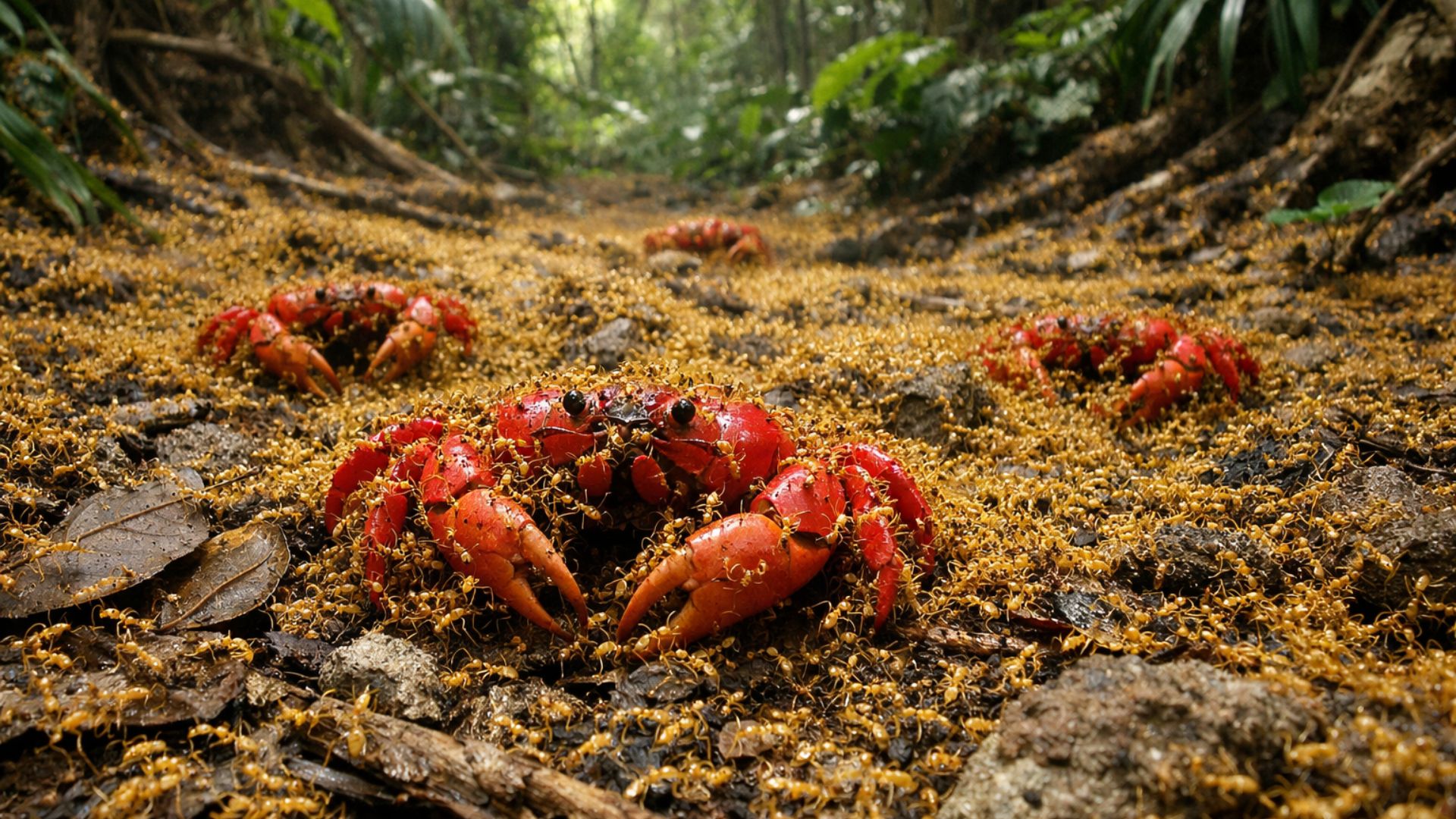
The information was revealed by scientific studies and Australian environmental reports, which began documenting the radical transformation of the island over the past few decades. Although the size of these insects suggests a limited risk, reality demonstrated the exact opposite. In no time, the yellow crazy ants formed a supercolony estimated at 12 billion individuals, a number that represents 50 times the human population of Australia.
This colossal contingent was able to eliminate over 40 million red crabs, a keystone species for maintaining local ecological balance. The impact was so severe that an ecosystem that had remained stable for about 110 million years began to collapse in just a few rainy seasons.
-
Neymar’s 14-year-old son, Davi Lucca, launches 3D dinosaur brand “Amigo Dino,” gaining attention on social media for his entrepreneurial spirit.

-
Improper Outlets Can Cause Fires and Damage Devices: How to Identify the Correct 10A or 20A Model for Each Appliance
-
Entrepreneur Who Started at 13 Delivering Flyers by Bike in São Paulo Now Runs a 4,000 m² Culinary Complex in Brazil

-
In China, Workers Use VR Goggles and Body Sensors to Train Humanoid Robots for Tasks Like Folding Clothes and Stocking Stores


The Formation Of The Supercolony And The Beginning Of Ecological Devastation

To understand why the yellow crazy ants received that name, it is necessary to observe their behavior. Unlike other species, they move erratically, constantly changing direction and attacking with extreme speed. This chaotic pattern makes any defensive reaction from prey difficult and makes the attacks highly efficient.
In an environment like Christmas Island, almost devoid of natural terrestrial predators, the arrival of these ants acted like the release of an invading army in an undefended territory. Initially introduced accidentally by cargo ships, hidden among imported goods throughout the 20th century, they found ideal conditions to expand without resistance.
Over the years, millions of individuals began to operate as if they were a single organism. During the rainy season, the ants emerge from the ground in true living rivers, advancing directly over the areas occupied by the red crabs. Armed with formic acid, an extremely aggressive chemical substance, they attack eyes and joints, blinding the crustaceans in seconds.
Scientific reports describe that the crabs, despite being hundreds of times larger, quickly become disoriented. Soon after, thousands of ants cover their shells, leading to death in less than 24 hours due to chemical saturation. The result was a drastic population decline, from 40 million to just 15 million individuals, a decline considered catastrophic and unprecedented in the island’s history.
The Cascade Effect: Collapse Of The Christmas Island Ecosystem


However, the damage was not limited to the crabs. Without these animals, responsible for removing leaves and organic matter from the soil, the forest environment changed rapidly. Thick layers of decomposing vegetation began to accumulate, making the soil drier, oxygen-poor, and dangerously susceptible to wildfires.
Additionally, young trees began to grow chaotically, blocking sunlight and completely altering the structure of the vegetation. Endemic bird species, such as the Abbott’s booby, lost nesting areas as adult trees began to die on a large scale. Thus, a complex and stable ecological system collapsed within an extremely short time frame.
Another decisive factor for the population explosion of the ants was an unlikely alliance with the yellow lac insect. These sap-sucking insects produce a sugar-rich substance called honeydew, which serves as high-energy fuel for the ants. In return, the ants began to protect the lac insects as if they were livestock, eliminating any natural predator that approached.
In areas where the lac insect was present, the density of yellow crazy ants increased by 95%, creating a feedback loop described by scientists as “throwing gasoline on a biological fire.” Without natural predators and with abundant food, the supercolony began to swallow the island centimeter by centimeter.
Human Intervention And The Unprecedented Biological Solution
In the face of uncontrollable advances, human intervention became inevitable. For years, Australia tried to contain the ants using protein baits with fipronil, a highly toxic chemical compound. The application required absolute precision, being performed only during the dry season when the crabs remained safe in their underground burrows.
Helicopters dispersed the bait over the forest at a density of 6 pounds per acre. In just four weeks, the numbers seemed promising: the ant population fell by 99%. However, the relief was temporary. Underground colonies survived, and from untreated areas, the ants returned with full force.
Moreover, each campaign cost between US$ 1.3 and 2 million, not counting collateral damage caused to native fauna. After testing 131 species over more than three years, scientists concluded that the chemical solution could not be maintained as a long-term response.
Then, the strategy changed radically. Instead of directly attacking the ants, the focus shifted to eliminating the lac insect, the true energy base of the supercolony. The solution came with the controlled introduction of the parasitoid wasp Tachardiaephagus somervillei, an insect almost invisible to the naked eye.
Each female lays her eggs inside the lac insect, and the larvae consume the host from the inside out, definitively interrupting honeydew production. After the aerial release of 18,000 wasps, the expansion of the ants began to stagnate naturally, without the need for chemical products or heavy machinery.
The biological intervention, carefully monitored to avoid historical mistakes like that of the cane toads in 1935, began to integrate into the ecosystem. Gradually, natural balance began to return to Christmas Island, concluding one of the strangest and most impressive ecological battles ever recorded.