Portuguese
  Spanish



Amateur Metal Detectors Find 35 Gold And Silver Coins Over 600 Years Old In Scotland
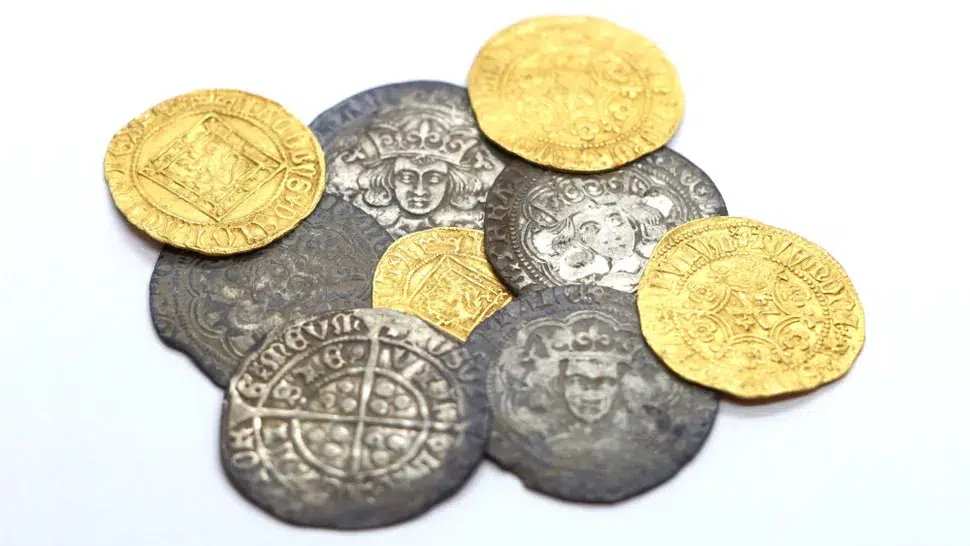
A collection of 35 gold and silver coins, dating back over 600 years, was discovered near the village of Cappercleuch in the Scottish Borders region. The discovery was made by Keith Young and Lisa Stephenson, amateur metal detectors, who referred to the find as “the discovery of a lifetime.”
Initially, 30 English and Scottish coins minted throughout the 15th century were found. After reporting the find to the authorities, archaeologists investigated the area and uncovered five more coins, bringing the total to 35.
Rare Coins of English And Scottish Kings
Among the discovered coins are groats from England minted during the reigns of Henry V (1413–1422) and Edward IV (1461–1483). Demys and half-demys of Scottish gold were also found, issued under the reigns of James I of Scotland (1406–1437) and James II (1437–1460).
-
14-Year-Old Girl Develops Solar-Powered Water Purification System for India, Eliminating Need for Electricity or Chemicals

-
Forgotten Canadian Machine Harnessed Waterfall Power to Supply Mines with Compressed Air for 70 Years Without Motors or Electricity
-
Berries, Strawberries, and Blueberries Could Transform Agriculture in Northeastern Brazil, New Tests Reveal

-
Danish Resident Discovers Six Viking Gold Bracelets Weighing 762.5 Grams, Third Largest Gold Treasure in Denmark


The groat was a large silver coin introduced in England in 1279, worth four pence. The Scottish demy got its name from the French word “démier,” meaning “half,” as it was worth half the value of the noble, an English gold coin.
In Scottish currency, the demy was valued at nine shillings, while the half-demy, its smaller version, was worth around 4.5 shillings.
Each coin features the image of the monarch corresponding to the time of its minting. Specialists believe that the coins may have been left at the site in the early to mid-1460s.
Investigation And Destination Of The Treasure
Following the discovery, Young and Stephenson reported the find to the Scottish Treasure Trove Unit, responsible for investigating buried objects found in Scotland.
Antony Lee from the Treasure Trove unit explained that coin hoards containing Scottish and English specimens are not commonly searched for, but treasures from this period are rare in Scotland. “Coin hoards containing a mix of English and Scottish coins are not uncommon, but we don’t see many treasures from this period in Scotland, so it’s a fascinating find,” Lee stated.
Archaeologists from the National Museums of Scotland assisted in the excavation and documentation of the site. Lee emphasized the correct attitude of the discoverers for reporting the find immediately, allowing specialists to conduct analyses on-site.
The coins will now be sent to the Scottish Archaeological Finds Allocation Panel (SAFAP). This independent panel will determine the coins’ value and allow specific museums to acquire them for display.
Museums wishing to claim the coins will raise funds to pay the reward to the discoverers, according to the “ex-gratia” reward system.
With information from Live Science.