Portuguese
  Spanish


The house on wheels was built on a Volkswagen Constellation 31.320 and completely dispenses with gas, but the burning of waste by diesel and the disposal of ashes require environmental care, even though the technology solves logistics in remote places.
A 6×4 motorhome with rare features in Brazil attracted attention when it was presented at the Serro Motorhomes factory in Campo Largo, Paraná, in early 2026. Built on the Volkswagen Constellation 31.320 truck, the project combines traction on both rear axles, a 320-horsepower engine, autonomy for weeks of isolation, and a set of solutions that operate entirely on diesel, including heating, the kitchen, and even the incinerator toilet.
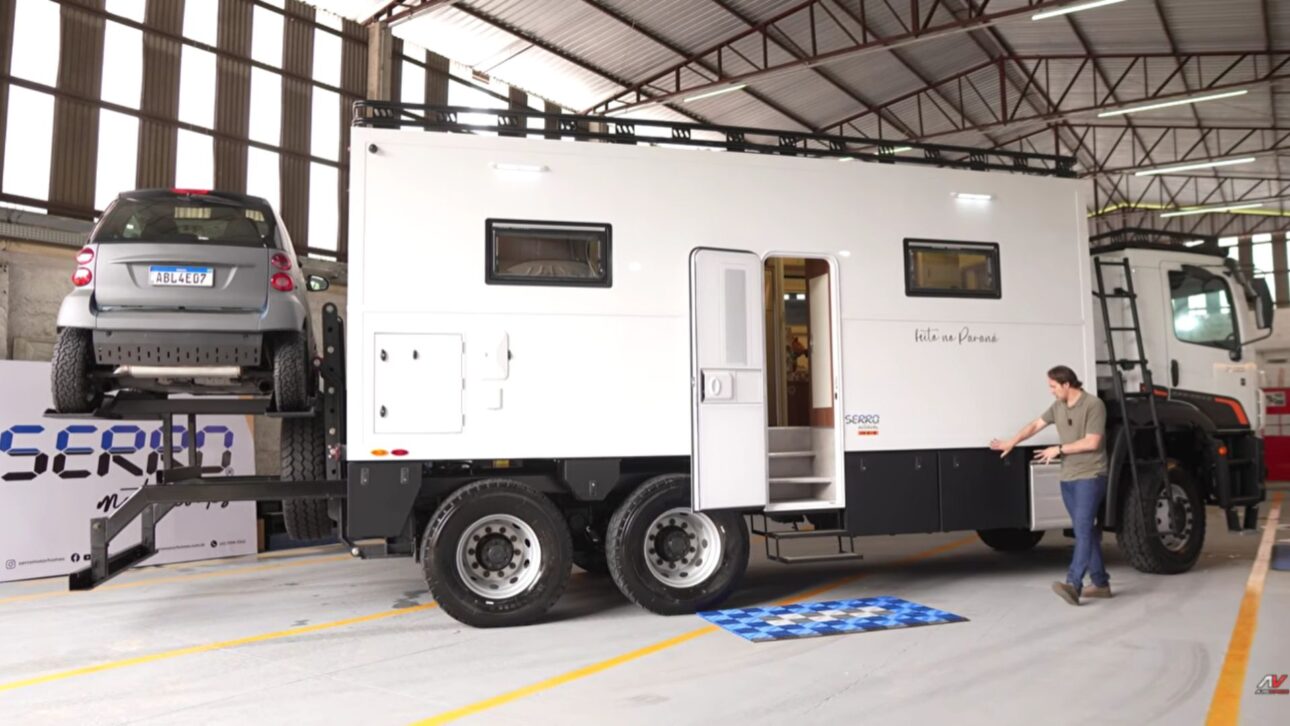
The model was custom-developed for a client who requested unusual features, including a rear platform that transports a compact car on the truck itself. Serro Motorhomes, a manufacturer with over three decades of experience in road implements and about ten years dedicated to houses on wheels, classifies the vehicle in the Off-Road Expedition line, aimed at long journeys over harsh terrains without sacrificing internal comfort.
The truck beneath the house
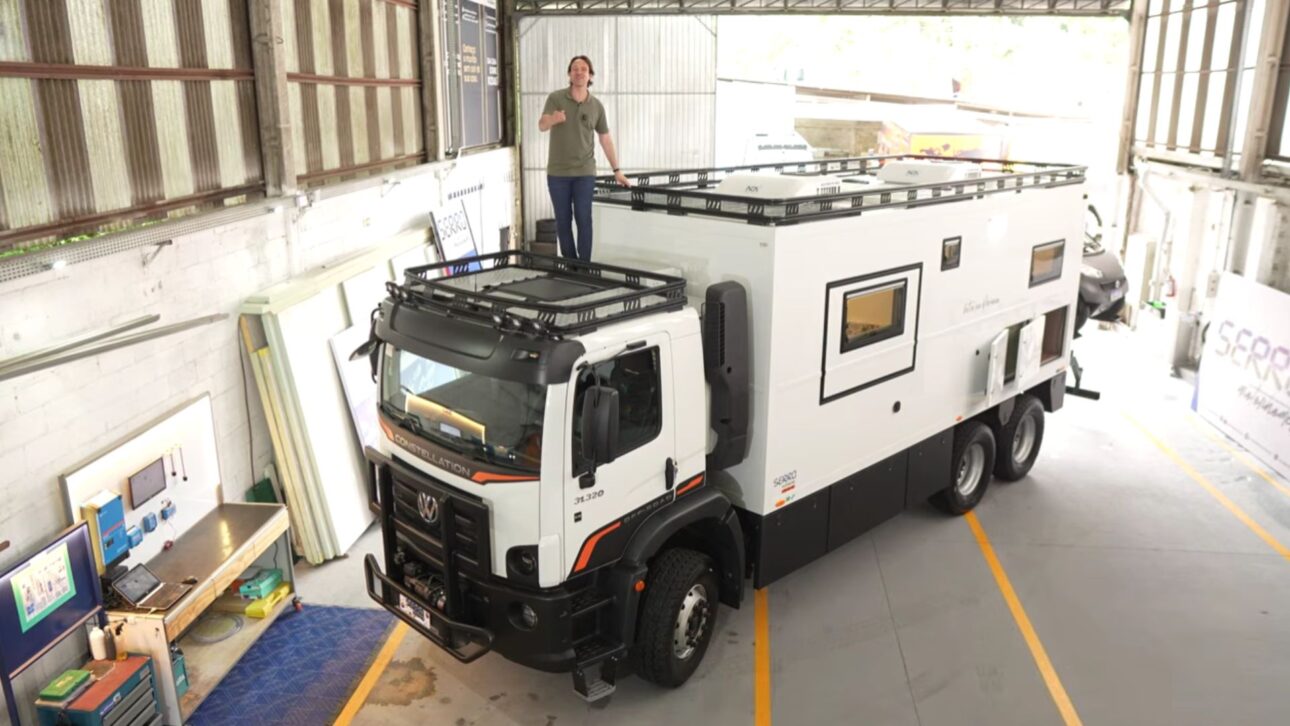
According to the technical specifications of Volkswagen Trucks and Buses, the model uses the MAN D08 six-cylinder engine, with 320 horsepower and 1,200 newton-meters of torque, associated with the V-Tronic automated transmission, provided by ZF, with 12 forward gears and two reverse.
-
Coastal City in Rio de Janeiro Faces Slow Destruction as Sea Claims 500 Homes and Businesses

-
48-Year-Old Woman Wins Million-Dollar Prize, Gifts Neighbor First International Trip as Thanks for Years of Support

-
Women Once Mocked for Collecting Trash Form Group to Turn Organic Waste into Compost, Generate Daily Income, and Improve Market Cleanliness in One of the World’s Lowest GDP per Capita Countries
-
Archaeologists Uncover 40,000 Roman Bronze and Copper Coins from the 3rd Century in Fire-Destroyed French Neighborhood



The designation 31.320 indicates the gross weight of around 31 tons and the power of 320 horsepower.
The 6×4 configuration means the vehicle has six support wheels, of which four are driven, distributed on the two rear axles.
For off-road use, the design received adaptations such as higher profile tires measuring 385/65 R22.5, single rear wheels, inverted leaf springs, differential lock, and a winch with a capacity of 15,500 pounds, equivalent to about 7 tons.
The truck has a maximum traction capacity of around 42 tons, which leaves plenty of room for the weight of the motorhome.
The full diesel system and the toilet that turns to ashes
The engine is naturally diesel, but Serro extended the same fuel to water heating, done by a 20-liter boiler, internal environment heating, and the kitchen cooktop.
The absence of gas cylinders facilitates international travel and expeditions in remote regions, where finding diesel is usually simpler than finding cooking gas.
The most impressive feature is the incinerator toilet, which burns waste using diesel and reduces it to fine ashes.
This type of equipment, popularized by the Cinderella line, manufactured by the Norwegian company Cinderella Eco Sales, usually operates with electricity or gas, according to technical material on the product.
The diesel version adopted in the project is what makes it consistent with the concept of the house. However, an environmental caveat is warranted regarding the argument that the ashes could be discarded anywhere in nature.
The recognized good practice in the motorhome universe recommends never disposing of waste near watercourses, springs, or living areas, even when the material has already been incinerated.
Autonomy for weeks away from everything
The proposal to stay isolated for about 15 days relies on three pillars, namely energy, water, and thermal insulation.
On the roof, the vehicle carries a solar power plant with three 610-watt panels, totaling 1,830 watts, which supply a bank of three Victron batteries of 200 amp-hours each, totaling 600 amp-hours.
All electrical management is handled by a Victron system, with outputs of 12, 24, and 220 volts, and the batteries can also be recharged by the truck’s alternator.
The water autonomy comes from a 500-liter clean water tank, complemented by about 200 liters of greywater, which comes from sinks, the shower, and the washing machine.
The house structure uses FCM-type panels, made up of fiber and insulating layers, about 6 centimeters thick, designed to maintain internal comfort in extreme temperatures.
Serro claims to protect the entire water system inside the house to prevent freezing in very cold conditions, a relevant precaution for those planning destinations like Alaska or Patagonia.
Project specifications, according to Serro Motorhomes
- Base: Volkswagen Constellation 31.320 6×4 truck
- Engine: MAN D08, 320 hp and 1,200 Nm of torque
- Transmission: automated V-Tronic by ZF, 12 forward gears and two reverse
- Off-road tires: size 385/65 R22.5, single rear wheel
- Energy: 3 solar panels of 610 W (1,830 W) and 3 Victron batteries of 200 Ah (600 Ah)
- Water: 500 liters of clean water and about 200 liters of wastewater
- Diesel: original tank of 275 liters, with an option for an additional tank
- Extras: rear hydraulic platform for car, pivoting chassis system, 15,500-pound winch, Starlink, and four cameras
The car on the back and the self-twisting chassis


The most unusual image of the set is that of a compact car, a Smart, supported on a lift platform at the back of the truck.
With hydraulic activation, the structure allows carrying a small vehicle for short trips after the motorhome parks, solving the lack of agility of a machine of this size.
According to the manufacturer, the owner is also considering installing another platform at the bottom for transporting a motorcycle.
Another engineering feature is the pivoting attachment system between the chassis and the house, a trademark of Serro in such projects.
On uneven terrain, the truck chassis twists, and the pivoting system, anchored at central points, allows the habitable part to remain stable while the chassis moves underneath.
The result, according to the company, is greater durability of the structure and more comfort on board, as the house does not absorb the torsion forces.
Inside, a house designed for extreme cold
The interior follows the expedition concept, with a finish that prioritizes durability and ease of cleaning without losing aesthetics.
The layout includes a direct passage between the cabin and the house, a room with a corner table arrangement, a complete kitchen with a diesel cooktop, oven, hood, and duplex refrigerator, as well as a bedroom with a double bed and a 3-kilogram washer-dryer, chosen to prevent occupants from needing to leave the vehicle in cold regions.
The bathroom features a separate shower box, skylight, and the aforementioned diesel incinerator toilet.
The furniture was made from marine plywood and formica, one of the lightest combinations available, and the electrical system keeps all equipment connected to the battery bank, so internal use does not depend on an external network connection.
When the vehicle is connected to a campsite’s power, a bypass prevents the current from passing through the batteries.
How much does a project like this cost
A motorhome of this size is not a shelf product, and the values provided by Serro reflect the complexity of the project.
According to the company, a 6×4 truck like the one used in this model starts at around 650 thousand reais, and the house, with the presented internal customization, revolves around 1.2 million reais, potentially reaching approximately 1.6 million reais with all off-road adaptations.
For those seeking a simpler project, the manufacturer indicates that it is possible to assemble a complete set starting at around 1 million reais.
The manufacturing time also follows the level of customization, varying from 15 to 18 months, according to the company.
These numbers are based on Serro’s own commercial information and should be treated as starting estimates, as each project is individually budgeted.
It is worth remembering that this is a niche vehicle, aimed at a specific audience willing to live long periods inside the house on wheels, in some cases giving up conventional properties.
The 6×4 motorhome from Serro Motorhomes sums up how far national engineering of implements can go when the goal is total autonomy far from urban infrastructure.
The set impresses with the combination of heavy traction, solar energy, water reserve, and the fully diesel system, which eliminates the dependence on gas.
The solutions, however, make sense mainly for a very specific traveler profile, and even the ingenious incinerator toilet requires responsibility in the disposal of ashes, no matter how advanced it is.
And you, would you embark on a weeks-long expedition isolated aboard a motorhome like this? Share in the comments what caught your attention the most in this project, if the full diesel system makes sense for the type of trip you envision, and how far you would take a house on wheels with this setup. The conversation is open for those who love the world of vehicles and adventures on wheels.