






 Portuguese
  Spanish


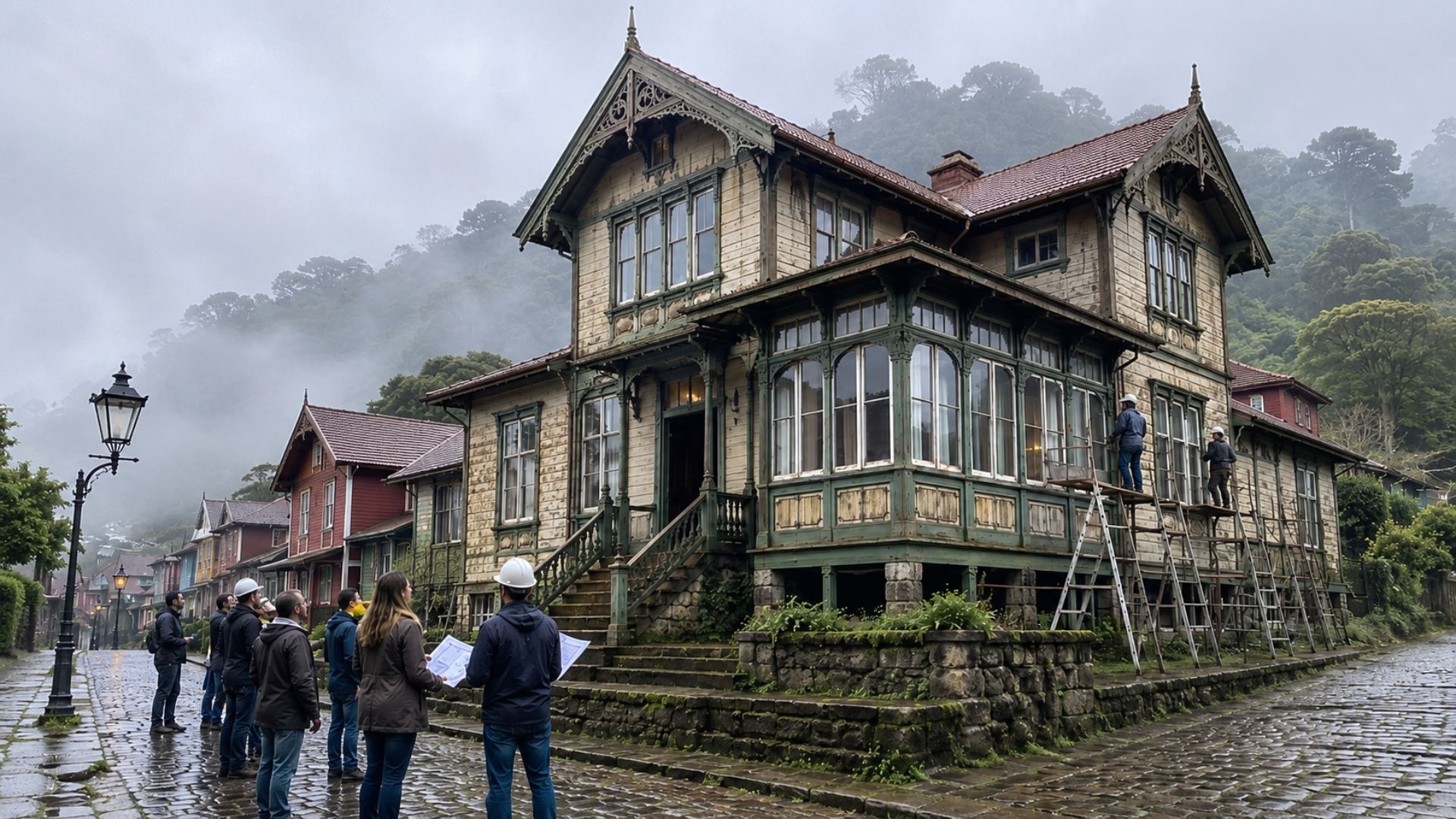

Historic village in ABC Paulista brings together railway architecture, listed properties, and public occupancy rules, with works planned in 34 buildings and administrative processes that replace the common logic of real estate with public notices, usage permissions, and preservation obligations.
The Village of Paranapiacaba, in Santo André, in ABC Paulista, will have 34 historic listed buildings restored through a public tender opened by the city hall, with an expected investment of R$ 11,760,406.21.
The houses are located in the lower part of the old railway village and are part of a protected set, a condition that prevents occupancy through the traditional real estate rental model and subjects the use of the properties to rules defined by the public authorities.
The main difference for those wishing to live in the area is legal and patrimonial: the properties belong to the municipal administration, do not enter the common rental market, and can only be occupied through public notices, calls, or usage permissions.
-
In the Caucasus Mountains, a Community Preserves a Language So Rare Few Outsiders Can Understand It

-
Slovakia’s Ice Cave Holds Over 110,000 m³ of Frozen Wonders, Boasts Walls Up to 27 Meters Thick, and Was Among the First Electrified Caves Globally

-
Street Cleaner Accidentally Receives $200,000 Transfer, Returns Unexpected Fortune to Rightful Owner
-
Australian Space Agency Investigates Six Mysterious Metal Spheres Found on Queensland Beach, Isolating Area Over Possible Space Debris Risk


In practice, the interested party needs to follow the official publications of the Santo André City Hall, present the requested documentation, and comply with the conditions set out in each administrative process opened for the village’s properties.
With architecture associated with the English presence and railway history, Paranapiacaba attracts visitors drawn by the mountain climate, frequent fog, and the set of wooden houses linked to the old São Paulo Railway.
Turning this interest into permanent residence, however, requires following preservation, maintenance, and usage rules compatible with the listed heritage, according to the public notices and permission terms published by the city hall.
How the occupancy of houses in Paranapiacaba works


Residential occupancy occurs through usage permission, a modality in which the resident receives authorization to use the property for a determined period, without acquiring ownership of the house.
This model provides for monthly payment, compliance with contractual obligations, and responsibility for the conservation of the historical asset, especially in the points defined by the public notice and the term signed with the municipal administration.
In previous calls, the City Hall of Santo André required prior inspection of the properties, submission of proposals, and signing of a contractual term, measures adopted to record the interested party’s knowledge about the state of the construction.
There were also notices where the permission could be valid for five years, with the possibility of extension for an equal period, always according to the specific rules of each process published by the city hall.
The conditions may change from one notice to another, but the procedures already disclosed include control over the use of the property, maintenance obligations, and restrictions to prevent alterations that would disfigure the constructions.
Therefore, the residence cannot be treated as a common house, subject to free renovations or adaptations carried out without authorization from the bodies responsible for preserving the ensemble.
When more than one qualified interested party competed for the same residential property, the city hall has already adopted a lottery in previous notices, according to the rules established for that public selection.
In processes aimed at commercial properties, on the other hand, the municipal administration informed that the highest monthly value proposal could prevail, provided the interested party was duly qualified.
Restoration targets listed properties in the lower part of the village
The competition opened in April 2026 deals with the contracting of restoration services for 34 listed historic buildings located in the lower part of Paranapiacaba.
According to the city hall, the properties are located on FForde, Fox, and Manoel Ferraz de Campos Salles avenues, and 15 of these buildings are semi-detached.

The exact amount planned for the intervention is R$ 11,760,406.21, with financial support from Iphan, the National Institute of Historic and Artistic Heritage.
The municipal administration informed that the competition proposals should be submitted electronically by May 19, 2026, with an electronic auction scheduled for the same date.
The purpose of the work is to recover buildings that are part of the historical landscape of the railway village and are part of the set of properties protected by listing.
As it is a listed heritage, the restoration must preserve architectural features and materials compatible with the ensemble, according to the applicable requirements for protected historical assets.
This type of intervention is also related to the physical conditions of the region, characterized by high humidity, mountain climate, and natural wear of wooden structures over time.
The conservation of properties depends on the combination of public works, technical monitoring, and the daily actions of permit holders or authorized traders occupying the village’s buildings.
Living in the village requires preservation rules
Those who receive authorization to occupy a house in Paranapiacaba assume obligations that go beyond the monthly payment stipulated in the public notice and the usage permission agreement.
In previous processes, the city hall informed that the contractor was responsible for the full maintenance of the residence, while the collected resources would be allocated to the municipal fund related to the management of historical and architectural heritage.
This model aims to reduce the risk of vacant or deteriorated properties while maintaining public control over a set recognized as historical heritage.
The resident starts living in a tourist and heritage area but also assumes formal responsibilities for the daily conservation of the occupied building, according to municipal rules.
The limitations mainly affect renovations, adaptations, and external changes, which need to respect the parameters defined for listed buildings and the architectural ensemble of the village.
Changes in facades, materials, volume, or original characteristics depend on technical authorization, as heritage protection considers the village as an urban ensemble and not just as isolated properties.
Regular occupation also helps maintain circulation in the lower part and reduce abandonment situations, according to statements previously made by the municipal administration in earlier calls.
In 2019, the city hall stated, through the then Secretary of Environment, Fabio Picarelli, that the occupation of the village contributes to bringing life to the place, preserving history, and increasing income in Paranapiacaba.
Properties do not follow real estate logic
For those intending to live in the village, access to the houses does not occur through traditional advertisements, brokers, or direct negotiation with private owners.
The procedure depends on the opening of a public notice, reading the rules, inspection when required, and submission of documentation within the official deadline established by the city hall.
In residential notices published in 2022, for example, the municipal administration opened opportunities for seven properties in the lower part, with monthly values between R$ 531.95 and R$ 618.77.
All properties were subject to the call’s rules, and the houses could not be converted into commercial establishments in that specific process disclosed by the Santo André City Hall.
Values lower than those practiced in valued areas of Greater São Paulo do not mean broad contractual freedom, because the occupation is linked to conservation obligations and a determined period.
The consideration provided in the notices appears precisely in the preservation requirements, the time limit of the permission, and the need to respect the public interest associated with the heritage.
There is also a difference between residential use and commercial activity exploitation, as each modality depends on bidding or calling with a defined purpose.
Some properties may be destined for cafes, souvenir shops, emporiums, or services related to tourism, but this use needs to be provided for in a specific notice.
When the process is residential, commercial occupation is not allowed, as already recorded in previous calls published by the city hall for properties in the lower part of the village.
Railway heritage remains under public control
Paranapiacaba has belonged to the Santo André City Hall since 2002, when the municipality began to manage the old railway village and its public properties.
Since then, the local management has combined tourism, historical preservation, housing, authorized commerce, and urban control in an area recognized for its architectural and railway heritage.
The usage permission model maintains the public ownership of the houses and allows the city hall to define rules for each new cycle of occupation.
Thus, the competition for historical properties does not occur through the logic of buying and selling, but through administrative procedures, deadlines, documents, and criteria provided in the notice.
For visitors, Paranapiacaba remains associated with tours, accommodations, gastronomy, trails, and cultural events held in the village and its surroundings.
For future residents, however, access to historical houses depends on constant monitoring of official publications and a willingness to comply with more specific rules than those of a conventional rental.
The restoration of the 34 buildings is part of the village’s occupation and conservation policy, keeping the properties under public control and linked to the requirements of the listed heritage.
The municipal management needs to reconcile daily use, tourism, and preservation, so that the restored houses remain regularly occupied and compatible with Paranapiacaba’s railway history.


