Portuguese
  Spanish


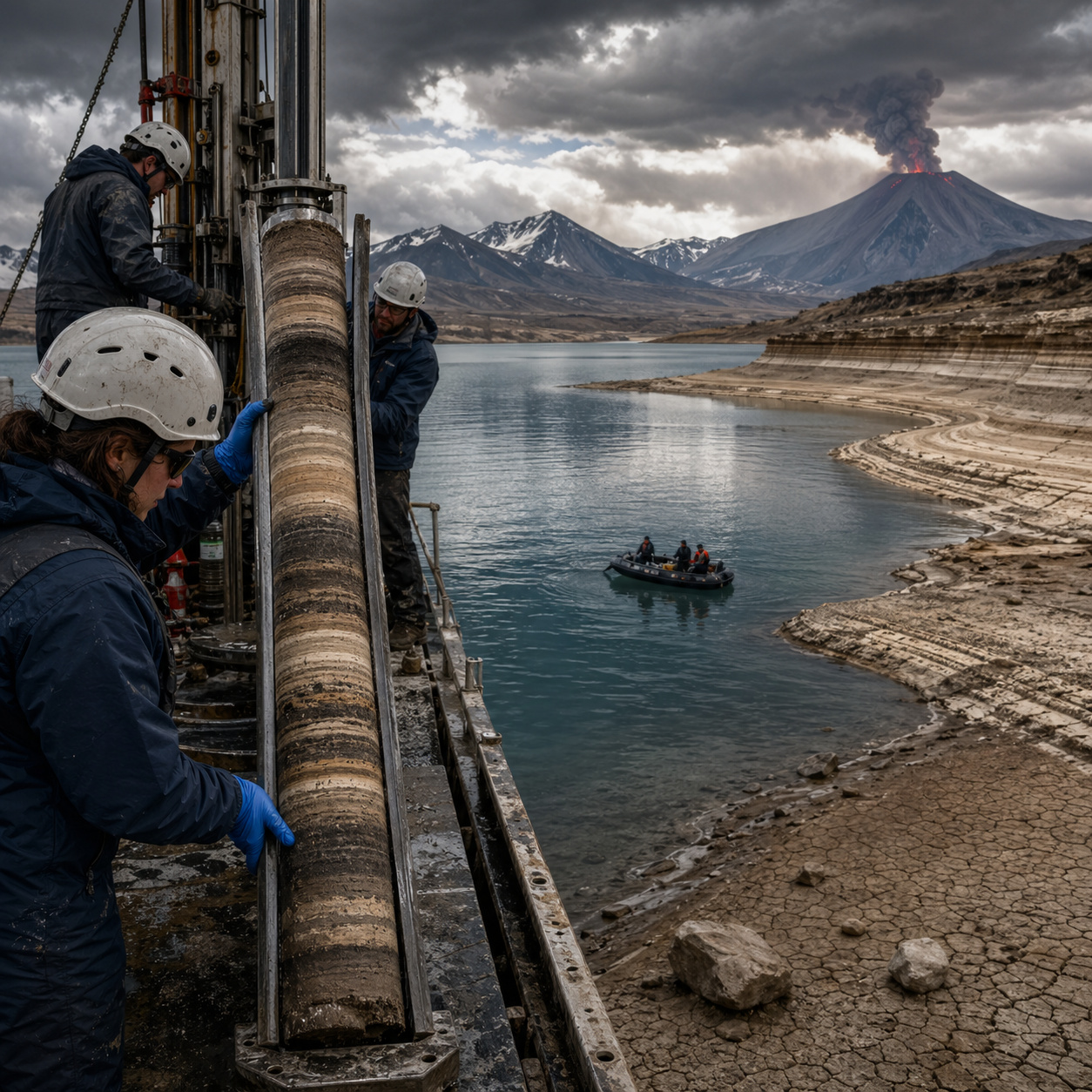

Drilling in Lake Van reveals 600,000 years of climate with droughts, eruptions, and extreme water level variations in Eastern Anatolia.
In 2010, the PALEOVAN project, conducted under the International Continental Scientific Drilling Program, carried out one of the most ambitious continental drilling operations in lacustrine environments in Lake Van, in eastern Turkey. According to the ICDP, the lake is a high-resolution paleoclimatic archive, with an area of 3,522 km², a maximum depth of 451 meters, and sediments capable of recording several glacial and interglacial cycles. The figure of 360 meters refers to the water depth at the Ahlat Ridge site, not the depth drilled below the lakebed. Studies published in 2014 report that the campaign recovered cores from two points, with boreholes up to 217 meters below the lake bottom and a composite sequence of about 219 meters, used to reconstruct approximately 600,000 years of environmental history of the Middle East.
Below, understand how this Turkish lake became a rare natural archive, why its sedimentary layers help reconstruct profound climate changes, and what this record reveals about the region’s environmental instability over hundreds of thousands of years.
Sediments preserve environmental changes with a level of detail impossible in historical records
The materials extracted from the lake bottom show an organized sequence of layers that reflect different environmental conditions over time.
-
Scientists Confirm “Greening” of Antarctica: Ice on the World’s Coldest Continent Turns Green as Mosses Multiply Over Tenfold in Four Decades

-
2,000-Year-Old Gold Rings Found with Human Bones in Thailand Reveal Rare Burial and Feature Ancient Indian Inscription

-
Lenovo Unveils Legion Y700 Tablet with RGB Backlighting, 5G, and SIM Card Support

-
World’s First Nuclear Hydrogen Unit Begins Operation: Copper-Chlorine Technology with Initial Capacity of 150 Liters per Hour, Aiming for 3,000 Liters per Hour



Wetter periods are associated with sediments rich in organic matter, while drier phases leave clearer records poor in biological material. This alternation allows for the identification of climatic cycles with a high level of precision.


The lake bottom acts as a continuous timeline, where environmental events are recorded without interruption for thousands of years.
Layers of volcanic ash reveal episodes of explosive activity in Anatolia
Among the most striking elements found in the samples are the layers of volcanic ash. These formations indicate that the region was repeatedly impacted by eruptions over the last 600,000 years.
This ash acts as an extremely useful geological marker, as it can be associated with specific events and used to accurately date different periods of the sedimentary sequence.
In addition to climate, the record reveals that the region was also shaped by intense geological events over time.
Variations in the lake level show cycles of drought and profound hydrological changes
The analysis of the sediments also allows for the reconstruction of the history of Lake Van’s water level. Over time, the lake has gone through phases of expansion and contraction, reflecting changes in the balance between rainfall and evaporation. In some periods, the water level dropped significantly, indicating phases of prolonged drought.
These fluctuations show that the region had already faced episodes of water scarcity long before current climate change.
Records indicate that climate changes can occur abruptly
One of the most relevant points of the research is the evidence of rapid transitions between different climatic states. Although there are relatively stable periods, the record also shows moments when the environment changed abruptly, with rapid alterations in humidity and the lake’s level.
This indicates that the climate system does not just evolve gradually but can undergo intense changes in relatively short intervals.

The data show that the Eastern Anatolia region was repeatedly exposed to severe climatic conditions, including long periods of drought.
These conditions would have a direct impact on vegetation, water availability, and, in more recent periods of history, on human occupation. The record makes it clear that extreme events have been part of the region’s natural dynamics for hundreds of thousands of years.
Data helps differentiate natural variability from recent changes
By accessing such an extensive record, scientists can compare the current climate with natural patterns of the past.
This allows for identifying what is part of the natural variability of the climate system and what may represent changes outside this pattern. Without this type of historical reference, it would be much more difficult to interpret the changes observed today.
The drilling in Lake Van is part of a larger international effort to understand Earth’s climate history. Similar projects in oceans, glaciers, and other lakes help to assemble a global picture of environmental changes over time.
In this context, Lake Van stands out as one of the most complete continental records ever obtained. The combination of these studies allows for reconstructing the evolution of the climate with an ever-increasing level of detail.
What do 600,000 years of records reveal about climate behavior?
With a continuous sequence spanning hundreds of thousands of years, Lake Van offers a rare insight into the functioning of Earth’s climate system.
Prolonged droughts, abrupt changes, and extreme events appear repeatedly throughout the record, showing that the climate has always been dynamic and complex.
The question that emerges from this data is inevitable: to what extent does what we are experiencing today fit into these natural cycles, or does it represent a change different from anything that has ever occurred in this time frame?