






 Portuguese
  Spanish
  2 min of reading
  4 comments


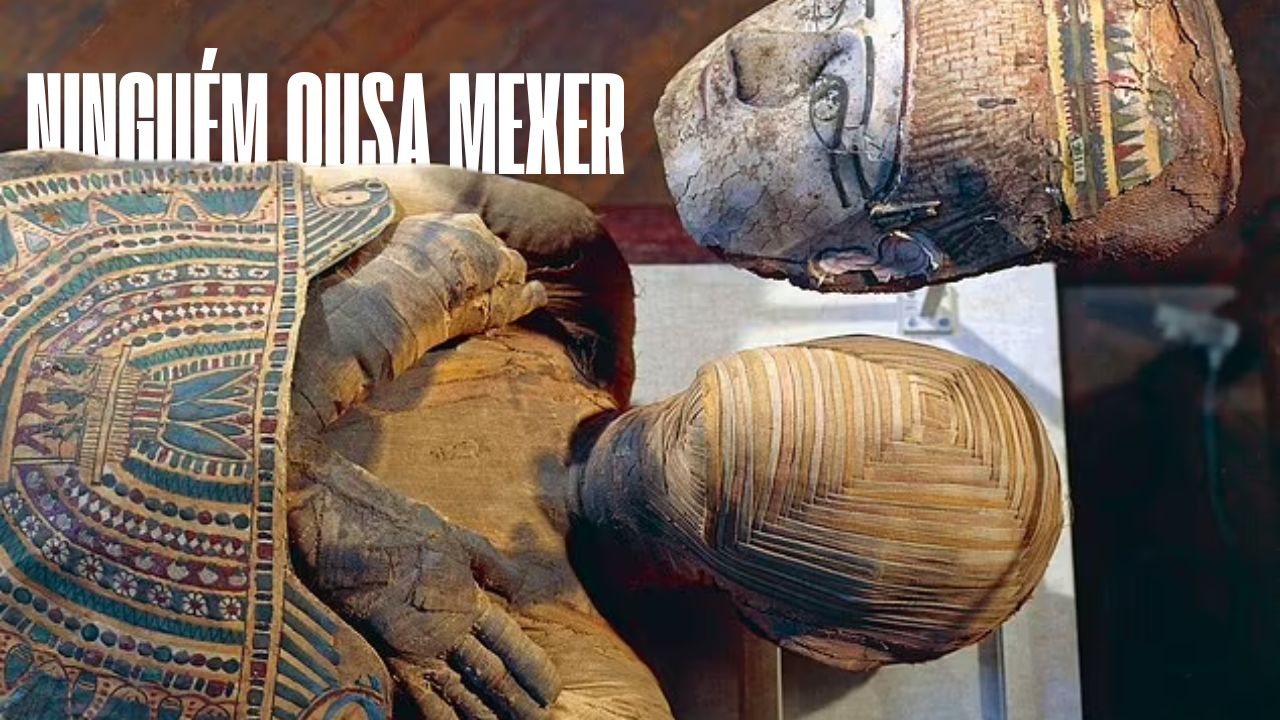


Discovery in the Valley of the Kings, the mysterious mummy Bashiri has a unique embalming method and remains surrounded by secrets. Scientists avoid unwrapping it for fear of destroying valuable evidence.
The mysterious mummy Bashiri continues to intrigue Egyptologists more than a century after its discovery. Enclosed in a unique embalming method and meticulously decorated, it challenges researchers who fear that unwrapping it could destroy valuable evidence.
It was found in the Valley of the Kings, in Luxor, by the renowned archaeologist Howard Carter, three years before he discovered the luxurious tomb of Tutankhamun. Since then, it remains an enigma in the Museum of Egypt, in Cairo, with no one daring to disturb its wrappings.
The Mystery of the Bashiri Mummy

The Bashiri mummy is considered “untouchable” due to the impressive technique used to wrap it. Its wrappings were carefully arranged on its face, forming a pattern similar to that of the Egyptian pyramids.
-
Brazilian Innovator Marcelo Loureiro Sets Guinness World Record with 12,000 km Robotic Surgery from Brazil to Kuwait

-
Workers Discover 19th-Century Iron Ship and Indigenous Artifacts During COP30 Construction in the Brazilian Amazon
-
Chinese robots trained for two weeks to row a dragon boat at the Sichuan Festival in China, took full control when humans stopped rowing, and even made rice dumplings in one of the most unusual tests ever conducted with humanoids.
-
Public school students in Sergipe create an early autism screening kit for vulnerable communities without a doctor, in the year Brazil won 8 awards at the world’s largest science fair.


This suggests that he was an important figure in the Ptolemaic era of Egyptian society, between the 2nd and 3rd centuries BC, when embalming techniques were at the height of sophistication.
Who Was Bashiri? What Science Has Already Discovered
Unable to unwrap the mummy, scientists turned to computed tomography and X-rays. These examinations revealed that he was a man of 1.67 m, but his identity remains a mystery.
In the tomb, an enigmatic inscription was found that may mean “Bashiri” or “Nenu,” but to this day, experts have not reached a consensus on its true name.
The Dilemma of Scientists – Unwrap or Preserve?
The wrappings of the Bashiri mummy are extremely fragile, and removing them would mean losing the only existing evidence of this specific embalming method.
Therefore, researchers continue to study it through non-invasive techniques, trying to uncover its secrets without compromising its integrity.
A Mummy Surrounded by Symbolism and Reverence
The external analysis of the mummy revealed a richly adorned ornament, reinforcing the idea that Bashiri was a man of great status.
Among the most striking symbols are:
- A collar adorned with falcon heads, the symbol of Horus, god of royalty.
- Scenes of the god Anubis, associated with the afterlife.
- Representations of Isis and Nephthys, goddesses of protection and rebirth.





Essa múmia eu vi no Louvre e não em Cairo.
A arqueologia moderna ajuda muito, sugiro , que continuem o estudo sem destruir a múmia, que é espetacular!.
Incrível!!👏👏