Portuguese
  Spanish


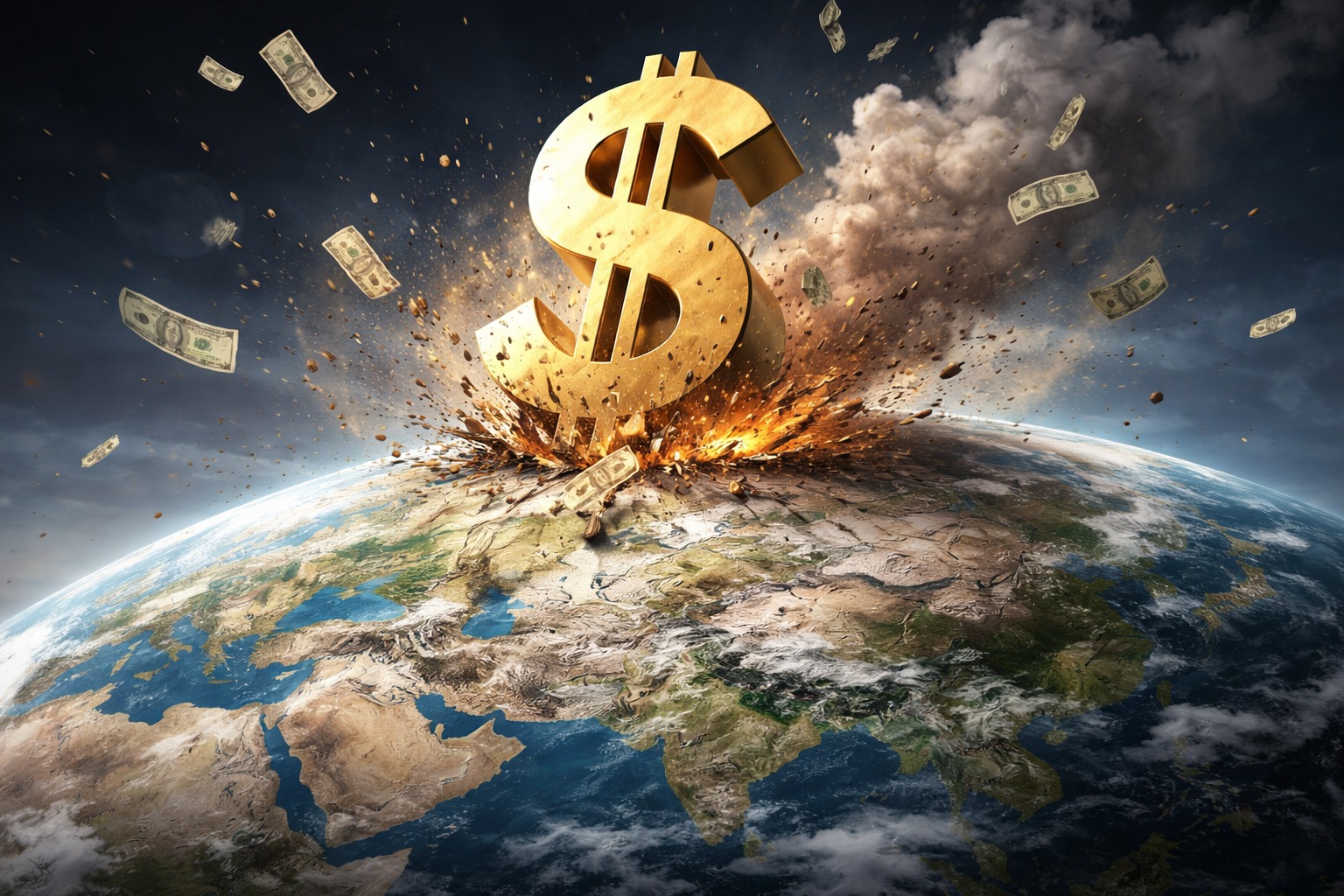

Dollar Falls 0.3%, S&P 500 Futures Drop 0.8% and Currency Index Accumulates 8.1% Decline After 15% Global Tariff Announced by Donald Trump and U.S. Supreme Court Decision
The dollar fell 0.3% and S&P 500 futures dropped 0.8% following the announcement of a 15% global tariff by Donald Trump and the U.S. Supreme Court decision, increasing uncertainties about U.S. economic policy and putting pressure on the dollar in the markets.
dollar Reacts to 15% Global Tariff and Supreme Court Decision
A Bloomberg index tracking the performance of the U.S. currency fell 0.3%, deepening the loss recorded on Friday.
The movement occurred in a backdrop of weaker trading, with markets in Japan and China closed for holidays.
-
China wants to impress the world once again with a mega canal featuring giant locks, deep waters, and space for the largest ships, in a project aimed at shortening journeys, reducing queues, and rivaling the Panama Canal in global trade.

-
Brazil saved US$ 32.4 billion in 2025 by switching from fossil to renewable energy and only ranked behind China and the United States on the IRENA global podium.

-
A company from SC that moves R$ 125 billion in agribusiness is integrated into an international group, maintains its headquarters and jobs in Chapecó, and is preparing to expand software for cooperatives, grain companies, and industries while targeting new markets without leaving the western region of Santa Catarina.
-
Portugal “hides” gold reserves of 382 tons valued at 47 billion euros in an armored building, and the story involves gold from colonial Brazil, Nazi Germany, and a fortune that once amounted to 866 tons.



Swiss franc, yen, and euro led the gains against the dollar after Trump announced a 15% global tariff.
The announcement followed the Supreme Court decision that struck down tariffs deemed “reciprocal” by the president.
In the United States, S&P 500 futures dropped 0.8%. In contrast, an index of Asian stocks rose by up to 1%, reflecting a reconfiguration of global investment flows in light of the new trade measures.
“The dollar is experiencing broad declines as the market tries to assess the implications of the Court’s decision,” said Rodrigo Catril, strategist at National Australia Bank in Sydney. According to him, the tariff regime is still in place, with more uncertainty.
Cumulative Impact and Annual Loss of 8.1%
The new tariff threat, combined with the court ruling and statements from U.S. officials defending trade policy, raised uncertainty in Washington.
The environment reinforces concerns about the loss of so-called American exceptionalism following the announcement of global tariffs in April.
The Bloomberg dollar index accumulated an 8.1% decline last year, the largest annual contraction in eight years.
The performance was pressured by the Federal Reserve’s monetary easing cycle and tariffs imposed by Trump.
U.S. officials maintained that the Supreme Court defeat should not nullify trade agreements made with partners.
Jamieson Greer, U.S. Trade Representative, told CBS that agreements with China, the European Union, Japan, and South Korea remain valid.
Demand for Asian Assets Grows Amid Weakness of the Dollar
In emerging markets in Asia, the Thai baht, Philippine peso, and Malaysian ringgit saw gains amid the weakness of the dollar. The movement reflected higher demand for assets in the region.
Asian stock markets also rose. An index of major Chinese companies listed in Hong Kong advanced by up to 3.1%, the highest increase since May 12. The main indices in Taiwan and South Korea reached record levels.
The rally provided the MSCI Asia Pacific Index with the best start to the year recorded compared to the S&P 500. The indicator exceeds the American index by over 11 percentage points year-to-date.
Gary Dugan, CEO of the Global CIO Office, stated that the immediate relief for Asian markets comes from the fact that the Supreme Court imposed limits on the implementation of the tariffs.
For him, the reduction of extreme risk could accelerate structural forces in Asia, such as stronger domestic growth and greater regional integration.
Prolonged Decline and New Trade Uncertainties
Uncertainty regarding global trade has returned to the radar of investors, according to strategists at Bloomberg.
The scenario is considered negative for American assets, especially in light of the recent volatility of the dollar.
“The decline of the dollar this morning has the potential to extend,” said Garfield Reynolds, strategist at Markets Live.
Global leaders also reacted to the new measures. The head of trade for the European Union announced they would propose suspending the ratification of an agreement made with the U.S. India postponed negotiations to finalize a provisional trade agreement.
China, India, and Brazil began to face lower tariffs after the court decision on Friday. According to strategists at Goldman Sachs, including Kamakshya Trivedi, the new injection of political uncertainty could negatively influence investor and business activity.
The instability reinforces the pressure on the dollar and keeps the market attentive to the next moves in American trade policy, amid an environment of uncertainty and global reaction to the announced tariffs.
With information from InfoMoney.