Portuguese
  Spanish


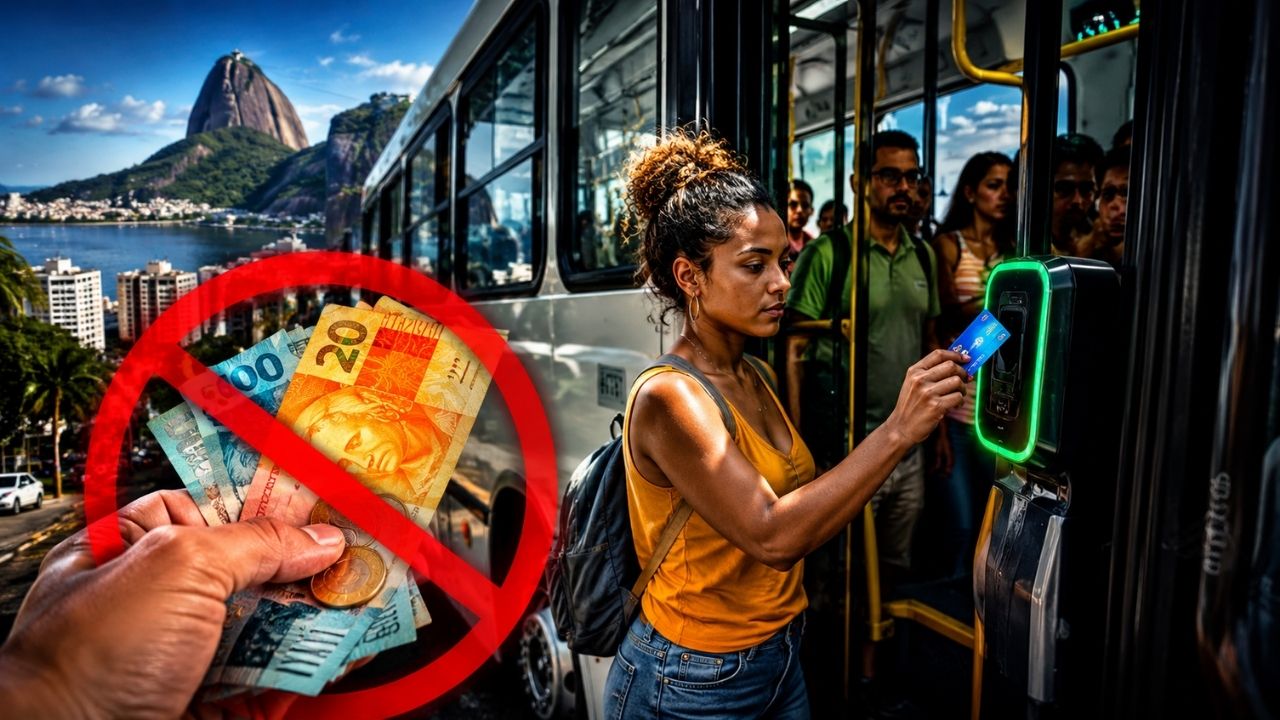

Starting May 30, Rio’s municipal buses will stop accepting cash payments, and passengers will need to use a card or app at the turnstile. The change aims to reduce boarding time, eliminate change with drivers, and increase safety on buses, but requires adaptation from those who still use cash.
Rio’s municipal buses will stop accepting cash payments starting May 30. With the change, those using the city’s lines will need to pass through the turnstile using a card or app, in a change that directly affects passengers’ routines.
According to information from the channel SBT Rio, the measure marks a turning point in Rio’s public transport, especially for those who still pay the fare in cash. The official proposal is to make boarding faster, reduce drivers’ contact with money, and decrease risks inside the vehicles.
Cash is no longer accepted at bus turnstiles

Under the new rule, cash payments will no longer be accepted on municipal buses operating in the city of Rio. Passengers will need to use electronic means, such as a transport card or app, to pass through the turnstile.
-
Facing Labor Shortage, Japan Plans to Invest $34 Million to Attract Foreign Workers in Construction, Healthcare, Industry, and Commerce

-
Brazilian City Makes Remarkable Leap, Becomes 4th Wealthiest in the Country with GDP of R$ 134.1 Billion

-
Controversial 6-day Workweek Elimination in Brazil Faces Economic Criticism Over Productivity Claims
-
Itaú to Refund Customers After 14 Years of Unauthorized Credit Card Charges; Agreement Includes No Interest or Adjustments, Deadline by 2028, with Potential Impact of Up to $6.5 Billion





The change primarily affects those who use cash for occasional trips. People who take buses only occasionally, tourists, seniors unfamiliar with apps, or workers who still receive part of their income in cash may need to adapt before the start date.
According to the Transport Secretariat, the decision aims to reduce boarding time. In practice, removing cash eliminates steps like checking bills, coins, and change, which usually slows down boarding the bus.
The impact also reaches drivers. Without the task of receiving cash fares, they no longer have to divide their attention between driving, collecting fares, and giving change. The expectation is that this will improve their work routine and reduce risk situations inside the vehicles.
Card and app become the focus of payment
With the end of cash on buses, payment will be made through digital means or cards accepted in the system. Jaé becomes one of the main options for passengers using municipal transport in Rio.
Users of the Intermunicipal Single Ticket can also use the Riocard, according to the informed rules. Benefits such as the Carioca Single Ticket and Margaridas Single Ticket remain available exclusively through the Jaé system.
The central point is that the passenger will need to arrive at the stop already prepared to pay without cash. Those who do not yet have a card, do not use an app, or usually decide on travel at the last minute should organize themselves to avoid problems at the turnstile.
This transition requires clear communication. In a city with millions of daily commutes, any change in payment can cause doubts, especially in the first days of adaptation.
City Hall bets on faster boarding and more security
The main justification from the city hall is operational. By removing cash from the process, buses can board passengers faster, reducing queues at the door and delays caused by manual collection.
Additionally, there is a security issue. Cash circulating inside the buses can make drivers and passengers more vulnerable to theft or robbery. With less cash on the vehicle, the city hall hopes to reduce this type of exposure.
For drivers, the change also represents one less task during the journey. Driving in Rio’s traffic already requires constant attention, and manual collection added another layer of pressure to the job.
Even so, the measure does not eliminate all the challenges of the system. The quality of transport, punctuality, overcrowding, and integration between modes continue to be important points for the user.
Passengers will have to adapt before May 30


The main challenge of the change lies in the public’s adaptation. Many passengers already use cards, cell phones, or electronic means daily, but there is still a portion of the population that relies on cash out of habit, necessity, or lack of digital access.
For this group, the end of cash payment may seem simple on paper, but difficult in practice. It will be necessary to know where to obtain or recharge cards, how to use the app, and which options remain valid for each type of benefit.
Advance information is essential to avoid embarrassment. A passenger who only discovers the rule at the time of boarding may be left without an alternative, especially during work, study, or medical appointment hours.
For this reason, the change should require guidance at the stops, terminals, on the buses themselves, and through official channels. The clearer the communication, the less impact there tends to be in the first few days.
Integrations and benefits continue with their own rules
The change in cash payment does not mean that all fare systems will be automatically unified. Some benefits and integrations continue to follow specific rules, depending on the type of card and the journey made by the passenger.
In the case of municipal benefits, such as Bilhete Único Carioca and Bilhete Único Margaridas, the information is that they remain linked to Jaé. Meanwhile, the Bilhete Único Intermunicipal continues to be accepted by Riocard.
This point deserves attention because many passengers use more than one mode of transport in the same day. Those who combine buses, BRT, VLT, or travel from other cities need to check which card or app best suits their routine.
Fare integration is a sensitive part of metropolitan transport. If the passenger does not understand the rules, they may pay more than expected or face a block when passing through the turnstile.
What changes for those who use buses in Rio
The end of cash on municipal buses in Rio represents an important change in the relationship between passenger, driver, and the transport system. The promise is faster boarding, less handling of money, and more security inside the buses.
But the measure also raises a practical question: will all passengers have enough time and information to adapt by May 30? The modernization of payment can facilitate the operation, but it also needs to work for those who are not yet connected to cards and apps.
In the coming days, attention should be focused on public guidance, recharge points, and clarity of rules for benefits and integrations. Without this, a measure created to streamline may cause confusion precisely at the time of boarding.
Do you think the end of cash on buses will improve transportation in Rio or could it make life harder for those who still rely on cash payments? Leave your opinion in the comments.