





 Portuguese
  English
  Spanish
  3 min of reading
  0 comments


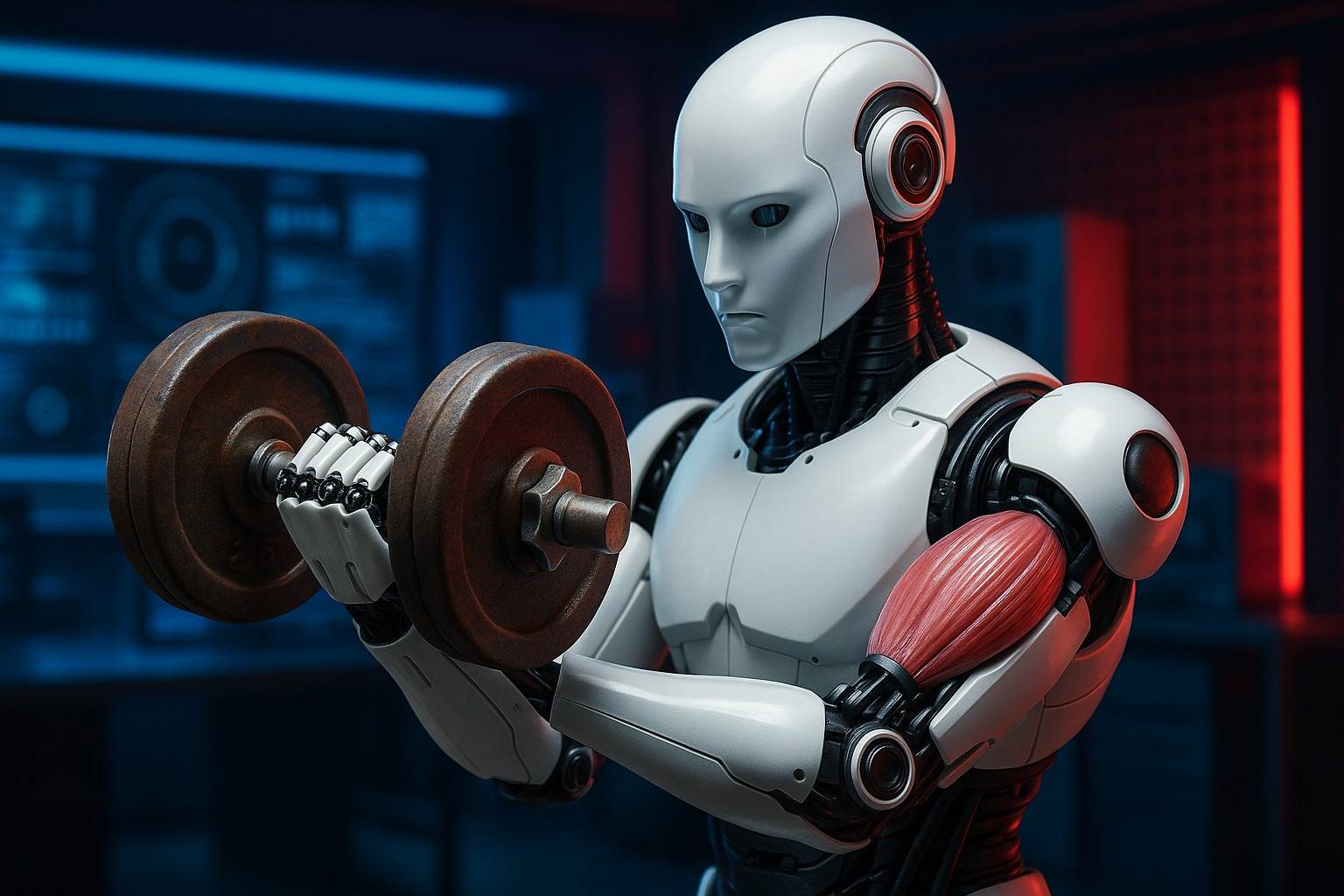
Created by Researchers at UNIST in South Korea, the New Artificial Muscle Weights Only 1.25 Grams, Lifts 5 Kilograms, and Surpasses by More Than 30 Times the Work Density of Human Muscles, Revolutionizing Robots, Prosthetics, and Wearable Devices
A technological advancement from the Ulsan National Institute of Science and Technology (UNIST) in South Korea may transform soft robotics and wearable devices.
Researchers have created a new artificial muscle capable of altering its mechanical state, transitioning from soft and flexible to rigid and extremely strong — like rubber turning into steel.
It hardens under heavy loads and softens when it contracts, overcoming one of the greatest challenges in current robotics.
-
The scientists did not expect it, but they found fossils of mysterious species in a cave among volcanic ashes over 1 million years old, revealing an ancient history.

-
Six 400,000-year-old teeth found in China contained a protein that was believed to exist only in the mysterious Denisovans: the discovery reveals that Homo erectus interbred with this extinct relative and left a genetic trace that still lives in human populations today.

-
Why are people parking hundreds of telescopes worth more than $10,000 in the middle of nowhere?

-
New Xiaomi device heats water in 3 seconds, automatically makes ice cubes, and also allows temperature adjustment via smartphone between 40°C and 90°C.




Overcoming the Barrier Between Flexibility and Strength
Artificial muscle materials are essential because they offer dexterity and interaction similar to humans.
However, the use of these technologies is limited by an unavoidable trade-off: flexible muscles generally lack the strength to lift objects, while the more powerful ones lack the necessary flexibility for delicate tasks. This limitation drastically reduces their utility in the real world.
Professor Hoon Eui’s team has overcome this obstacle with a muscle that weighs only 1.25 grams and exhibits dynamic behavior.
It hardens under heavy loads while maintaining structural integrity, and then it contracts, regaining flexibility.
The innovation lies in a double cross-linked polymer network, which combines covalent bonds for strength with physical interactions activated by thermal stimuli, ensuring elasticity.
Magnetic microparticles embedded in the material allow control of its movements with external magnetic fields, which was demonstrated in object-lifting tests. This combination makes the muscle extremely versatile for practical applications.
Impressive Load Capacity and Performance
The artificial muscle can support up to 5 kilograms — about 4,000 times its weight — and can stretch up to 12 times its original length when softened.
“This research overcomes the fundamental limitation in which traditional artificial muscles are highly elastic but weak, or strong but rigid,” stated Professor Jeong.
According to him, the new technology paves the way for more versatile soft robots, advanced prosthetics, and intuitive interfaces between humans and machines.
In addition to strength and flexibility, the muscle exhibits superior energy production. During contraction, it reaches a tension of 86.4%, more than double that of human muscles. Its work density reaches 1,150 kJ/m³, about 30 times greater than that of human tissue.
“Work density indicates how much energy per unit volume the muscle can provide, and achieving high values together with high elasticity has been a long-standing challenge,” the researchers explained.
New Paths for Robotics and Biotechnology
The development may benefit technologies that require human-like interaction.
Applications include prosthetics that follow body movements, flexible robots capable of navigating complex environments, and wearable devices that adapt to user needs.
Recently, scientists at MIT have also developed artificial muscles aimed at complex and multi-directional movements. Inspired by the human iris, the material they created contracts circularly and expands outward simultaneously.
The study presenting the Korean advancement was published in the journal Advanced Functional Materials and reinforces the transformative potential of this emerging technology for the future of robotics and human-machine interface.





Be the first to react!