






 Portuguese
  Spanish


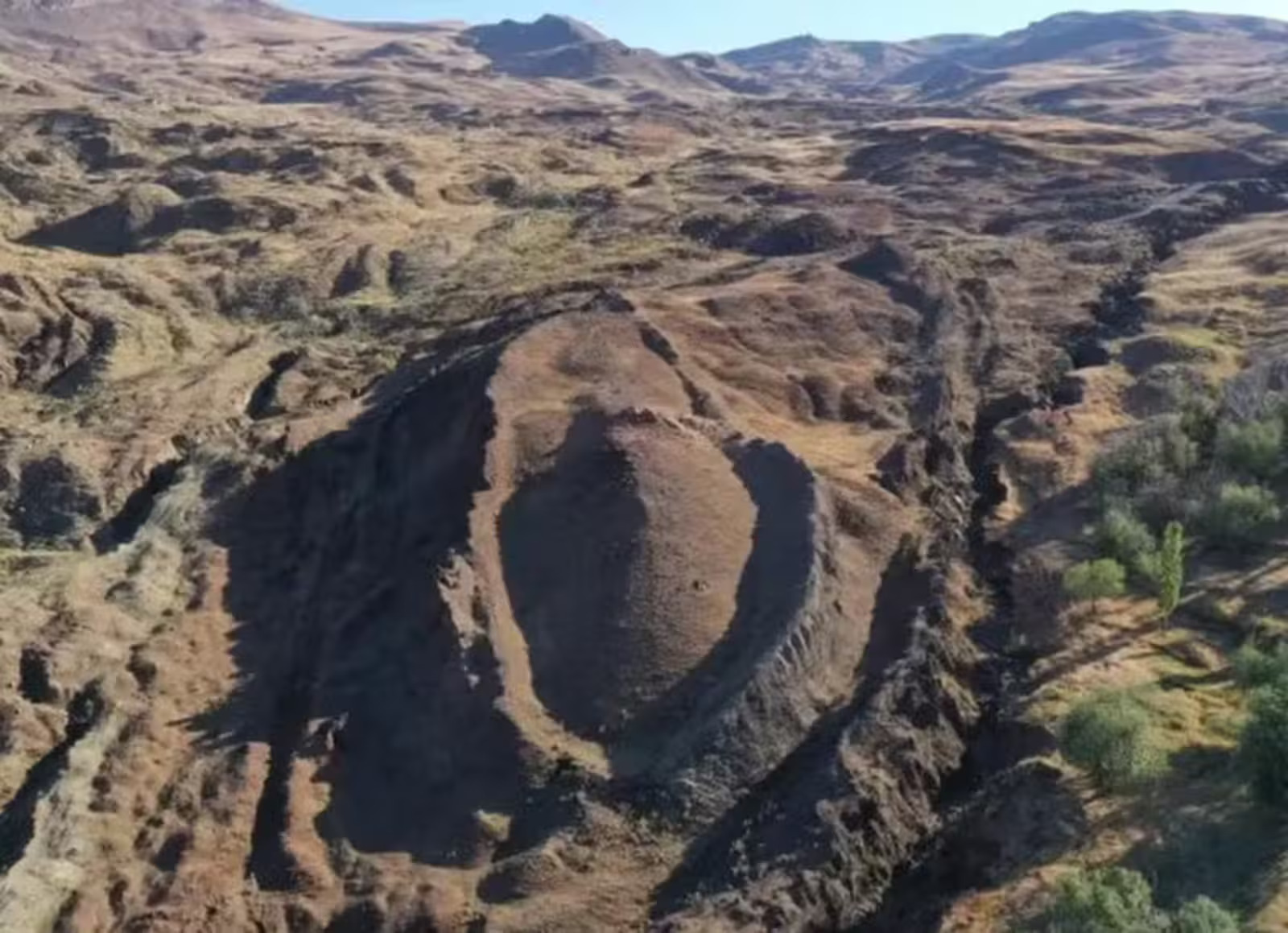


Researchers identified tunnels, subterranean cavities, and chemical differences in Durupınar, Turkey, reigniting the debate about Noah’s Ark, while experts remain cautious due to the absence of conclusive evidence
An investigation in Durupınar, Turkey, identified tunnels and subterranean cavities in a boat-shaped formation near Mount Ararat, reigniting the ongoing debate about the existence of Noah’s Ark and its relation to the structure.


Structure returns to the center of the debate
Researchers claim to have found patterns in the Durupınar formation using ground-penetrating radar.
According to the team, these patterns resemble organized compartments, something compatible with biblical descriptions of the vessel.
-
ChatGPT Alerts FBI to Prevent Planned Murder of 8-Year-Old in Brazil’s Espírito Santo

-
Scientists Discover 125-Million-Year-Old “Pregnant Fossil” with Preserved Embryos and Microscopic Larvae Inside Mollusk in England

-
17-Year-Old Justin Bernstein Develops Bacteria to Produce Glass on Arctic Ice to Reflect Sunlight, Wins $50,000 U.S. Scholarship

-
The 19-Meter Rocket-Helicopter: A Private Industry Prototype That Challenged Space Race Logic



The discovery places Durupınar back at the center of a discussion involving science, archaeology, and religious tradition.
Tunnels, cavities, and signs in the soil
In addition to the tunnels and subterranean cavities, analyses indicated chemical differences in the soil within the formation.
Higher levels of organic matter and potassium were identified, which, for the researchers involved, could indicate the ancient presence of decomposing wood.
In this group’s reading, this set of signs would reinforce the hypothesis that the structure has an artificial origin.
Shape fuels ancient speculations
The shape of Durupınar has drawn attention for decades.
The structure, located a few kilometers from Ararat, has a boat-like shape and dimensions similar to those described in the biblical book of Genesis.
Discovered in the mid-20th century after natural events, the formation has been associated by different groups with the possible Noah’s Ark.
This resemblance has helped keep alive the speculations about a connection between the rocky structure and the vessel mentioned in religious tradition.
Scientific community remains cautious
Despite the enthusiasm, most experts adopt caution.
For the scientific community, formations like Durupınar can be explained by natural geological processes, without the need for extraordinary archaeological interpretations.
This position adds to the history of the search for Noah’s Ark, marked by unconfirmed claims over time.
Since Antiquity, different expeditions have announced the discovery of remnants of the vessel, but no conclusive evidence has been accepted by science.
Mount Ararat remains a symbol of the search
Mount Ararat continues to be linked to this search because it is often associated with the place where the ark is said to have rested after the flood.
At the same time, the biblical text itself mentions the mountains of Ararat in a generic way, without pointing to a specific location.
Thus, the identification of the tunnels in Durupınar emerges as yet another chapter in this long history of attempts, and not as definitive proof.
With information from Aventuras na História.


