Portuguese
  Spanish


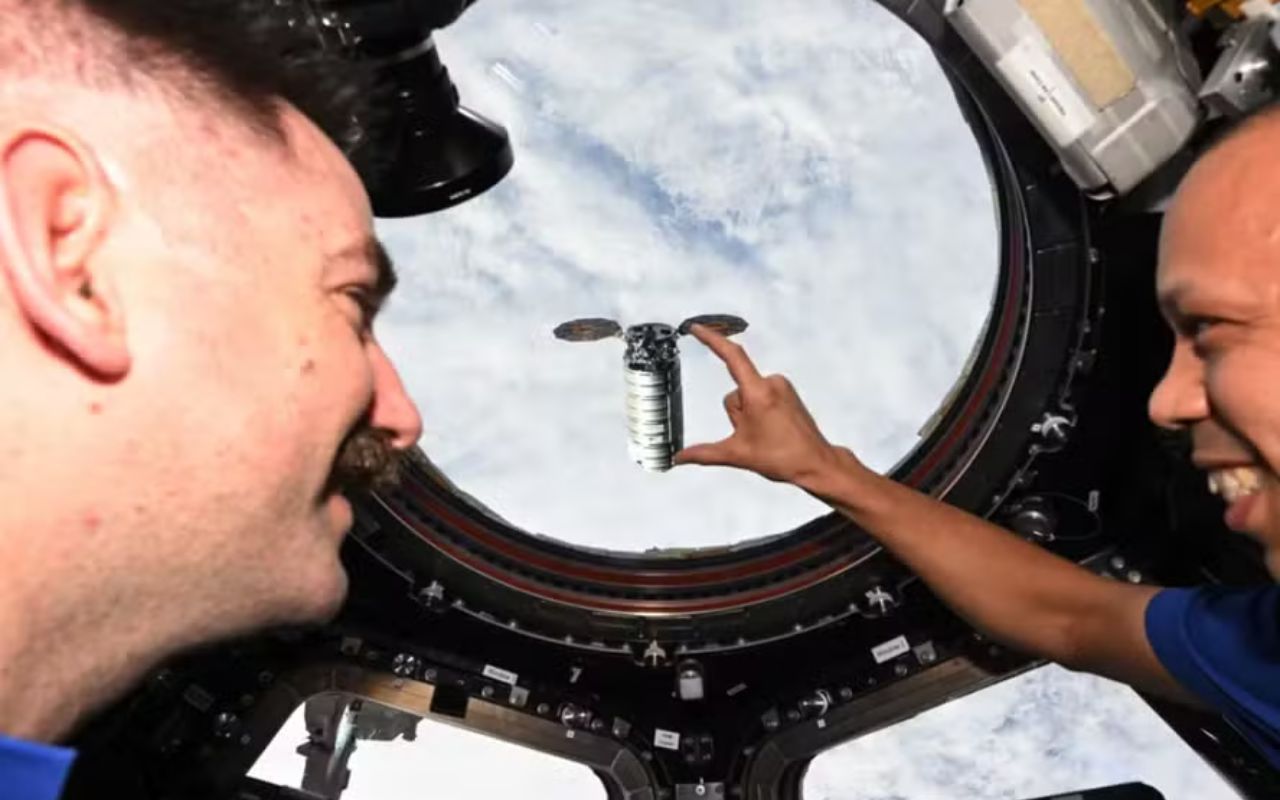


See how NASA astronauts Chris Williams and Jack Hathaway took advantage of the arrival of the Cygnus XL spacecraft to create an amazing optical illusion on the ISS.
While the Artemis II mission celebrated the return of its crew to Earth, the routine of discoveries and relaxation continued for those remaining in orbit. On the last day of April 13, NASA astronauts Chris Williams and Jack Hathaway, who are part of the current crew of the International Space Station (ISS), starred in a curious moment by using an optical illusion to “hold” the Cygnus XL spacecraft with their hands.
The fun recording occurred during the approach maneuvers of the Northrop Grumman cargo vehicle, which was transporting essential supplies for the continuation of scientific research in space.
The future of the International Space Station and its legacy
The ISS, where Chris and Jack filmed, is a monumental structure 109 meters long.
-
The industrial waste that even recyclers didn’t want has gained value in the interior of Bahia: two entrepreneurs invested R$ 2.8 million to transform 350 tons per year of foam, rubber, and plastic into boards that can replace wood and MDF.

-
What is a red flashlight used for, after all? See why it is so commonly used at night.

-
He has never read a line of code, but he already knows how to work: the French company UMA presented in Paris the Northstar, its first AI-powered humanoid robot designed for factories and warehouses, capable of copying tasks just by observing an employee in action.

-
A young Kenyan engineer collects plastic waste from the streets and transforms it into robots that translate physics lessons into sign language in real-time, a machine made with old bottles that teaches what was missing to deaf children left out of science.



Divided into segments operated by different nations, such as the American sector (USOS) and the Russian (ROS), the station has received more than 280 visitors in its 25 years of continuous operation.
Despite its historical relevance, the orbital giant already has a date to end its activities:
- The official retirement is scheduled for the end of 2030.
- The deorbiting process is expected to occur in 2031.
- The station will be directed for a controlled descent in a remote area of the Pacific Ocean.
Until that moment arrives, NASA astronauts continue to transform complex science into something accessible.
What did the Cygnus take to space?
The importance of this delivery goes far beyond visual entertainment. The vehicle arrived loaded with over 5 tons of crucial items for human survival and work outside the planet.

The management of these loads is a meticulous task that began immediately after the hatches were opened for the unloading of the Commercial Resupply Services 24 (CRSS24) mission.
Among the delivered items, the following stand out:
- New scientific experiments for various fields of study.
- Hardware and equipment for the maintenance of the ISS structure.
- Fresh food to improve the diet of the crew in orbit.
- Logistical support items for daily maintenance operations.
Astronaut Jessica Meir celebrated the success of the operation on her social media, highlighting the efficiency of those involved: “Congratulations to @Astro_ChrisW and @astro_hathaway for the first capture of a cargo vehicle using the Canadarm from @csa_asc at @Space_Station! Mission accomplished today.”
The message reinforces that success depends on collaboration between the agency, Northrop Grumman, and SpaceX, which launched the cargo ship on a Falcon 9 rocket on April 11.
Technical challenges of docking with the Cygnus XL spacecraft
Connecting two gigantic objects in space is not a simple task. As the spacecraft travel at extreme speeds, any miscalculation can pose severe risks to the structure of the ISS and the lives of the crew members.
The alignment must be impeccable for the docking devices to fit together without causing material damage or loss of pressure. Therefore, the manual capture through the Canadarm2 robotic arm is a high-tension process.

After being held by the mechanism, the Cygnus XL spacecraft was directed to the station’s door that faces our planet. This technical success allowed the unloading routine to begin without delays, ensuring that scientific experiments were initiated according to the schedule set by the teams on the ground.
The viral prank was recorded moments before the cargo ship was officially docked.
With information from Revista Galileu