Formation recorded by the Perseverance mission was chosen in a public vote as Image of the Week and became a curious example of pareidolia on Mars
In September 2024, NASA’s Perseverance rover photographed a rock on Mars with such a peculiar shape that it began to be compared to a human head “lying” on the ground, with a tired appearance. The image was selected by public vote as Image of the Week 189 of the mission, for the period from September 22 to 28, 2024, according to NASA.
The record drew attention because it mixes space exploration, visual curiosity, and the science of human behavior. After all, although the image seems to suggest a face, the most accepted explanation lies in a phenomenon known as pareidolia.
Perseverance has been exploring Mars since 2021 in search of signs of the planet’s past
The Perseverance rover landed on Mars on February 18, 2021, as part of the Mars 2020 mission. Since then, the robotic vehicle has been traversing the planet to search for signs of ancient microbial life and collect samples of Martian rocks and regolith, according to NASA.
-
Ancient Stone City in the Desert, Once Home to 30,000, Puzzles Scientists with Nabateans’ Water Mastery 2,000 Years Ago

-
Ancient Creature Thought Extinct Since Dinosaur Era Reappears, Baffling Scientists

-
India Deploys Giant Fabric Tubes Filled with Sand to Combat Coastal Erosion and Rebuild Disappearing Beaches

-
China Unveils Most Human-Like Humanoid Robot for Public Sale, Featuring Silicone Skin and 88 Joints, Priced from $17,600




Built and operated by NASA’s Jet Propulsion Laboratory, JPL, the equipment has become one of the main tools for direct observation of the Red Planet.
Moreover, the mission has already captured striking images over the years. Among them are formations compared to a snake, snowman, and even a kind of “spaghetti” on the Martian ground.
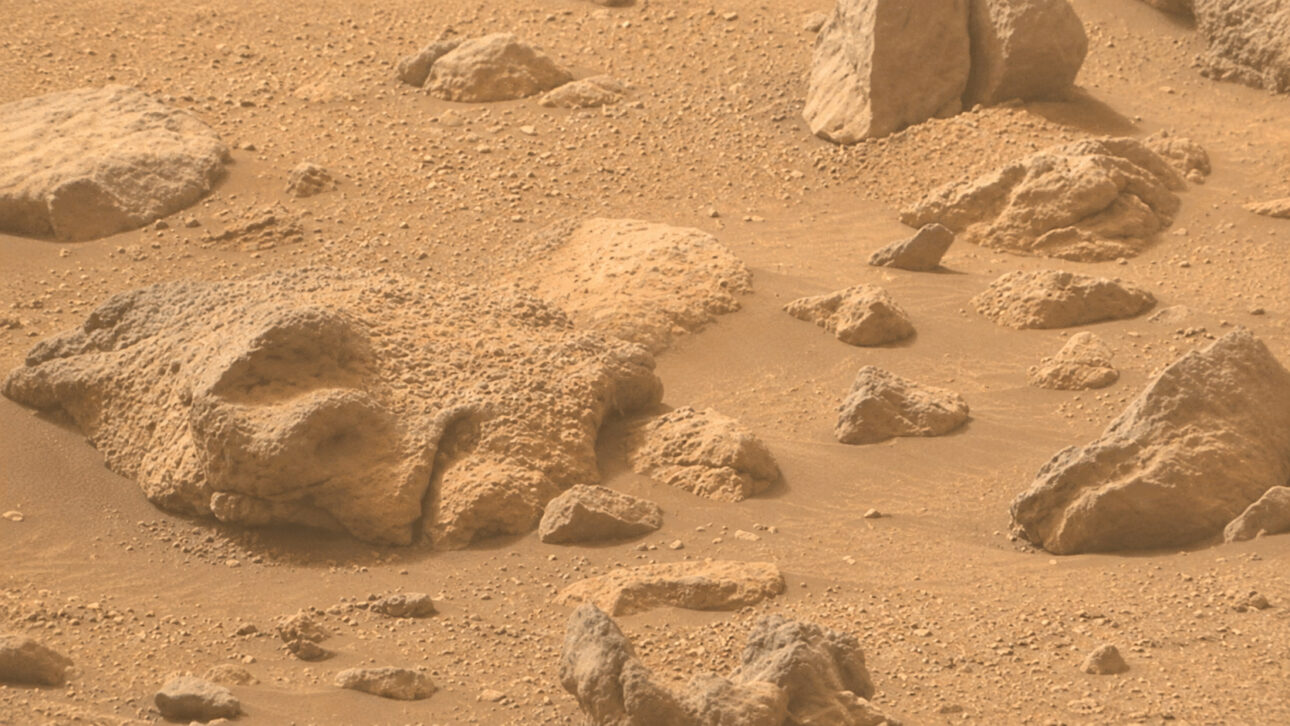
Rock with face-like appearance became a highlight by public vote
The image of the supposed “tired face” was captured by the Right Mastcam-Z camera of Perseverance. Shortly after, the photo entered the mission’s public gallery and was chosen as the weekly highlight by internet users.
In practice, what is seen is just a Martian rock formation. Even so, the angle, shadows, and contour of the stone created a familiar appearance to human eyes.
This type of visual interpretation usually occurs when the brain tries to organize random shapes into known images. Therefore, Mars did not reveal a human head, but rather a curious example of how we perceive patterns.
Pareidolia explains why we see faces in rocks, clouds, and shadows
Pareidolia is the psychological phenomenon that makes people recognize faces, animals, or objects in random visual stimuli. This can happen in clouds, stains, shadows, lights, and, of course, Martian rocks.
Research on facial pareidolia describes this effect as a convincing illusion of perceiving facial features in inanimate objects. Scientific studies on the subject have been published by researchers like Jess Taubert, affiliated with the University of Queensland.
Therefore, the image taken by Perseverance draws attention not only for the space scenery. It also reveals how the human brain quickly interprets the world around it.
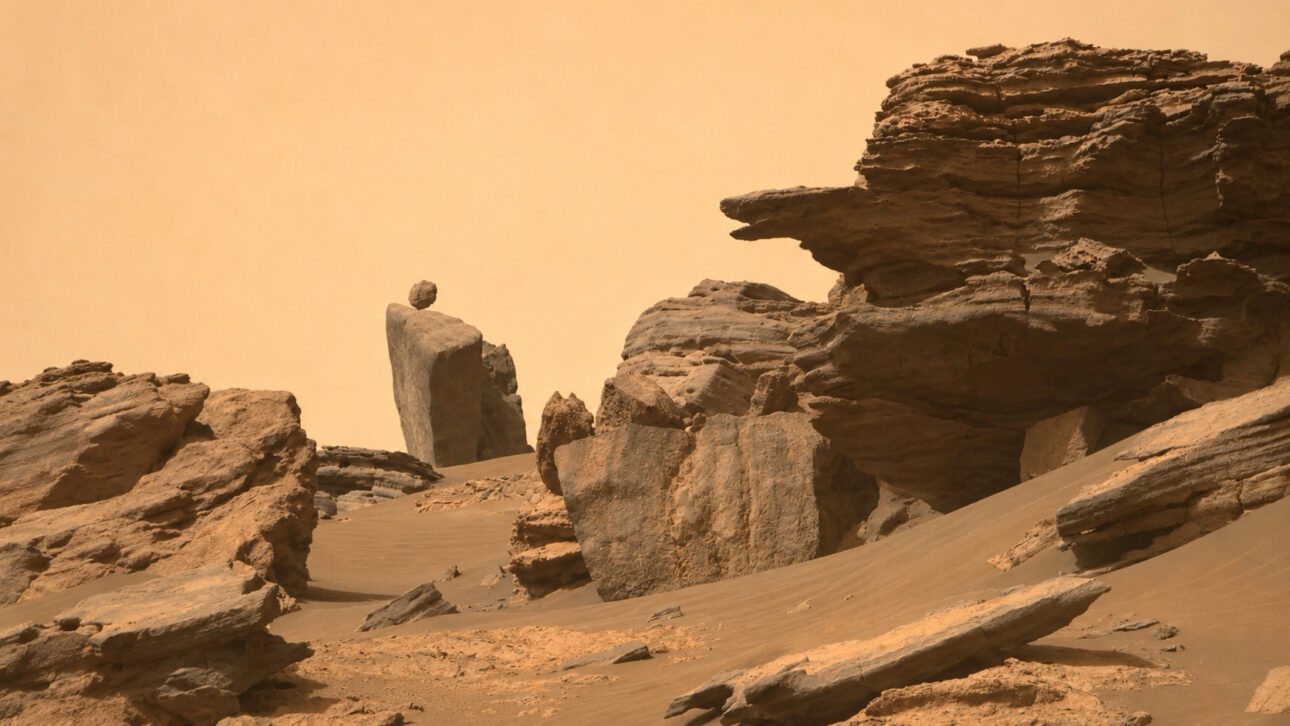
Carl Sagan related pattern recognition to human survival
The idea also appears in the work “The Demon-Haunted World” by Carl Sagan. In it, the author highlights that recognizing possible threats was important for human survival.
An ancestor who mistook a stone for a lion could flee unnecessarily. Even so, they would remain alive. On the other hand, ignoring a real danger could cost them their life.

Image on Mars shows more about the human brain than about aliens
The rock photographed by Perseverance does not indicate intelligent life, a human face, or artificial construction on Mars. The case is, above all, a combination of Martian geology, lighting, perspective, and human perception.
Even so, the record remains fascinating. After all, by observing Mars, humanity also ends up seeing its own mental mechanisms reflected in a distant, dry, and completely unknown landscape.