Portuguese
  Spanish


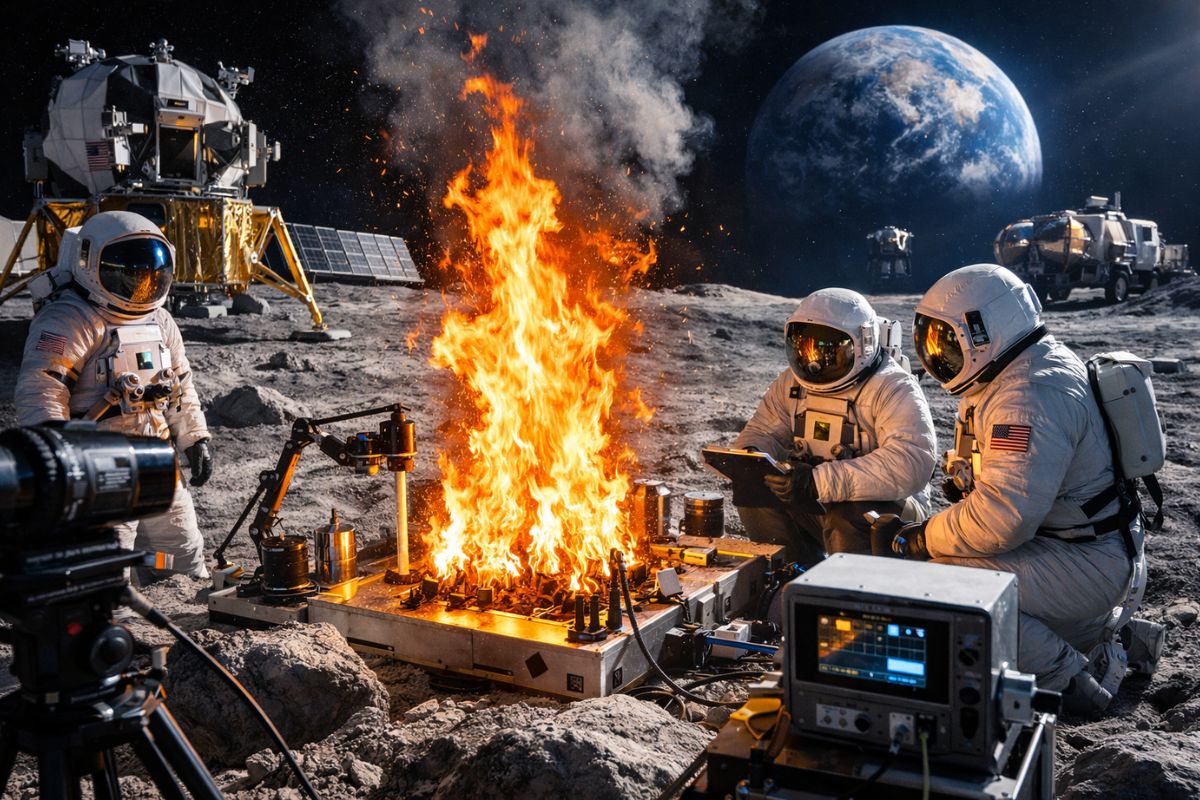

NASA FM2 test will light fire on the Moon with four solid fuel samples and record flames in lunar gravity to guide materials for the Artemis program
The fire on the Moon will be caused by NASA in an unprecedented experiment called Material Flammability on the Moon (FM2), aimed at observing and recording how flames behave in lunar gravity and generating reference data for safety in crewed missions.
The test is planned to be launched by the end of 2026, will focus on four solid fuel samples, and will take place in the lunar environment, as the Artemis program advances following the Artemis 2 milestone and the preparation for future stages.
What NASA wants to discover with fire on the Moon
The FM2 proposal is simple in concept and critical in practice: to create a real database on flammability in partial gravity, something that does not yet exist outside of Earth. The team describes that the tests should provide reference data and integrate a larger effort to understand how lunar gravity alters the flammability of materials.
-
15-Year-Old American Builds Ocean Generator with PVC Pipe and 3D-Printed Propeller for $12, Wins National Prize, Presents at White House, and Makes Forbes 30 Under 30 List

-
$12 Billion Invested in AI Data Centers in Semi-Desert Mexican State, But 17 of 18 Municipalities Now Face Water Shortages, Residents Receive Water Only 3 Days a Week
-
How Much Does Starlink Satellite Internet Cost for Cars, Trucks, and RVs? Prices for Antenna, Accessories, and Plans

-
Scientists Convert Food Waste into Aviation Fuel, Successfully Test 50% Blend with Conventional Kerosene to Cut Emissions and Promote Sustainable Flights


In practice, fire on the Moon could reveal differences that are currently only estimated with models and indirect evidence. And this gap matters because fires in space missions can be catastrophic when the behavior of flames changes.
Why fire behaves differently off Earth

On Earth, a small flame tends to take on a shape similar to a drop due to the hot gas rising and the action of gravity on the cooler, denser air. This movement does not occur in the same way in microgravity, where flames can become more rounded and spherical.
That is why NASA has accumulated years of research on combustion in space and established tests to select suitable materials, such as NASA STD 6001B, used to evaluate what can or cannot be employed in space flights.
How the FM2 test will be until the end of 2026
According to the FM2 report, the mission aims to launch four solid fuel samples and record the characteristics of flames for an extended period under lunar gravity. The idea is to move beyond assumptions and measure, with direct data, how fire evolves on the Moon and what patterns emerge in partial gravity.
In addition to improving risk assessment, this helps translate science into engineering: which materials become safer, which require new requirements, and where protocols need to be adjusted.
The critical point: lunar gravity may be more dangerous
Even with NASA’s extensive research on flammability in space, researchers admit that there is still only a rough estimate of how current knowledge applies to lunar missions.
In the FM2 document, the team points out an important concern: the lunar gravity may be more dangerous in certain partial gravity environments, as the flame propagation rate may be a function of gravity peaks.
This warning also connects to the design of essential systems, with implications for the design of space suits and material decisions in modules and equipment, in a scenario where any delayed response could be costly.
How fire on the Moon connects to the Artemis program
The timing of FM2 is considered particularly relevant because the Artemis program is evolving: after Artemis 2, NASA officials began to announce Artemis 3, which is expected to conduct more preliminary tests before missions that take humans to the Moon in future stages of the program.
And there is a clear cycle in this path: if FM2 works, Artemis crews gain a real layer of safety; if Artemis expands lunar presence, science learns even more about the physics of fire beyond Earth, which feeds back into new design decisions.
What comes after FM2
Engineers are also aiming for an even more direct goal: material qualification tests on the lunar surface itself. However, in the latest report, researchers acknowledge that this may not be possible until there is a prolonged human presence on site.
Until then, fire on the Moon from FM2 serves as a bridge: a practical experiment, with prolonged measurements, to reduce uncertainties that are still significant today when it comes to fire in partial gravity.
Should fire on the Moon become a mandatory test before any crewed Artemis mission advances to longer stays?