






 Portuguese
  Spanish




NASA releases Rosalind Franklin, rover on Mars, and highlights Artemis 2 after the Orion heat shield shows good condition.
The NASA has opened two fronts that stir the imagination of anyone: it has released the implementation of the Rosalind Franklin mission, a rover designed to hunt for signs of life on Mars, and it also received good news from the other side of space, with the heat shield of the Orion capsule showing good condition on the return of Artemis 2.
The contrast is striking. While NASA plans to place a laboratory on wheels on Martian soil, it is also practically reviewing the component that determines whether a spacecraft returns home intact after facing extreme temperatures. The details of both projects help to understand why the next step could be decisive.
Rosalind Franklin Mission: the green light to hunt for life on Mars
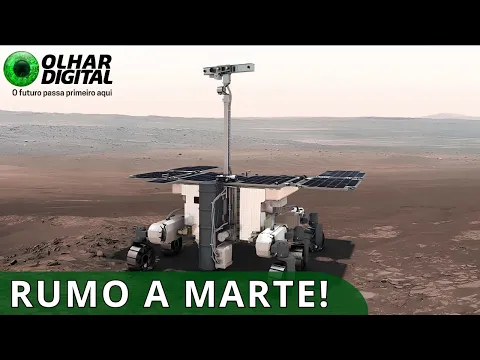
The NASA has received authorization to proceed with the implementation of the Rosalind Franklin mission, developed in partnership with the European Space Agency. The launch is scheduled for the end of 2028, and the promise is straightforward: to take to Mars the first rover aimed at searching for signs of past or present life.
-
China Develops Custom 140-Ton Electric Mining Truck with 770 kWh Swappable Battery, Deploys 290 Units in Xinjiang’s Largest Zinc Mine

-
Meta to Launch Arena, a New Prediction App Targeting 3.56 Billion Users, Competing with Polymarket and Kalshi

-
Scientist Challenges Famous Human Evolution Theory, Argues Homo Sapiens Evolved Gradually Over Thousands of Years
-
15-Year-Old American Builds Ocean Generator with PVC Pipe and 3D-Printed Propeller for $12, Wins National Prize, Presents at White House, and Makes Forbes 30 Under 30 List




The landing is planned for the Oxiaplano region, with the mission targeting the most valuable point of all: Martian soil. According to the NASA statement, the central objective is to analyze samples in search of possible traces of biological activity. And this changes the game because it is not just about “seeing” Mars, but investigating what may have truly happened there.
Who does what in the partnership and how the rover is supposed to get there
The overall coordination of the project will be with the European Space Agency, including the development of the rover and the landing module. The NASA will provide technical support through the Rosalyn Franklin support and assistance project, taking care of stages such as launch system planning, engines, and essential components.
The equipment will be sent by the Falcon Heavy rocket from SpaceX, launching from the Kennedy Space Center in Florida, linked to NASA. The most interesting piece is what will go inside the rover: high-precision scientific instruments, including equipment aimed at identifying chemical substances in the collected samples. The question is simple: what will the soil reveal when it is “read” up close?
What scientists hope to discover in Martian soil
The expectation is that the data will help deepen the understanding of Mars’ geological evolution and the possibility that the planet once hosted conditions favorable to life. If the rover finds chemical patterns and consistent signals, the discussion shifts to another level, because this could also guide future missions and exploration decisions.
In practice, NASA wants to turn curiosity into evidence. And when an agency talks about “past or present,” the message is clear: the search is not symbolic, it is investigative. The kind of investigation that captivates the entire world in the coming chapters.
Artemis 2: the thermal shield test at the most critical moment
While planning Mars, NASA also closely analyzed a sensitive point of the Artemis program: reentry. On the return of Artemis 2, the Orion capsule faced one of the most critical stages of the mission, descending at extremely high speed and encountering external temperatures of about 2,800ºC due to friction with the air.
This is where the deciding piece comes in: the thermal shield. It prevents the interior of the spacecraft and its components from being affected by intense heat. In Artemis 1, in 2022, this same type of shield showed a level of wear above expectations, which led to analyses and discussions among engineers and specialists. Nevertheless, NASA maintained the design for Artemis 2. And the difference was in the way of returning.
Why the reentry of Artemis 2 was different and what that changed

In Artemis 2, the reentry trajectory was steeper. As a result, Orion was exposed to peak heat for a shorter time, reducing the thermal load on the structure. After landing in the ocean, the visual inspection brought relief: the thermal shield showed good overall condition, with only small areas of charred material near the connection region with the spacecraft structure.
NASA will still conduct more complex analyses in the coming weeks to understand the performance in detail. But the initial result already conveys an important message: the protection that was concerning in Artemis 1 now returns with a more controlled scenario. And this always raises another question.
What comes next in the Artemis program and why it matters
With Artemis 2 marking an important stage in the evaluation of this type of protection, NASA is moving on to the next phases of the program. Artemis 3 is expected to test the integration between the Orion capsule and the landing modules developed by private companies in Earth orbit. Meanwhile, Artemis 4, scheduled for 2028, is expected to mark the return of astronauts to the lunar surface, landing in the Lunar South Pole region.
In parallel, the idea of creating conditions for permanent bases on the Moon is also gaining traction. A demonstration mentioned in this context was the presentation by the company Maxpace of a scaled-down version of an expandable space habitat, designed as part of a new architecture for commercial stations in low orbit, with ground tests and demonstrations in space still this decade, aligned with the timelines of NASA. The race now is not just to arrive, but to stay.
In your opinion, is NASA closer to finding signs of life on Mars or to turning the Moon into the next human address?





