






 Portuguese
  Spanish


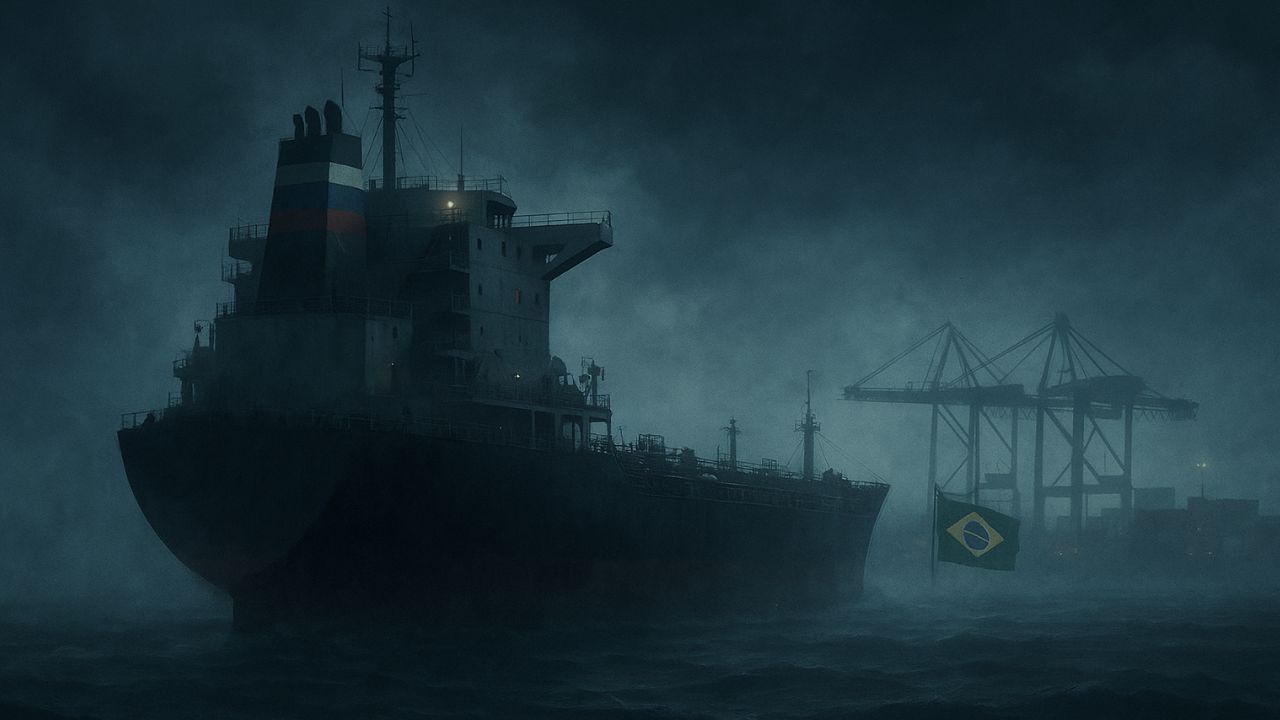


Investigations Reveal That Russian Ghost Ships Continue Bringing Oil and Fuel to Brazil, Even Under International Sanctions.
Russian ships classified as part of the so-called “ghost fleet” continue to arrive in Brazil with oil and fuel since August 17, 2022, the date of the first recorded docking in Santos.
The practice occurs even after sanctions imposed by the United States, European Union, and United Kingdom against these vessels, which gained notoriety during the Russia-Ukraine War.
The investigation conducted by BBC News Brasil, released in September 2025, revealed that at least 36 Russian ships from this fleet operated in Brazilian ports between February 2022 and July 2025.
-
With a record production of nearly 3 million barrels per day, Petrobras resumes importing diesel in July, highlighting the bottleneck in Brazilian refining.

-
Qantas and Airbus Invest in Company Aiming to Convert Unsorted Household Trash into Jet Fuel

-
Brazil’s ANP Opens 86 New Oil Blocks in the Equatorial Margin, Expanding the Amazon River Mouth Frontier

-
OPEC+ Boosts Oil Supply by 188,000 Barrels per Day in July 2026, Leading to Price Drop from $112 to $89 per Barrel in Under Two Months
They unloaded fuels at terminals like Paranaguá (PR) and Santos (SP), taking advantage of the fact that Brazil has not adhered to international sanctions.
What Is Putin’s “Ghost Fleet”?
The term “ghost ship” is used by experts to identify oil tankers that navigate with the Automatic Identification System (AIS) turned off, making them difficult to track.
Moreover, these vessels often change flags, names, and ownership frequently, making it nearly impossible to hold their owners accountable in case of environmental accidents.
According to Alexander Turra, a professor at the USP Institute of Oceanography:
“The ships of the ghost fleet are older, often lacking adequate insurance, and in the event of an accident, it would be extremely difficult to claim damages.”
This network of ships emerged after the price cap of US$ 60 per barrel imposed by the G7 on Russian oil in 2022.
To circumvent this measure, Moscow began using tankers registered under flags of convenience and companies based in tax havens, directing fuels to countries that have not adhered to the sanctions, such as Brazil, India, Turkey, and China.
Brazil as a Safe Port
Between 2022 and 2025, Russia established itself as the largest supplier of diesel to Brazil, accounting for about 60% of imports.
The movement began even during Jair Bolsonaro’s government, which publicly announced negotiations with Vladimir Putin in June 2022 to bring cheaper fuel to the country amid rising prices.
The imported volume surged from US$ 100 million in 2022 to US$ 5.4 billion in 2024, according to the National Agency for Waterway Transportation (Antaq). By July 2025, it had already reached US$ 3.07 billion in Russian fuels.
Under Lula’s government, the flow intensified. During a visit to Moscow in May 2025, the president reaffirmed the strategic importance of the energy partnership with Russia.
Diplomatic, Economic, and Environmental Risks
Experts warn that the presence of these Russian ships in Brazil could lead to serious consequences. From an environmental perspective, the risks involve oil spills or large-scale accidents.
In diplomatic terms, Brazil could be targeted for reprisals. Researcher Benjamin Schmitt from the University of Pennsylvania stated:
“Any company doing business with these vessels is financing Russia’s illegal invasion. This could make Brazil a target for secondary sanctions from the United States.”
Similar cases have occurred in other countries, such as India, which was sanctioned in August 2025 for maintaining business with Russian fuels outside the price cap.
Sanctioned Russian Ships Operating in Brazil
Despite international prohibitions, at least six sanctioned ships have unloaded fuel in Brazilian ports after 2024.
Among them is the Manta, a vessel that changed flags six times since 2022 and unloaded 17,200 tons of diesel in Suape (PE) in July 2025.
Another example is the NS Pride, a ship mentioned by Bolsonaro in 2022 when announcing the arrival of 35 million liters of diesel. Renamed Prosperity, it was included in the sanction lists of the U.S. Treasury and the European Union in 2024.
The Brazilian Dilemma
Authorities such as the Navy, Federal Revenue, and Antaq claim they have not received instructions to block Russian ghost fleet ships.
Jurists, such as Professor Ingrid Zanella (UFPE), argue that if the documentation is in order, there is no legal basis to prevent the entry of these vessels.
On the other hand, energy and environmental experts insist that the risks go beyond legality, impacting Brazil’s diplomatic image and exposing the country to international sanctions.








Vcs só pensam em política…. Mas não vêem que é uma guerra e tem um culpado e os EUA usa o mercado para punir o agressor… Infelizmente tem que puxar a sardinha para políticos extremistas!!!
Eu acho que essas acusações precisam de confirmação, provas. Atualmente os EUA estão buscando e inventando – inventando – pretextos para sabotar o governo brasileiro, com o fim de forçar o Brasil a voltar a ser seu subordinado. Os EUA estão tentando armar mais um golpe contra o Brasil.
Por que não comprar da forma que o mundo compra. O problema é quando internamente colocam o pais numa classe onde excepcionalidades devem ser obedecidas, num tipo de subordinação que serve aos interesses daqueles grupos de paises que se beneficiam das mesmas praticas, mas que ditam suas regras de excepcionalidade para aqueles que julgam seus subordinados. O Brasil faz bem em garantir seus interesses, adotando a mesma postura corrente no mundo da politica hipocrita internacional.