Portuguese
  Spanish


What looks like a wall of cotton rolling through the sky is one of the planet’s rarest and most predictable atmospheric phenomena, a giant wave of air that behaves like a tide and only appears almost on schedule in an isolated corner of Queensland
The Morning Glory is a cloud that defies common sense: a white cylinder that can stretch for hundreds of kilometers, moves alone through the sky, and almost always arrives at the same time of year, at dawn, in a remote part of northern Australia. From afar, it looks like a roll of cotton pushed by an invisible hand.
The most impressive thing is not just the size, it’s the regularity. While almost every extreme phenomenon is unpredictable, this cloud appears with such seasonal punctuality that it has become a pilgrimage destination for a peculiar group of adventurers: pilots who travel the world just to fly close to it.
A cloud wall that walks alone through the sky
The view is breathtaking. According to Weatherzone, it is an immense roll-shaped cloud that forms in the far north of Queensland and over the Gulf of Carpentaria, becoming famous precisely in the Burketown region.
-
Switzerland Maps Light Patterns to Track Snowmelt and Forest Microclimates with 10-Meter Precision

-
Scientists Race to Harness Vast Underground Energy for Clean Electricity
-
23andMe Convinced 15 Million to Share Genetic Data, Went Bankrupt in 2025, and Auctioned DNA Database for $305 Million

-
Firefly Aerospace Becomes First Private Company to Successfully Land Lunar Module Upright on the Moon


The size borders on the unbelievable. According to Weatherzone, in one of the recorded occurrences, the cloud reached almost 300 kilometers in length, moving through the sky like a continuous barrier of cotton that seems to have no end.
And it doesn’t stay still, it travels. A single cloud stretching for hundreds of kilometers and crossing the entire horizon is the kind of scene most people will never see in their lifetime. The scale is otherworldly, but it happens right here on Earth.
Where the phenomenon is almost on schedule
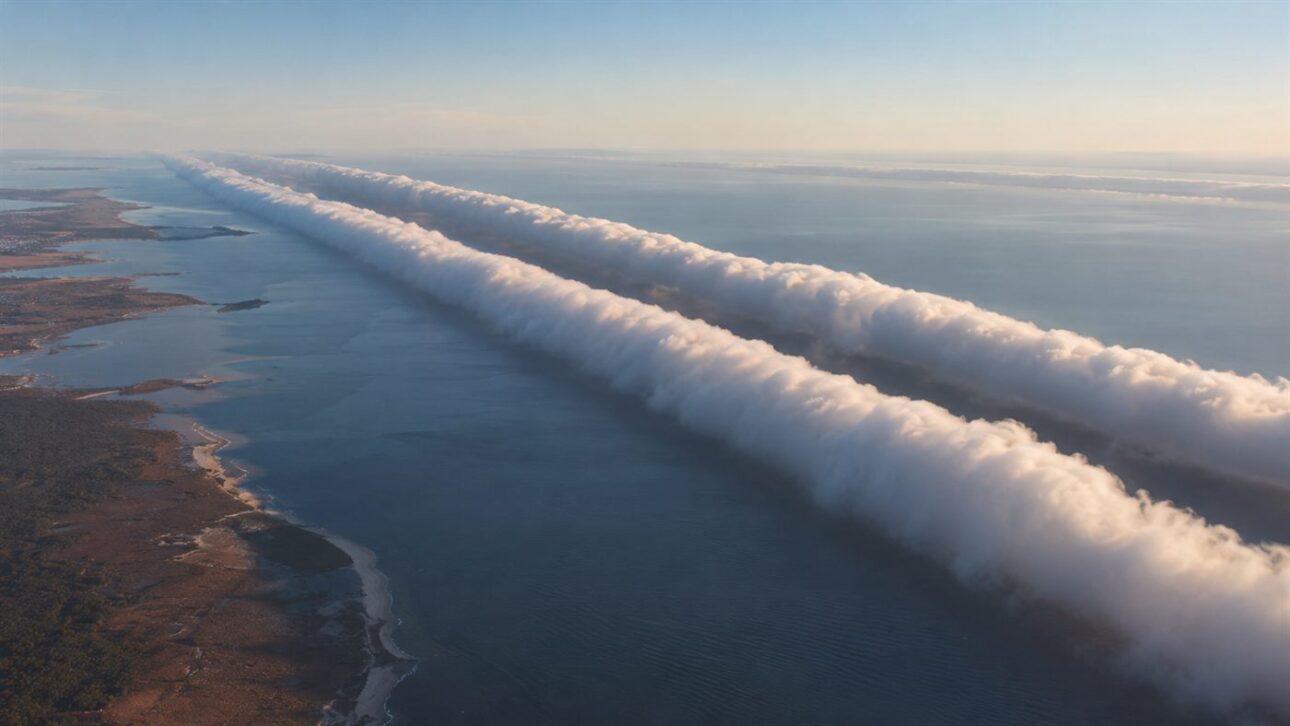
The location is surprisingly specific. According to Gliding Australia, the phenomenon only occurs with some reliability in a single place, the Gulf Savannah region, in northern Queensland, Australia.
The time window is also narrow. According to Gliding Australia, the cloud usually appears between the end of September and mid-October, a short period that concentrates the season and organizes the lives of those who want to see it up close.
This combination is what makes the case unique. Having a rare atmospheric phenomenon that almost always appears in the same place and at the same time is a rarity that nature almost never offers. Burketown has, therefore, become an unlikely meeting point in the middle of nowhere.
How the Morning Glory is born: colliding breezes
The origin lies in the meeting of winds. According to Gliding Australia, the phenomenon forms when opposing sea breezes collide over the Cape York Peninsula, pushing a dense mass of air upwards.
Then comes the domino effect. According to Gliding Australia, with the collapse of this mass of air, it is pushed over the gulf by the trade winds, generating a movement that propagates through the sky like a true wave.
The result is a traveling air wave. It is not the cloud that moves from outside to inside, it is an invisible wave that pushes the air upwards and causes the cloud to form and dissipate as it advances. What is seen is the crest of this wave taking shape.
A “bore” in the sky: the same physics as a river wave
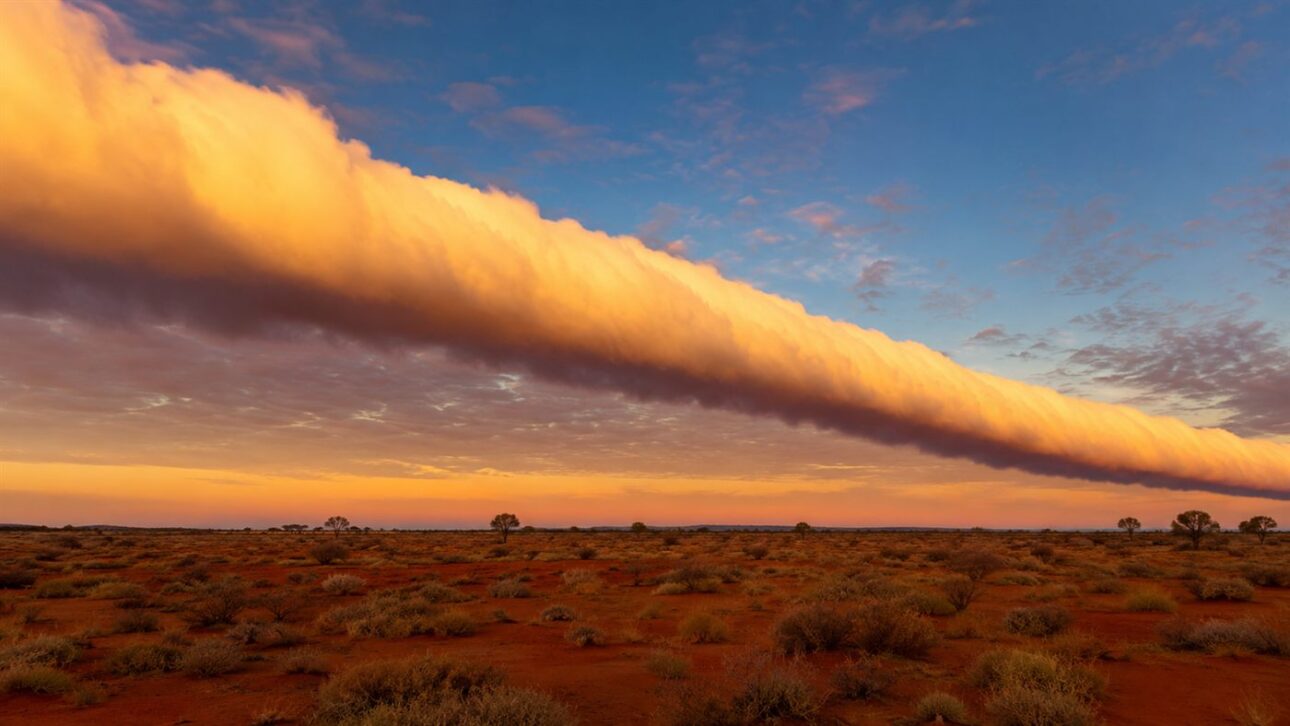
The right comparison is not with the open sea, but with a river. According to Gliding Australia, what forms is a phenomenon similar to a tidal bore, that wave that travels upriver against the current.
Meteorology explains the mechanism in detail. According to Weatherzone, winds blowing from the sea in opposite directions converge over the Cape York Peninsula at night, forcing the air to rise, and this air then descends during the early morning.
The final trigger is a temperature layer. According to Weatherzone, if there is a low-altitude temperature inversion over the Gulf of Carpentaria, this descending air can trigger an atmospheric gravity wave, and it is on the crest of this wave that the cloud takes shape. The cooler air condenses at the top of the wave and creates the white wall; behind it, the air sinks and the sky clears.
Hundreds of kilometers of tube at 20 knots
The speed gives the dimension of the spectacle. According to Gliding Australia, the cloud can extend for hundreds of kilometers across the southern Gulf of Carpentaria and advance at up to 20 knots, maintaining the pace over long distances.
It is a coherent and enduring atmospheric object. According to Weatherzone, the structure behaves like a compact and organized wall, quite different from common clouds that form and dissipate chaotically.
This stability is the key to everything. An air wave so well-behaved that you can follow it for hours is what transforms the cloud from a simple phenomenon into a flight path. The regularity becomes an invitation.
Pilots who cross the world to surf the cloud
Here the story gains human protagonists. According to Weatherzone, the Morning Glory attracts glider pilots from all over the world, who come to take advantage of the updrafts on the leading edge of the immense cloud.
The experience described is almost spiritual. According to Gliding Australia, pilots enjoy a smooth and practically endless lift, flying along a cloud line that extends beyond the reach of sight.
The mechanism of the flight is ingenious. The front of the wave pushes the air upwards, and it is in this current that the glider sustains itself, gliding alongside the cloud like a surfer on the wall of a wave. Except the wave here is made of air and measures hundreds of kilometers.
Men who return for decades after the same wave
The devotion of some pilots is impressive. According to Gliding Australia, among the adventurers who gather in Burketown is Geoff Pratt, who was already on his 24th expedition after the Morning Glory.
Others carry decades of experience. According to Gliding Australia, pilot Bill Olive was celebrating three decades of flights related to the phenomenon, with records dating back to his first hang gliding experiences in 1995.
This return year after year says a lot. When someone returns 24 times to the same remote corner of the planet after a cloud, it’s because it has stopped being a trip and turned into an addiction to beauty. The cloud creates devotees.
An isolated village that became a mecca for flying
The size of the contrast is part of the charm. According to Gliding Australia, pilots come from all over Australia and sometimes from abroad, operating from a controlled-access airport in the middle of one of the most remote regions of the continent.
Burketown does not have the infrastructure of a big city, and that’s precisely the point. A small town lost in northern Australia transforms, for a few weeks a year, into the world capital of a phenomenon that exists nowhere else with the same consistency.
The local economy feels the effect. The cloud season moves the village and puts on the map a destination that, without it, few in the world would know how to point out. Nature, alone, has become a tourist attraction.
Why the Morning Glory fascinates science
The case shows that the sky still holds spectacles that unite beauty and cutting-edge physics. The Morning Glory is, at the same time, a natural work of art and a living laboratory of atmospheric gravity waves, the type of phenomenon that helps scientists understand how air moves on a large scale.
The lesson remains about the value of what is rare and punctual. If a cloud can become a life destination for pilots from all over the world, it is because nature, when it repeats with precision, has a power of fascination that no machine reproduces. The extraordinary, sometimes, has a scheduled time.
And here’s a challenge for you: how many natural spectacles like this are scattered around the planet, just waiting for someone to discover the exact day and place to see them happen?