






 Portuguese
  Spanish


In the Namib Desert, Giant Dunes Produce Low Sounds That Echo for Kilometers. The Mysterious “Singing Dunes” Challenge Explorers and Fascinate Scientists.
Imagine walking among golden sand dunes, with the absolute silence of the desert around you. Suddenly, a deep sound begins to echo, like distant thunder, an airplane engine, or even a ghostly melody. This is not a figment of the imagination: it is the phenomenon of the singing dunes, recorded in only a few places on the planet, and it finds its most impressive expression in the desert of Namibia.
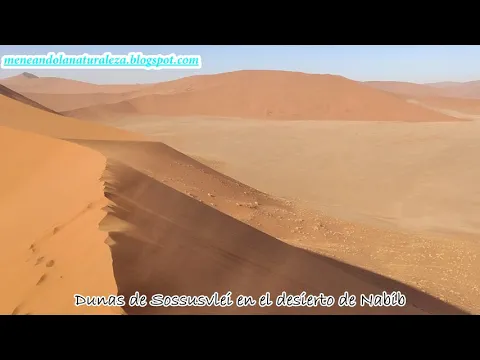
The giant dunes of Sossusvlei, some over 300 meters high, are not just postcard landscapes. They produce natural sounds that can be heard kilometers away, an acoustic spectacle that mixes science, mystery, and poetry.
What Makes the Dunes “Sing”?
The phenomenon is the result of the synchronized movement of millions of grains of sand. When the surface of the dunes slides en masse — whether due to strong winds or the action of a landslide — the particles collide in resonance, producing low-frequency vibrations that propagate through the air.
-
Award-Winning Japanese Restaurant Reveals It Has Preserved Part of the Same Frying Oil for 66 Years

-
American Youth Transforms from Severe Obesity to U.S. Air Force Enlistment, Losing 90 Kilograms in Two Years
-
11-Year-Old Entrepreneur Sells 60 Homemade Sweets Daily, Mastering Cost Calculation, Social Media Promotion, and Client Negotiation Since Age 7

-
Peruvian Mountain’s 5,200 Aligned Holes May Unveil Ancient Indigenous Market for Corn and Cotton



The sound is low, deep, almost hypnotic. Studies show it can reach up to 105 decibels, equivalent to the noise of a rock concert or that of an airplane during takeoff.
The most fascinating aspect is that each dune has a characteristic “tone,” as if they were natural instruments, tuned by the grain size and moisture of the sand.
A Mystery That Intrigued Centuries of Travelers
Reports of “singing” dunes have existed since ancient times. Marco Polo, on his travels through Asia, described the phenomenon as “voices of spirits haunting the deserts.”
Bedouins of the Sahara believed the sounds were messages from gods or warnings from invisible creatures.
In Namibia, European explorers who crossed the region in the 19th and 20th centuries reported hearing “the desert roaring,” unable to explain its origin. It was only in the 20th century that scientists began to rigorously investigate the phenomenon, confirming its physical basis.
The Science Behind the Song of the Sand

Research conducted by French and American physicists showed that the secret lies in the uniformity of the grains. For the dunes to sing, the sand needs to have:
- similar-sized grains, typically between 0.1 and 0.5 millimeters;
- extremely dry surface;
- stable climatic conditions that favor landslides.
When millions of these grains move in sync, they create a coherent acoustic wave. It is the same principle as a choir or a musical instrument, but on a planetary scale.
A Rare Natural Concert in the World
Although similar phenomena have been identified in deserts in California, Mongolia, and the Sahara, Namibia is considered one of the best places on the planet to witness the singing dunes.
The formations of Sossusvlei and Deadvlei gather the perfect conditions: towering dunes, uniform sand, and an extremely arid climate.
For those lucky enough to hear it, the experience is described as mystic. The sound can last several minutes, growing and diminishing in intensity, until it disappears as mysteriously as it began.
From Myth to Technology
Interestingly, the study of singing dunes is of interest not only to geologists and tourists. Physicists and engineers use this phenomenon to better understand granular acoustics, a field that investigates how solid particles produce collective sounds.
This knowledge can have applications in areas such as civil engineering, seismic sensors, and even space exploration, as Mars also has sand dunes that may produce similar sounds.
The Song That Resonates in the Human Imaginary
More than a physical phenomenon, the singing dunes of Namibia are a reminder of the poetic power of nature. In one of the driest places on Earth, where life seems scarce and absolute silence reigns, the sand itself finds a way to manifest.
It is as if the desert has its own voice, holding ancestral memories in every low vibration that resonates through the air. For travelers, it is an unforgettable spectacle.
For science, it is a window to understand the dynamics of the Earth. For humanity, it is a symbol of nature’s ability to surprise us even in the harshest of environments.


