Portuguese
  Spanish


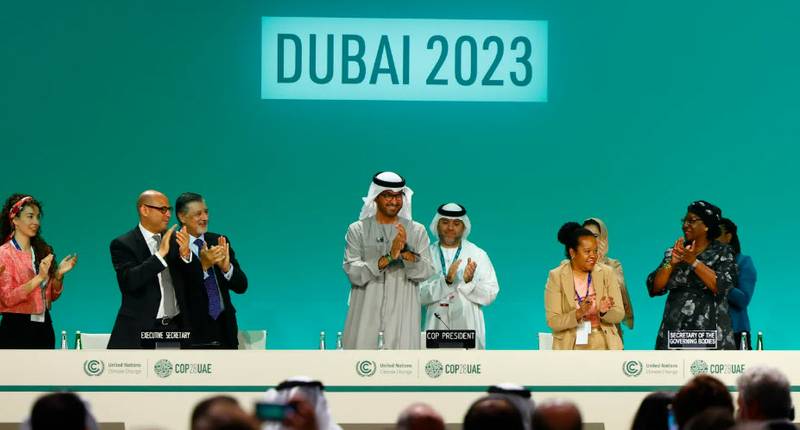

NOIA Responds to the Text Entitled COP28 and Nationally Determined Contributions, Duplicate Energy Efficiency, Net Zero Emissions, Climate Financing, Energy Financing, Credit Rating Agencies.
The COP28 was marked by intense negotiations and finally reached an agreement on a document entitled UAE Consensus, which was approved by the Conference of the Parties. The UAE Consensus represents a significant step toward concrete actions to combat Climate Change and keep the 1.5°C goal within reach. It is an important milestone for the United Nations Conference on Climate Change and a sign of progress in international cooperation to address one of the most pressing challenges of our time.
The UAE Consensus, approved during the COP28, highlights the urgency of phasing out fossil fuels and achieving net zero, encourages the submission of Nationally Determined Contributions across the economy, and sets specific targets for renewable energy and energy efficiency by 2030. In addition, it creates momentum for a new architecture for climate financing, representing a tangible commitment from the parties involved in the conference.
COP28: A New Path to the Future
The UAE Consensus followed a year of inclusive diplomatic commitments and two weeks of intense negotiations. ‘The world needed to find a new path. By following our North Star, we found that path,’ said the COP28 President, Dr. Sultan Al Jaber during his closing speech. ‘We worked hard to ensure a better future for our people and our planet. We should be proud of our historic achievement.’
-
With a record production of nearly 3 million barrels per day, Petrobras resumes importing diesel in July, highlighting the bottleneck in Brazilian refining.

-
Qantas and Airbus Invest in Company Aiming to Convert Unsorted Household Trash into Jet Fuel

-
Brazil’s ANP Opens 86 New Oil Blocks in the Equatorial Margin, Expanding the Amazon River Mouth Frontier

-
OPEC+ Boosts Oil Supply by 188,000 Barrels per Day in July 2026, Leading to Price Drop from $112 to $89 per Barrel in Under Two Months

New Commitments and Challenges
The main commitments contained in the final negotiated text include:
• An unprecedented reference to the transition from all fossil fuels to enable the world to achieve net zero emissions by 2050.
• A significant advance in expectations for the next round of Nationally Determined Contributions, encouraging ‘emission reduction targets across the economy.‘
• Creating momentum behind the financial architecture reform agenda, recognizing for the first time the role of credit rating agencies and calling for an expansion of concessional services and grant financing.
• A new and specific target to triple renewable energy and double energy efficiency by 2030.
• Acknowledging the need to significantly scale up adaptation financing beyond doubling to meet urgent and evolving needs.
Role of Ocean Industries in the COP28 Pact
The President of the National Ocean Industries Association (NOIA), Erik Milito issued the following statement regarding the non-binding pact:
‘The goals set by COP28 underscore the fundamental role of the American offshore industry in achieving the objectives of mitigating climate change while enhancing global living conditions.
‘As global energy demand continues to rise, the reality is the need for all energy sources to remain in the foreseeable future in order to effectively meet the energy security needs of a growing global society. The U.S. Offshore is uniquely positioned to provide the energy sources on which Americans depend for a high quality of life while providing a roadmap to address emissions.
‘The U.S. Gulf of Mexico consistently demonstrates the ability to produce oil and natural gas with lower greenhouse gas emissions intensity than nearly all other regions. Encouraging the increase in production in the Gulf of Mexico is not only in the national interest but also globally advantageous, avoiding a shift to higher emitting sources to meet… (Original length: 3420 characters).
Source: AtCoMedia, Inc