






 Portuguese
  Spanish
  3 min of reading


Dutch Company Develops New Category of Single Blade Wind Turbine. The Model Is Cheaper, Generates More Power and Even Withstands Winds of Up to 252 km/h.
The installation of offshore wind turbines has emerged as a promising business, as it not only takes advantage of the natural wind coming from the seas but also saves space that would be used on land and potential environmental damage. However, projects in this regard are still trying to balance installation and maintenance costs with energy generation potential. In this way, a new single-blade wind turbine emerges promising to be the great solution, costing half the price to generate even more electricity than conventional models.
Touchwind and Its New Single Blade Turbine
This is the single blade wind turbine from the Dutch company Touchwind. Although it has a single blade, where the more well-known ones have three, and lacks sophisticated systems, the project can cost half the amount of a normal installation and still have more power. But how is this possible?
According to the website New Atlas, for this to be possible, the turbine was developed around a single-piece rotor, positioned at the end of a pole that, in turn, is hung from a barrel with a floating buoy below it.
-
Brazilian scientists are simultaneously advancing two research projects on clean hydrogen and driving solutions that could transform the energy matrix, enhance industrial competitiveness, and accelerate large-scale emission reduction targets.

-
Advancement in renewable energy: A R$ 150 million project launched by Petrobras and Finep aims to create state-of-the-art electrolyzers for green hydrogen, strengthening national research and preparing Brazil to compete in a billion-dollar energy market.
-
Illiterate or semi-literate grandmothers were trained to repair solar systems, open rural workshops, and light up homes that still depended on kerosene.
-
The world has bet on green hydrogen as the fuel of the future, but now faces the side effect: producing 1 kilogram requires about 9 liters of ultrapure water, and the largest projects on the planet are precisely in the driest regions of the Earth, where water is already scarce for people.






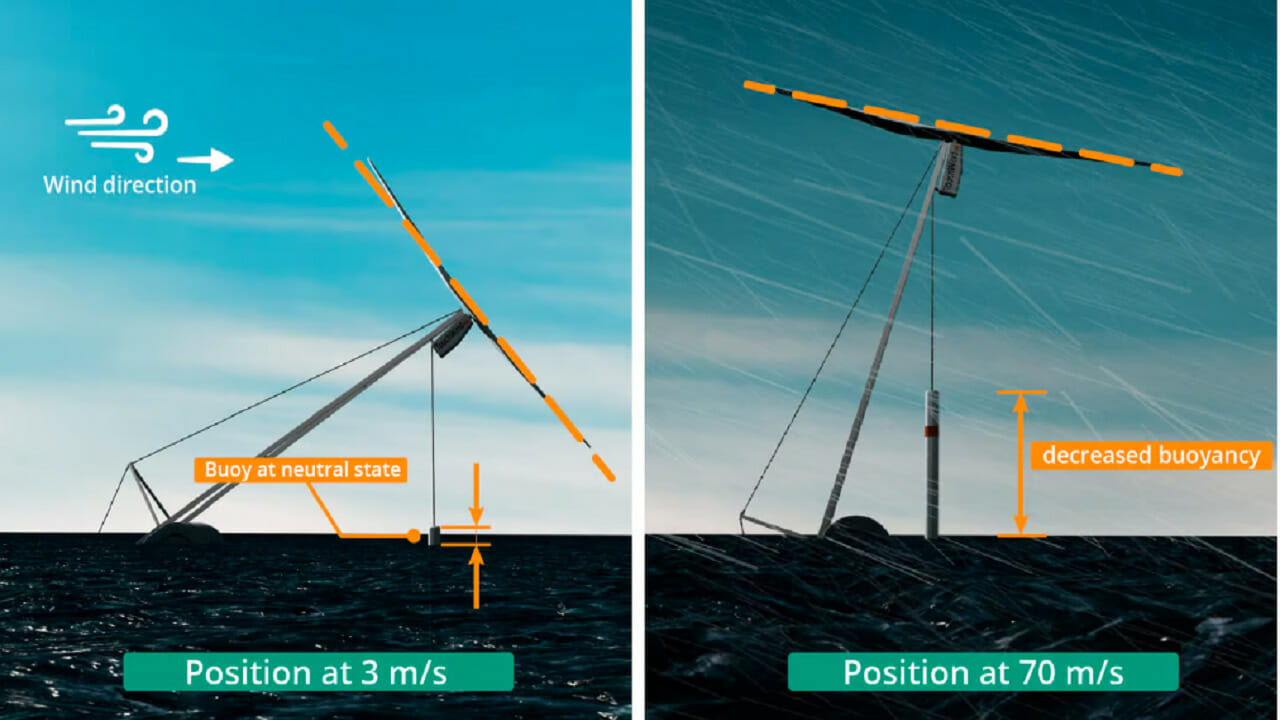
All this structure remains submerged. On the outside of the water, the blade of the wind turbine is fixed to the masts, and both are slightly inclined, always remaining above the surface due to the buoyancy of the buoy. As the wind hits the structure, the blade of the wind turbine starts to rotate and, with the weight and movement, pulls the mast upwards, becoming almost vertical, like the well-known turbines.
New Single Blade Wind Turbine Works with Winds of Up to 252 km/h
The secret of the new wind turbine is the submerged part. With the buoy and ballast supporting the entire structure, there is no risk of the wind turbine being lifted out of the water.
In this way, it can operate in more extreme situations. According to the company itself, while a common structure needs to shut down when the wind exceeds 90 km/h, this single-blade wind turbine can continue working at speeds of up to 252 km/h. With less downtime, more power is generated.
The company has completed the prototypes of the land-based and floating support platforms that make the wind turbine operate, in the Netherlands. It is now expanding tests, which have already received investments from the Japanese shipping company Mitsui OSK Lines. Touchwind estimates that the investments will accelerate the time to launch the turbine in the market; however, it still does not know when it will produce at scale. Therefore, it is not possible to determine how much it will cost and whether it will be commercially viable in the industry.
New Wind Turbines Arrive on the Market
In addition to this new single-blade wind turbine model for the offshore market, inventors Ali El Zaher Buendia and Oscar Garcia developed a project called Bi-Generator Vertical Wind Turbine, which can generate up to 100 MW of energy.
The vertical wind turbine represents a significant advancement in the sector, as it is strategic, optimizing the capacity to capture wind energy, making it more efficient. Additionally, the turbine utilizes a unique blade design that expands torque and rotational speed.
The main advantage of this wind turbine model is its accessibility and practicality. The inventors emphasize that the wind energy equipment is very easy to 3D print and can also be produced artisanal.








Be the first to react!