Portuguese
  Spanish


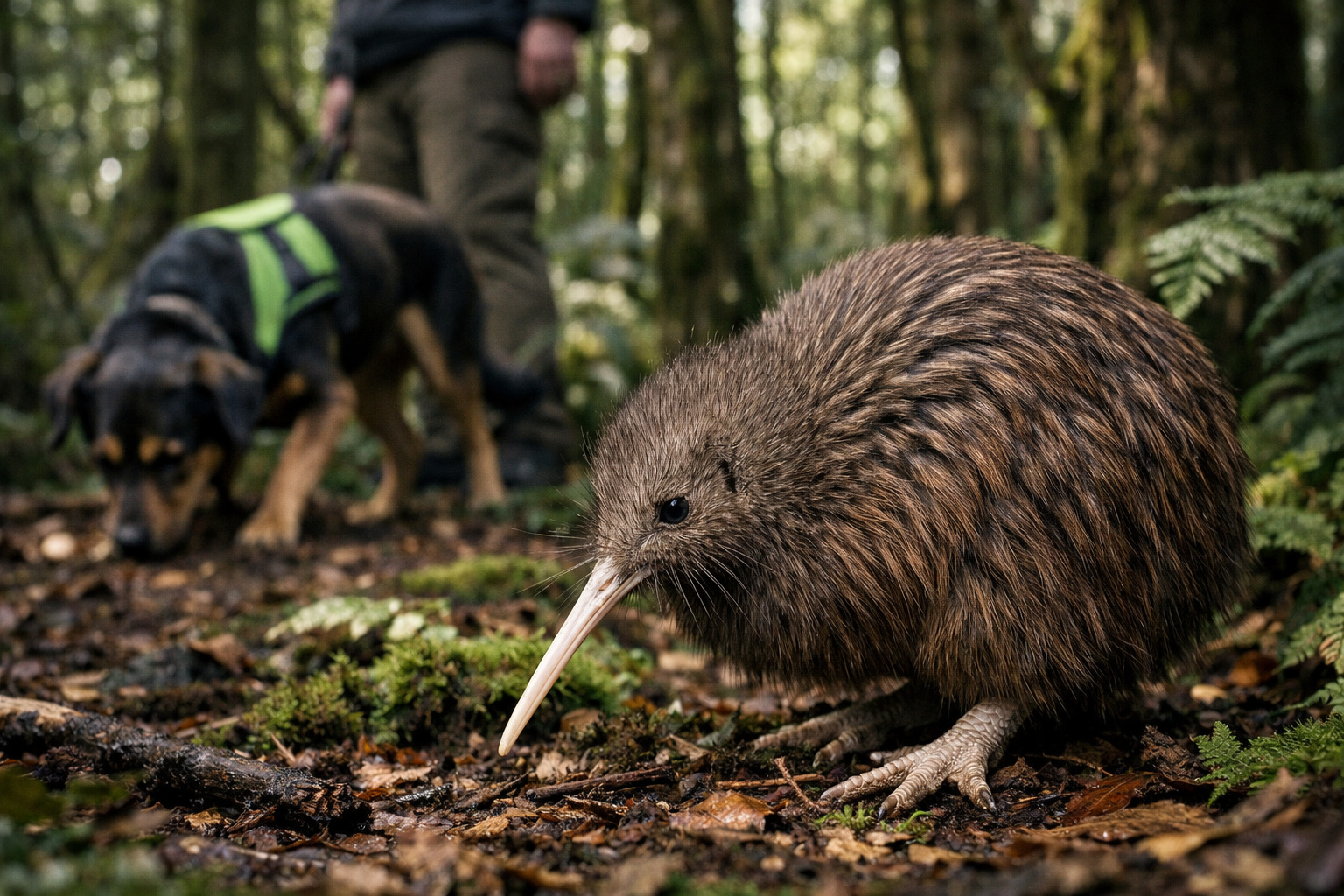


Country That Evolved Without Terrestrial Predators Uses Biological Technology, Scientific Data, and Unprecedented Programs to Prevent the Extinction of the Kiwi, Sacred Bird for the Maori, While Declaring War on Rats, Weasels, Possums, and Feral Cats Until 2050
For millions of years, New Zealand remained almost completely isolated from the rest of the planet. This isolation shaped one of the most unique ecosystems on Earth. It is estimated that around 80% of the country’s plant and animal species are endemic, meaning they do not exist anywhere else in the world. In this scenario, large terrestrial predators simply did not evolve. There were no tigers, wolves, foxes, or wild felines. As a direct consequence, birds came to occupy the center of the ecosystem, many of them without developing any instinct to flee.
It is in this context that the kiwi, the most emblematic bird of New Zealand, emerges. Incapable of flying, slow-moving, nocturnal, and with extremely vulnerable reproduction, the kiwi evolved in a world where fleeing was never necessary. However, when the environment changed abruptly with the arrival of humans and invasive mammals, this same adaptation turned into its greatest weakness.
The information was disclosed by official reports from the Department of Conservation (DOC), as well as scientific studies and public environmental conservation programs developed by the New Zealand government over the past few decades.
-
Farewell to Toilet Paper? New Technology Sparks Debate on Bathroom Habits

-
Young Entrepreneur Who Started Recycling Bottles at Age 3 Becomes Environmental Icon in the U.S.

-
Nivea Blue Tin Cream: Popular Post-Beach and Pool, But Pharmacist Warns About Missing Ingredients and Common Summer Mistakes Regarding UVA and UVB Protection.
-
Archaeologists Recover Colossal Structure Lost for Over 1,600 Years Under the Sea, Including 22 Monumental Blocks Weighing Up to 80 Tons, Intriguing Experts.




The Biology of the Kiwi Explains Why the Species Collapsed So Quickly

The kiwi has existed in New Zealand for millions of years. It does not fly, moves slowly, nests directly on the ground, and lays only one egg at a time, which is extremely large and can represent up to 25% of the bird’s body weight. Its lifespan ranges from 25 to 30 years, and the chicks are born fully covered in feathers, leaving the nest about five days after birth without receiving food from their parents.
Despite this, kiwis grow slowly. They take between three and five years to reach sexual maturity and lack a natural instinct to fear predators. From an evolutionary standpoint, they belong to the group of flightless birds, being distant relatives of the emu, cassowary, and moa, the latter now extinct. Currently, there are five species of kiwi, all living exclusively in the wild in New Zealand. This means that if the kiwi disappears from the country, it disappears from planet Earth.
For the Maori people, the kiwi is a taonga, a sacred treasure with profound cultural, spiritual, and historical value. Its feathers were traditionally used in making the korowai, a cloak reserved for tribal chiefs. Today, more than 90 community groups and indigenous tribes are directly involved in protecting the species, preserving around 230,000 hectares of forested areas. In 2024, New Zealand even opened the first hospital dedicated exclusively to treating kiwis, located in Kerikeri, an area that houses around 10,000 brown kiwis.
Introduced Predators Created a Cascading Effect That Led to the Extinction of Over 90% of the Population


It all started in the 17th century, with the arrival of Europeans. Along with humans, cats, dogs, rats, weasels, possums, and other mammals were introduced to the archipelago, which had not existed in that ecosystem until then. For a fauna that had evolved for tens of millions of years without terrestrial predators, the impact was devastating.
Historical estimates indicate that millions of kiwis lived scattered across New Zealand. By 1998, that number had dropped to less than 100,000 individuals. Just ten years later, in 2008, the population plummeted to around 70,000 kiwis. In just over a century, more than 90% of the total population disappeared.
The data explains this rapid decline. The kiwi cannot fly, does not run agilely, and does not have a body structure to withstand impacts. A single dog bite can cause fatal fractures or internal bleeding, leading the animal to death in a matter of minutes. For the chicks, the threat is even greater. About 70% of young kiwis die as a direct result of attacks by weasels and feral cats, with weasels responsible for most of the deaths.
Rats, in turn, rarely kill adult kiwis, but play a systemic role in the population collapse. They compete for food, weaken the chicks, and, above all, serve as the primary food source for weasels. When the rat population grows, the weasel population grows alongside it, intensifying predation. This phenomenon is known as ecological cascade effect.
The reproductive numbers reinforce the gravity of the situation. About 50% of kiwi eggs do not hatch. Among the chicks that are born, 90% die in the first six months of life. Only 10% survive beyond that period, and 5% or less reach adulthood — one of the lowest survival rates ever recorded among birds.
Why New Zealand Decided to Use Dogs to Save a Species That They Themselves Threaten
Given this critical scenario, New Zealand attempted fences, traps, poisons, and isolated areas. However, with dense forests, steep terrain, and hundreds of islands, total control proved unfeasible. It was then that an unimaginable decision emerged: to use dogs to save the kiwi.
The proposal faced strong public rejection. After all, dogs were seen as one of the biggest threats to the species. An incident that occurred in the late 1980s marked the history of conservation in the country, when a single out-of-control dog exterminated dozens of kiwis in just a few nights, virtually eliminating an entire local population.
Even so, scientists chose to act based on data. The central question was simple: why do humans fail to find kiwis while dogs do not? The answer lies in their sense of smell. A dog has between 200 and 300 million olfactory receptors, while humans have only 5 to 6 million. The kiwi leaves a characteristic chemical signature, detectable even under layers of soil and leaves.
Between 1991 and 1994, the Department of Conservation (DOC) officially launched two programs: Kiwi Aversion Training and the Conservation Dogs Program. The goal was extreme: to preserve the smelling ability while completely eliminating any hunting behavior.
The selection process is rigorous. Breed is not determinative, but temperament is decisive. Impulsive dogs, with a strong chasing instinct or difficulty stopping actions, are discarded. The approved ones exhibit high concentration, low impulsivity, and absolute control over human commands. The training follows a strict sequence: detect, stop, and signal, without any physical contact with the kiwi.
Operation Nest Egg and Predator Free 2050: The Strategy That Changed Extinction Statistics
In parallel, in 1994, the DOC launched Operation Nest Egg, focused on the most vulnerable period of the kiwi’s life: from egg to chick. With the help of conservation dogs, nests are accurately located. When the risk of predation is high, eggs are selectively removed and artificially incubated.
After hatching, the chicks are raised in predator-free areas for 6 to 9 months until they reach about 1 to 1.2 kg, enough weight to withstand weasels and cats. The results are considered historic. Before the program, only 5% of kiwis reached adulthood. Afterward, the rate rose to 60 to 70% in protected mainland areas and 80 to 90% in predator-free islands.
Still, the population continues to decline by about 2% per year without ongoing intervention. Therefore, New Zealand announced the ambitious Predator Free 2050 plan, aiming to eliminate more than 30 million invasive predators, including rats, weasels, and possums, by 2050. It is the first country in the world to officially declare this goal.
The history of the kiwi shows that environmental conservation is neither simple nor linear. But every surviving bird proves that science, discipline, and responsibility can reverse deep ecological tragedies.
If science has already shown that it is possible to reverse the collapse of a species on the brink of extinction, how far do you think countries should go to save their native fauna before it is too late?