Portuguese
  Spanish



Luxembourg Students Develop Innovative Electrocaloric Air Conditioner That Promises To Deliver Nearly Twice The Efficiency Of Traditional Models.
Based on a phenomenon known as electrocaloric cooling, a new system, similar to a heat pump, promises to revolutionize heating and cooling in environments. This innovative electrocaloric air conditioner offers nearly twice the efficiency of conventional units. In the following paragraphs, we will explore the various advantages this advanced system brings.
New Electrocaloric Air Conditioner Delivers Twice The Efficiency Of Traditional Models
Among the advantages of this new air conditioner is that it has no moving parts that wear out and require maintenance, does not use harmful refrigerants, and, as a result of the above factors, consumes much less electricity.
Most air conditioning units and refrigerators operate based on the compression and expansion of a fluid, which absorbs or releases heat as it migrates between environments with different pressures.
-
Brazil Constructs First Japanese SABO Barrier in Nova Friburgo to Prevent Landslides, a $3 Million Concrete Trap for Rocks, Logs, and Mud

-
Brazilian Navy’s Technology Plays Strategic Role in Future of Small Modular Reactors, Boosting Nuclear Energy Capacity with Innovative Solutions for Power Generation and Industrial Applications

-
China Surpasses U.S. and Russia Combined in Submarine Production
-
Xiaomi Unveils Smart Glasses in Brazil with 12MP Camera, 4K Video, and AI Features, Challenging Ray-Ban Meta


Despite these systems being relatively cheap and simple to produce, they are not very efficient, meaning they consume a lot of energy for the service they provide; about one-fifth of the electricity used in buildings worldwide goes to cooling and air conditioning.
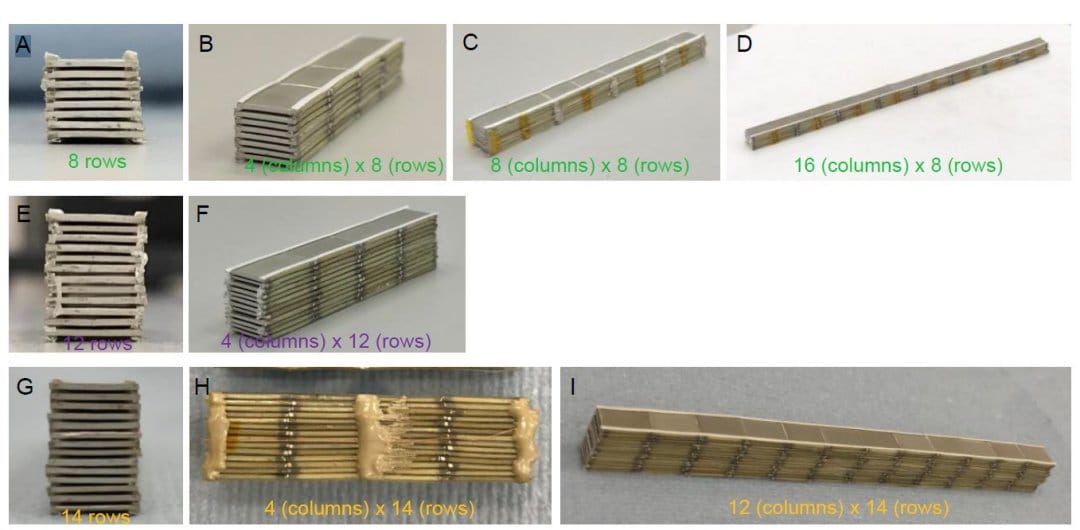
[Image: Junning Li et al. – 10.1126/science.adi5477]
Now, Junning Li and colleagues from the Luxembourg Institute of Science and Technology have developed a refrigerant-free cooling device made of metals that include lead, tantalum, and scandium.
The new electrocaloric air conditioner’s system can achieve maximum efficiencies of over 60%, which is nearly double the efficiency of typical household air conditioning units. The technology is based on a principle called electrocaloric cooling, which occurs when a temporary increase in temperature is followed by a subsequent decrease when the electric field is removed.
Understand How The New Electrocaloric Air Conditioner Works
The prototype of the new cooling system consists of a stack of eight strips of a material known as lead tantalate and scandium, which is electrocaloric. This stack was immersed in a heat transfer fluid, silicone oil.
When an electric field is turned on, it causes the strips to heat up, forcing the fluid to move to the right; when the material cools down, the fluid moves to the left, generating permanent regions of hot and cold, with about a 20 °C difference.
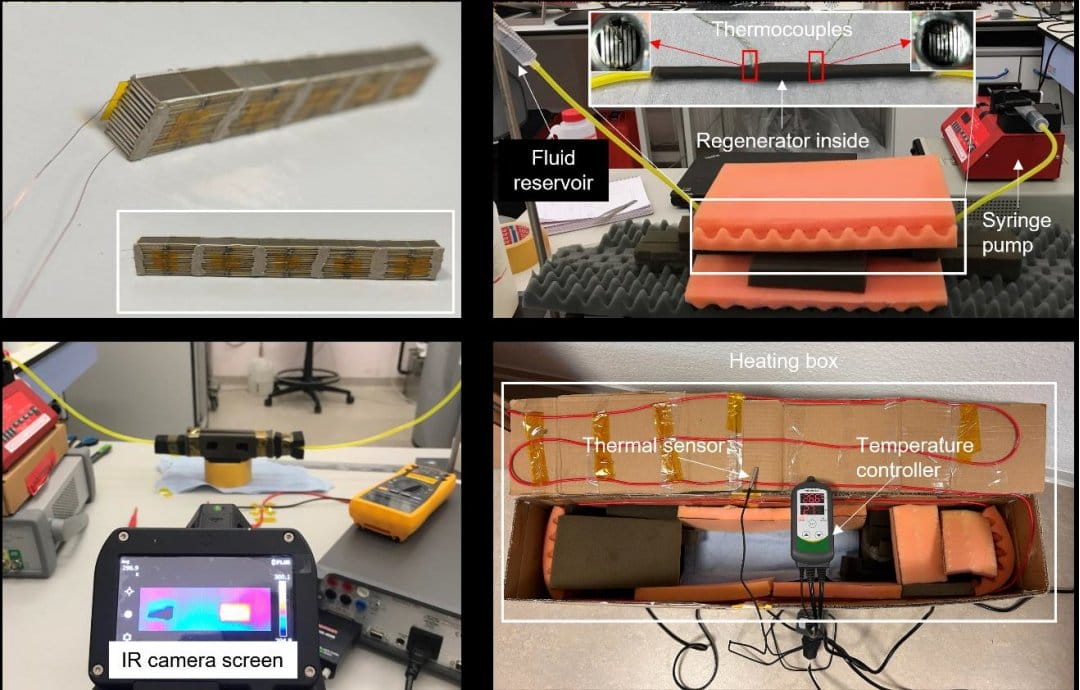
[Image: Junning Li et al. – 10.1126/science.adi5477]
These regions are used as hot and cold reservoirs, from which the oil can circulate through pipes to cool or heat rooms or objects. Although the efficiency of the device is theoretically 67%, the current prototype achieves about 12% efficiency. The researchers hope to get closer to the theoretical maximum by seeking a thermal conductor better than lead tantalate and scandium.
Researchers At MIT Develop Air Conditioner For Personal Use
In addition to this new electrocaloric air conditioner, researchers at the Massachusetts Institute of Technology (MIT) have developed a cooling bracelet called Wristify, an innovation that promises to provide waves of cold or heat directly to the user.
The functioning of the device is smart, featuring a system attached to the bracelet that directs pulses with warm or cold waves directly to the user’s wrist.
According to researchers, by continuously sending these waves to a specific area, they can impact the entire body, taking advantage of human skin’s sensitivity to rapid temperature changes.
According to Sam Shames, the project’s developer, this process creates an illusion that tricks the body into feeling cold or hot at the desired location. This idea could be a great alternative for those without air conditioning at home, potentially playing a role in reducing energy consumption related to building cooling. The bracelet has an autonomy of 8 hours, and the sensors allow for a temperature variation of up to 0.4 °C per second.