






 Portuguese
  Spanish
  3 min of reading
  0 comments


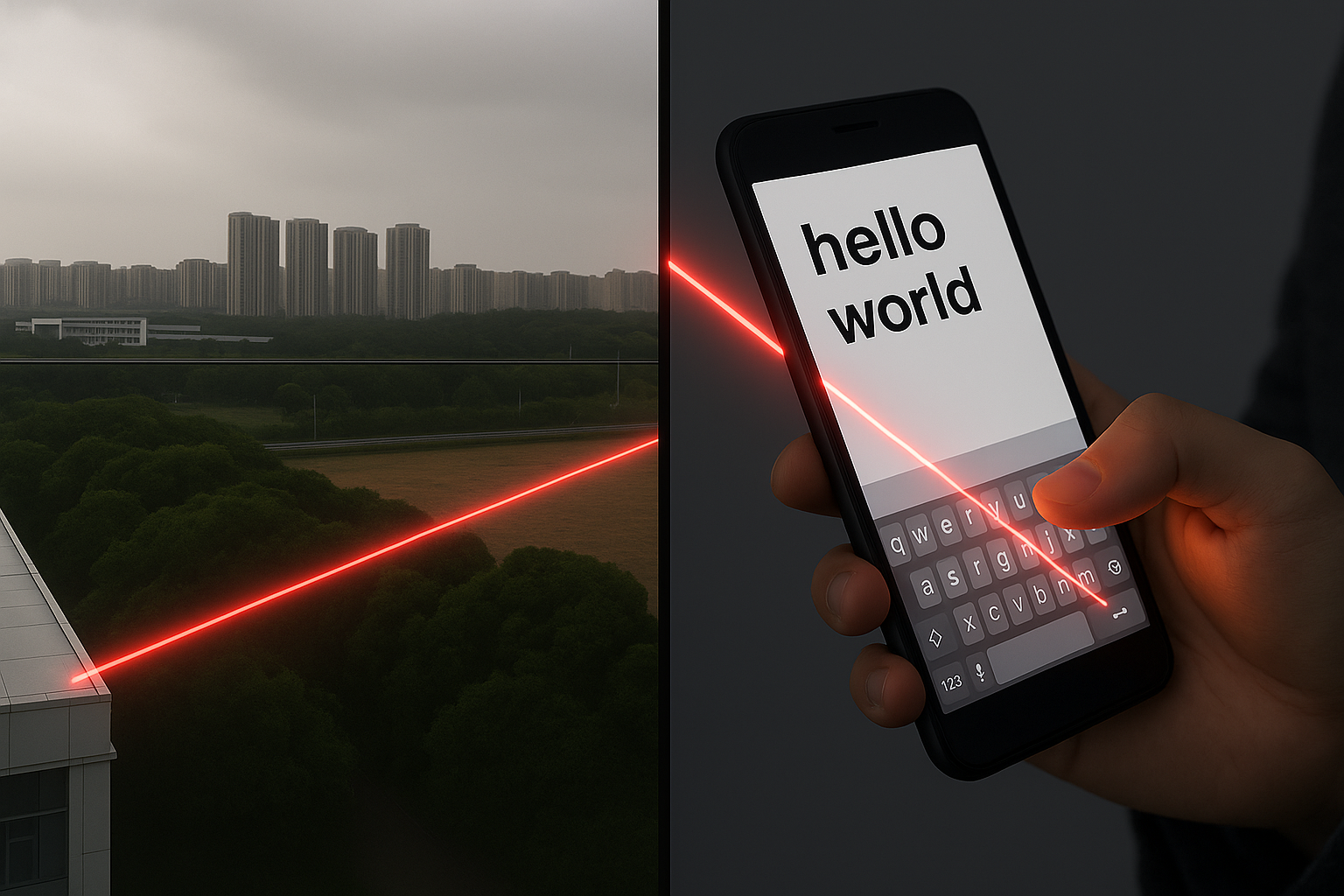
Chinese Technology Uses Laser to Identify Letters from 3 Millimeters to 1.36 Km Away, Surpassing Limitations of Common Telescopes.
Imagine being able to read letters the size of a sesame seed from a distance equivalent to 14 football fields. This is possible with new Chinese laser technology.
It sounds like something out of a spy movie, but that’s exactly what a group of Chinese scientists has achieved.
Using advanced laser technology, they created a system that can decipher tiny details from up to 1.36 km away.
-
Giant crane lifts up to 3,000 tons, requires special logistics to reach the site, and can transform 18-hour operations into just 3 hours, speeding up the hoisting of oil platforms, refineries, and plants in giant industrial projects.

-
A discarded microwave may contain 22-carat gold in internal components; study recovered a 450 mg nugget from electronic boards.

-
Who has the highest IQ: the oldest child, the middle child, or the youngest? A study with 240,000 people published in Science reveals a difference of up to 3.2 points and indicates which position in the family tends to have an advantage.
-
A YouTuber spent almost a year transforming the failed invention into an autonomous flying umbrella: the drone uses a camera and Raspberry Pi to follow the person and protect them from the rain on its own.


New Approach to an Old Challenge
Observing details from afar has always been a challenge. Powerful telescopes and high-precision lens cameras encounter a common obstacle: air distortion.
Light spreads and scrambles during its journey, making it difficult to read small elements like printed text.
To overcome this, researchers adopted a different technique.
Instead of trying to directly capture a perfect image, the new system uses the way light behaves when it hits and returns from a surface.
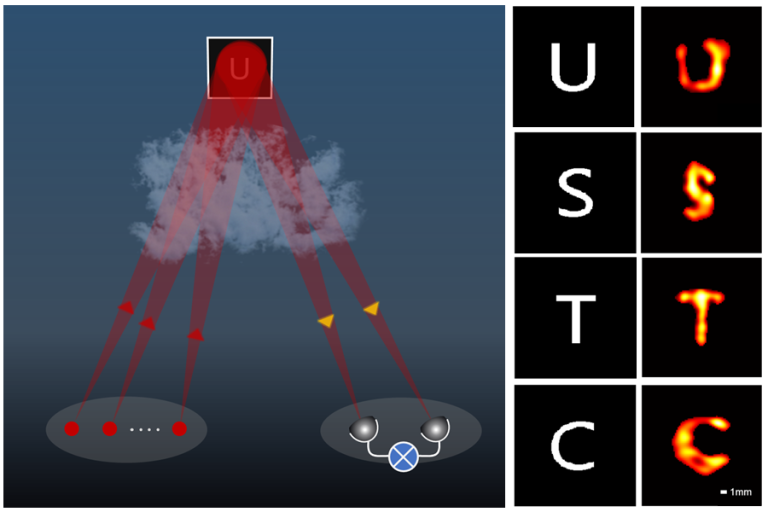
This approach is called Active Intensity Interferometry. In practical tests, scientists were able to clearly reconstruct letters just 3 millimeters high from over a kilometer away.
The average size of a letter displayed in a WhatsApp conversation, on a standard-configured smartphone, is between 2 and 3 millimeters tall on the screen.
This value can vary depending on:
- the model and resolution of the phone,
- the font size set by the user,
- and the operating system.
How the Experiment Worked
The method involves the coordinated use of Chinese lasers and telescopes.
The system uses eight infrared Chinese laser beams, which are fired toward the target. When the light reflects, it is captured by two telescopes positioned a distance apart.
These telescopes do more than just record an image. They track subtle changes in light intensity over time.
The data is then processed by computer algorithms. The result is the reconstruction of tiny details of the object’s surface, including almost microscopic texts.
If a common telescope can only distinguish shapes of at least 42 millimeters at that distance, the new system achieved a resolution 14 times higher, according to the study’s authors.
L.-C. Liu et al.
Possible Applications
This new technology could have uses in various fields. Archaeologists, for example, could study sculptures on high cliffs without needing to climb. Environmental researchers could also observe hard-to-reach habitats.
Nevertheless, the main advantage may be the possibility of remote reading without conventional visual equipment, such as binoculars or cameras. This opens up possibilities for future applications in sectors like security, engineering, and science.
There Are Still Limitations
Despite the advancement, the system is not perfect. It requires precise alignment of the lasers and telescopes, which makes it more complicated to use in moving or unstable environments.
Additionally, there must be direct line of sight with the target, which is not always possible. It is also necessary to illuminate the object with lasers, which can be a problem in situations requiring confidentiality or discretion.
The responsible team is aware of these limitations and is already working on improvements. Among the goals are more precise control of the Chinese laser beams and the use of artificial intelligence to further refine the reconstruction of captured images.
The complete study was published in the journal Physical Review Letters and represents an important step in the evolution of high-precision optical sensors.
With this, what once seemed like a scene from science fiction is now beginning to become a reality.


Be the first to react!