






 Portuguese
  Spanish
  5 min of reading
  0 comments


The creator of the I Build Stuff channel tried and failed in 2024, when his first flying umbrella still needed hand control. Almost a year later, he presented the autonomous version: a drone that hovers alone over a person’s head and follows them in the rain, without anyone piloting. An invention that mixes stubbornness and engineering.
Leaving the house in a storm and not getting even your hair wet, without holding anything, with a device floating alone over your head. It sounds like a scene from a sci-fi movie, but that’s exactly what a viral video on the internet shows, in which the creator of the I Build Stuff channel displays his autonomous flying umbrella in full operation. The invention, which combines a homemade drone with a common umbrella, finally managed to do what it promised: follow the person in the rain on its own.
The most interesting part is not just the result, but the journey to it. This flying umbrella is the second version of a project that initially went wrong. It took almost a year of trial and error, several frustrations, and a good dose of improvised engineering to turn a flawed idea into an invention that really flies and obeys. The story has everything the public loves: a somewhat crazy dream, an initial failure, and a turnaround through sheer persistence.
The invention that started wrong
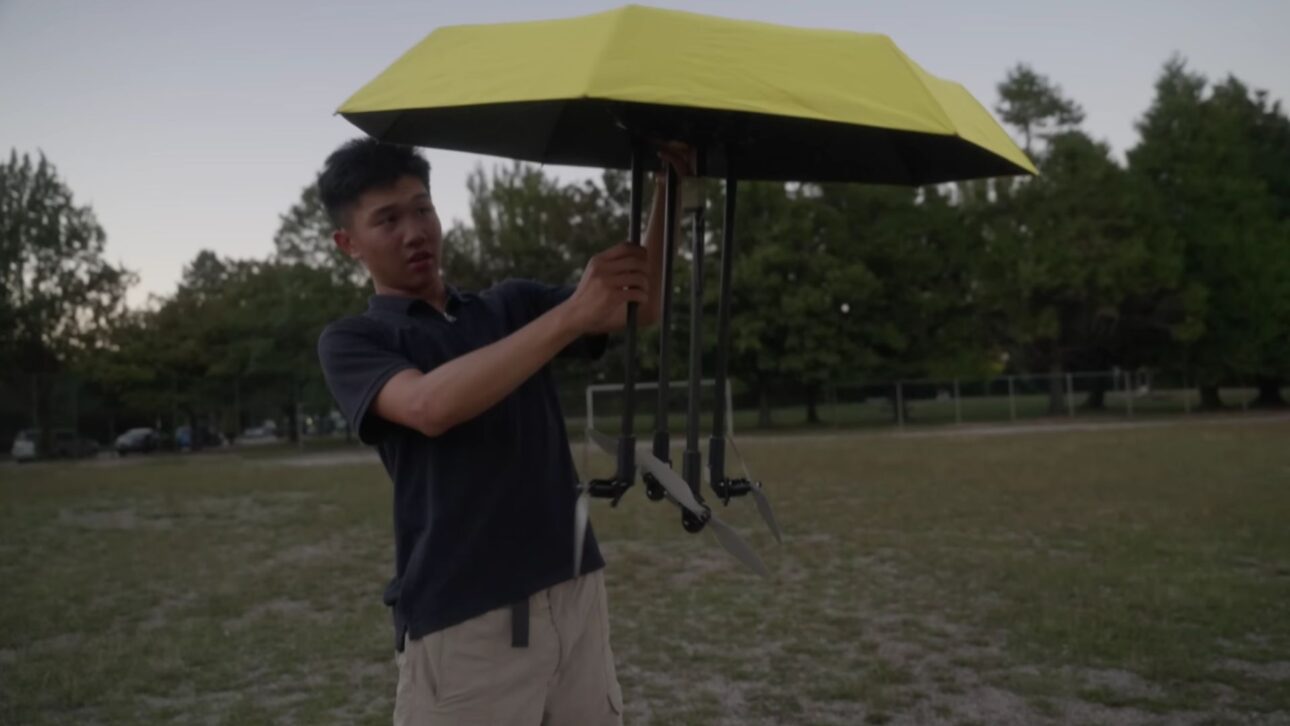
It all started in 2024, when the creator assembled the first version of the flying umbrella. In practice, it was a drone with an umbrella attached on top, and it even worked, but with a glaring problem: someone needed to pilot the device with a hand-held control. In other words, to avoid getting one hand wet holding an umbrella, the person got the other wet holding the control. The invention solved the problem by creating another identical one.
-
The first trillionaire in history, Elon Musk notices Brazil and its internet, Starlink, which works even in the middle of nowhere, emerges for just R$ 600, fits in a backpack, operates via satellites, and offers dual-band Wi-Fi with WPA3 security.

-
Heir bought 23,000 degraded acres in the Scottish Highlands, fenced the area, planted nearly 1 million native trees, and transformed empty mountains into a forest officially recognized after meeting 15 evaluation criteria over 20 years.

-
The oceans received a historic investment of $6.4 billion for conservation, blue economy, and sustainable fishing, but the question is whether the promise will actually turn into protected seas.
-
10-year-old boy from Bahia finds a different way to multiply, reorganizes partial sums in base 10, and transforms a common school calculation into an example of mathematical creativity that went beyond the test, was reviewed by teachers, and turned into a technical article.




The spectators did not forgive and pointed out the flaw immediately. Instead of abandoning the idea, however, the creator took the criticism as a challenge. As reported by the specialized site New Atlas, it was this flood of comments that motivated the complete redesign of the project, now with a clear goal: to make the flying umbrella work autonomously, without any human control. The failure of the first version became the starting point for the second.
How the Autonomous Flying Umbrella Works
The magic lies in how the drone sees and follows the person. According to Interesting Engineering, the device uses a handmade quadcopter, with X-shaped arms, and a special camera installed under the umbrella. This camera is a time-of-flight type, which emits light and analyzes the time and phase of the reflection to create a very precise three-dimensional image of the surrounding environment.
All this information is sent in real-time to a Raspberry Pi, a mini-computer the size of a card, which does the calculations and determines exactly where the person is. Then, it sends commands to the flight controller, adjusting the power of the propellers so that the flying umbrella remains always just above the user’s head. The creator even tested GPS tracking, but the accuracy was too poor, with errors of several meters, which would make the umbrella float far from the person it was supposed to protect.
Almost a Year of Trial and Error
The path to the functional version was far from smooth. The creator spent about a year tweaking the project, testing different ways to make the drone follow the person. He went through cameras, distance sensors, and, according to reports of the process, even toyed with the idea of a hidden human operator controlling everything, before finally getting it right with the true autonomous system.
Each failed attempt taught something. The invention needed to be light enough to fly, stable enough not to topple the umbrella, and smart enough not to lose sight of the person. After many adjustments, the autonomous flying umbrella began to do what seemed impossible: hover in place, follow someone walking, and even stay in the air during heavy rain. It was proof that persistence in invention is as valuable as talent.
Not the Only One: The Race for the Drone Umbrella


As original as it may seem, this creator is not alone in this idea. The notion of a hands-free flying umbrella has been pursued by inventors and companies for a few years. In Japan, for example, the company Asahi Power Services is developing a similar product, named Free Parasol, designed to protect from both rain and sun, also with automatic tracking of the person.
These commercial prototypes still face practical limits, such as weight and battery life, hovering around a few kilograms and a few minutes of flight per charge. The difference is that while companies work with teams and budgets, the flying umbrella from the YouTube channel was born from a home workshop, which makes the feat even more impressive. The race for this invention shows that the desire to walk in the rain without getting wet is more universal than it seems.
Why this invention matters, beyond not getting wet
It may seem like just a fun curiosity, but the technology behind the flying umbrella is serious and increasingly common. The same type of autonomous tracking that keeps the drone above the person’s head is what makes cameras follow athletes, delivery drones find addresses, and robots avoid obstacles. In other words, playing with an umbrella is also training solutions that apply to the entire industry.
Of course, there are still barriers before seeing people parading with drones on their heads down the street. Short battery life, noise from the propellers, safety in case of a fall, and behavior on windy days are real challenges. Even so, the invention serves as a showcase of what a dedicated maker can achieve at home, with accessible parts and a lot of patience. And, let’s face it, the image of an autonomous flying umbrella following someone in the rain is hard to get out of your head.
The autonomous flying umbrella is proof that seemingly silly ideas can yield real engineering when someone insists on them. From a failure with a handheld controller to a drone that protects from the rain on its own, the invention enchants precisely by mixing genius and stubbornness.
The practical question remains: will this ever become a shelf product? And you, would you agree to walk in the rain with a drone hovering over your head, or do you think it’s too dangerous to leave the video? Tell us in the comments what you thought of this invention.




Be the first to react!