






 Portuguese
  Spanish
  5 min of reading
  0 comments


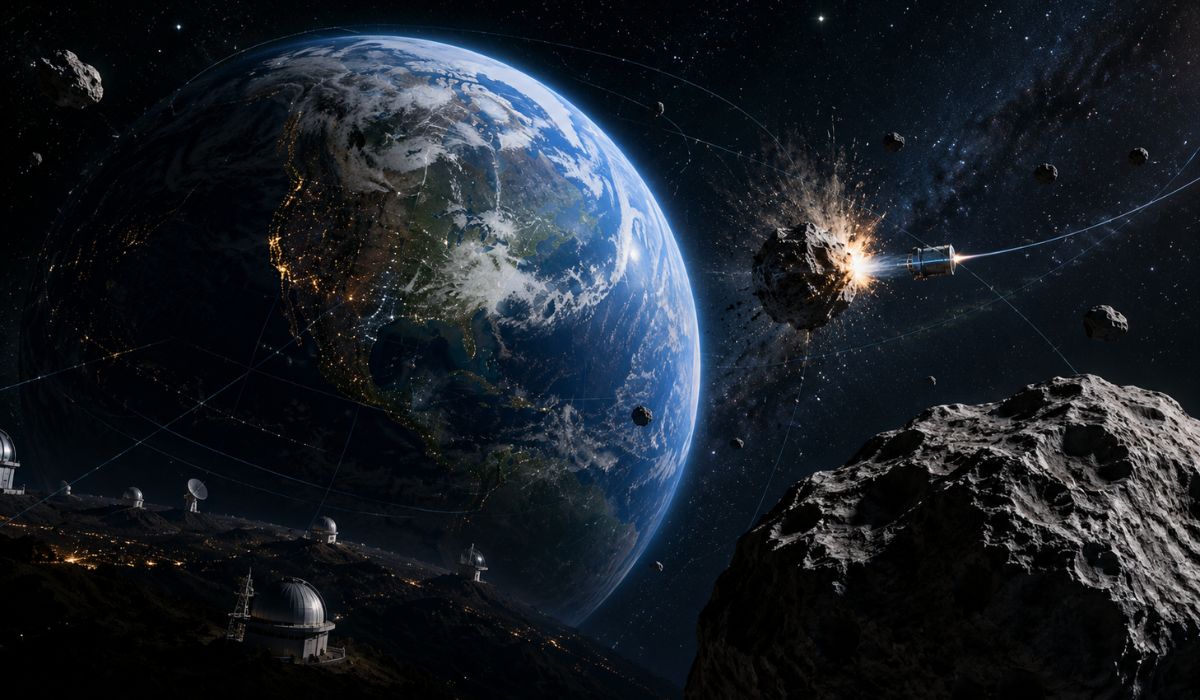
NASA details how observatories, calculation centers, and open data help scientists track near-Earth asteroids, reduce orbital uncertainties, and guide technical responses in planetary risk scenarios.
The defense of Earth against asteroids relies on an international network of observatories, calculation centers, and shared databases.
According to a text published by NASA on April 10, 2025, open access to scientific information allows researchers to identify near-Earth objects, review trajectories, and estimate impact risks based on independent observations.
This work occurs continuously, before any object gains public attention.
-
Chinese hypergravity machine is so insane that it reaches 1,900 G-tons, is located underground, spins giant arms at high speed, and can simulate earthquakes, storms, ocean depths, and even pressures from the Earth’s depths.

-
Scientists claim to have created a way to “store solar energy” in a liquid molecule and release that heat when needed.
-
NASA is advised to create a biocontainment facility on the Moon to prevent samples from Mars, the Moon, or other places in space from arriving directly on Earth with possible dangerous contaminants.

-
Scientists open lost cave in Norway and encounter a forgotten Arctic world with 46 species that existed 75,000 years ago.


When telescopes detect a new celestial body, the observation data is sent to the Minor Planet Center, the institution responsible for gathering measurements of small bodies in the Solar System.
From this record, researchers from different countries can track the same object and contribute with new measurements.
The model reduces the reliance on a single analysis.
With observations made on different nights, by different telescopes, and from various points on the planet, specialized centers can recalculate the asteroid’s orbit and update risk estimates.
According to NASA, this process is part of the so-called planetary defense, an area dedicated to locating, tracking, and studying objects that may approach Earth.
How monitoring of near-Earth asteroids works
The tracking begins when a newly detected object has a trajectory compatible with the region near Earth’s orbit.
At this stage, it can be included in confirmation systems used by the astronomical community, allowing for the collection of new observations before the orbit is defined with greater precision.
Initially, the uncertainty is usually greater.
Scientists work with a range of possible future positions, which is reduced as new measurements are incorporated into the models.
Therefore, initial impact probabilities can change quickly, without the asteroid having physically altered its path.
When detailed analysis is needed, the Center for Near-Earth Object Studies, or CNEOS, calculates orbits and impact probabilities.
The Sentry system, maintained by CNEOS, continuously monitors the asteroid catalog for potential collisions with Earth over the next 100 years.
This monitoring also involves the International Asteroid Warning Network, known by the acronym IAWN.
The network brings together observatories, space agencies, and scientific institutions that collaborate in tracking near-Earth objects and exchanging technical information when a case requires additional attention.


The case of asteroid 2024 YR4
The asteroid 2024 YR4 demonstrated in practice how estimates can change with the arrival of new observations.
The object was discovered at the end of 2024 and, in January 2025, CNEOS analyses indicated a chance greater than 1% of impact with Earth on December 22, 2032.
NASA itself reported at that time that the calculations could vary from day to day as more data was gathered.
In February 2025, the probability exceeded 3%, according to the space agency.
The index drew attention for being the highest ever recorded for an object of that size, but it did not represent a confirmation of collision.
It was an estimate based on a still limited set of observations.
In the following days, new telescopes sent additional measurements.
With this, the orbit was refined and the range of uncertainty decreased.
On February 24, 2025, NASA reported that the impact chance of 2024 YR4 with Earth had dropped to 0.004%, classifying the asteroid as no significant threat for 2032 and the years following.
The analysis did not end at this point.
After the risk to Earth was ruled out, scientists still monitored a small possibility of impact with the Moon on December 22, 2032.
On March 5, 2026, new observations made with the James Webb Space Telescope also eliminated this possibility, according to NASA.
International network supports planetary defense
The coordination of NASA’s actions in this area is the responsibility of the Planetary Defense Coordination Office, known by the acronym PDCO.
The agency works with CNEOS, with observatories funded by the agency, and with international partners to discover, track, and characterize near-Earth objects.
The volume of tracked objects helps to gauge the work.
The European Space Agency reported in November 2025 that astronomers had identified the 40,000th near-Earth asteroid.
These bodies range from a few meters to kilometers in diameter and follow orbits that bring them relatively close to the planet.
Even so, the catalog is not complete.
The concern of planetary defense programs is to locate in advance objects large enough to cause damage in case of impact.
According to technical material from CNEOS, no known asteroid has a significant chance of hitting Earth in the next 100 years, but undiscovered objects remain a reason for monitoring.
The exchange of data between institutions allows different teams to review results and point out any inconsistencies.
In practice, a risk calculation can be checked by independent groups, which increases the robustness of the estimates used in public alerts or technical decisions.
DART Mission Tested Trajectory Alteration
In addition to monitoring, NASA also tested a trajectory alteration technique.
On September 26, 2022, the DART mission deliberately collided with Dimorphos, a small moon of the asteroid Didymos.
The system posed no risk to Earth and was used as a planetary defense experiment.
After the impact, measurements confirmed a change in Dimorphos’s orbit around Didymos.
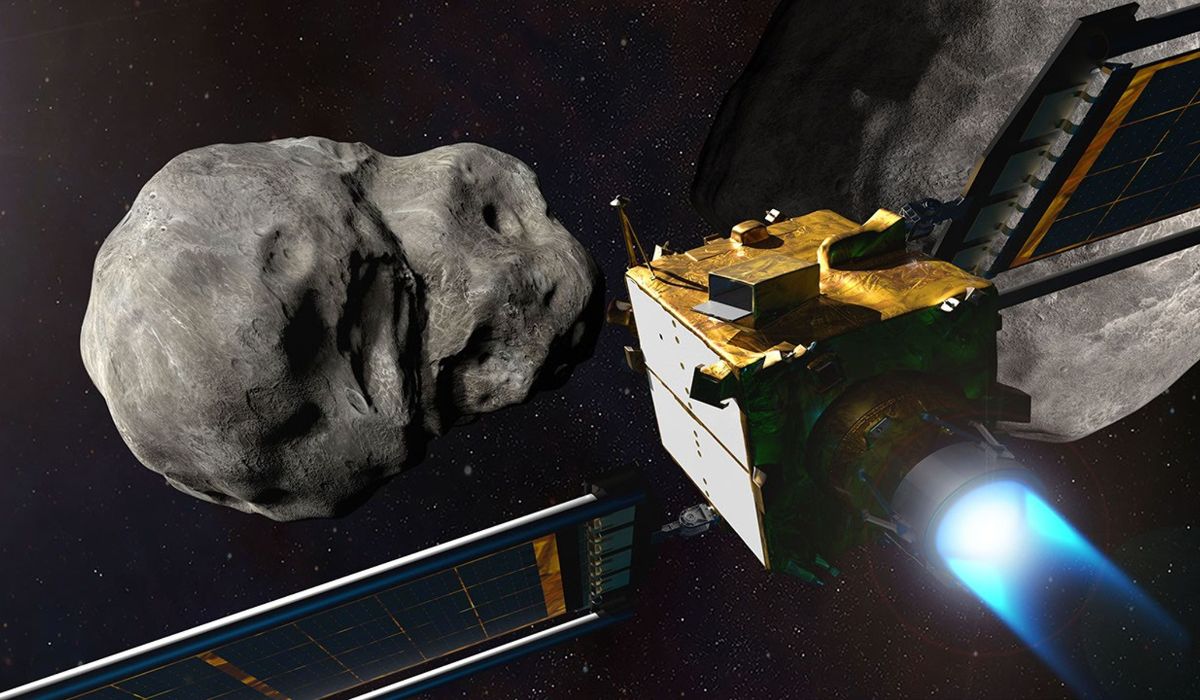
According to NASA’s Jet Propulsion Laboratory, the orbital period was reduced by about 32 minutes, a result that demonstrated the ability of a spacecraft to alter the movement of a celestial body through kinetic impact.
This type of technique depends on advance notice.
Before any attempt at deflection, it would be necessary to detect the asteroid, confirm its orbit, measure physical characteristics, and assess whether the probability of impact justifies a response.
For this reason, continuous tracking remains the first step of any planetary defense plan.
NEO Surveyor should expand the search for asteroids
The next anticipated advancement in this area is the NEO Surveyor space telescope.
According to the Jet Propulsion Laboratory, the mission is planned for launch no earlier than September 2027 and is designed to discover and characterize potentially hazardous asteroids and comets approaching Earth’s orbit.
The observatory will use infrared detection, technology that can aid in identifying dark or difficult-to-observe objects by optical telescopes.
The mission should also contribute to more accurately measuring the size, shape, composition, and trajectory of asteroids, according to NASA’s information about the project.
Planetary defense, therefore, depends on a sequence of verifiable steps: discover objects, publish observations, review calculations, update probabilities, and if a confirmed risk exists, evaluate mitigation measures.
In a real threat scenario, the response capability would begin with the same process that reduced uncertainty in the case of 2024 YR4: shared observations and technical analysis conducted by independent teams.







Be the first to react!