






 Portuguese
  Spanish
  6 min of reading
  0 comments


Seen from above, the Zuluk road looks like a giant snail embedded in the mountain: there are 32 zigzag curves that rise to more than 3,400 meters in the Himalayas, on a stretch of the ancient Silk Road in Sikkim that is now a closed military zone on the India-China border.
Viewed from above, it doesn’t look like a road, it looks like a scribble someone made on the mountain without lifting the pen from the paper. The Zuluk road, in eastern Sikkim, India, stacks 32 zigzag curves on top of each other to conquer a stone wall at more than 3,400 meters altitude, in the heart of the Himalayas. The design is so tight and so symmetrical that, from afar, the layout resembles a giant snail or a snake coiled on the slope. It was this shape that took the road out of anonymity and turned it into a photography phenomenon.
What few people who see the photo know is the size of the story behind that zigzag. This path is a piece of the ancient Silk Road, the network of trails where caravans carried silk, wool, salt, and tea between Tibet and the Bengal plain for centuries. After the war between India and China in 1962, the region became a national security zone, and today the Zuluk road cuts through a restricted military zone a few kilometers from the Chinese border, where not every traveler can enter.
A staircase of 32 curves embedded in the mountain
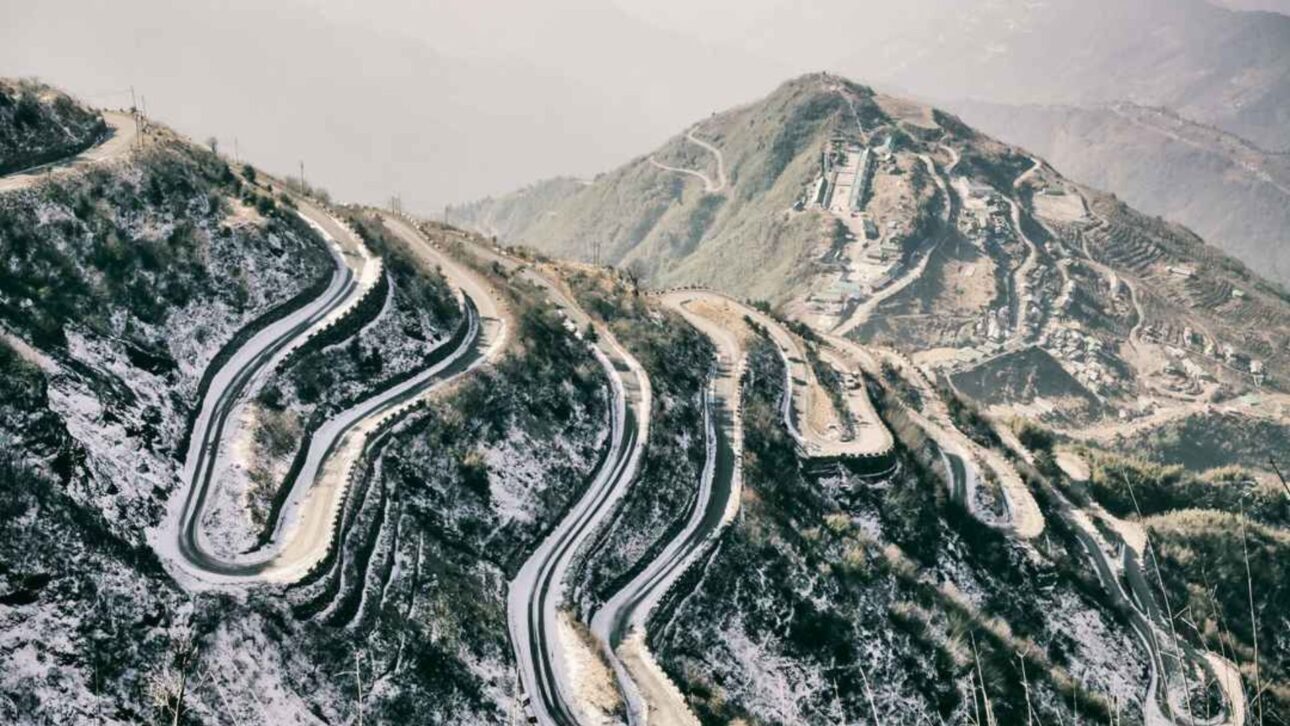
The famous stretch is just a piece of the climb, and it has its own name: Zig Zag Road. According to regional guides like Sikkim Darjeeling Tourism, there are 32 sharp zigzag curves that connect the village of Zuluk to the Thambi View Point lookout, at about 11,200 feet, or nearly 3,400 meters. Each loop was fitted into the previous one so that a truck can gain altitude without falling, and the set is considered by those who know it as a feat of mountain engineering.
-
Rio de Janeiro receives more than R$ 5.5 billion in sanitation, includes almost 1 million residents from communities in the formal customer base, and brings water, sewage, and proof of residence to regions historically neglected by urban infrastructure.

-
Via Mar promises to relieve BR-101 in Santa Catarina, but it will be the state’s first toll state highway and faces soft soil and rice fields that threaten the timeline.

-
To halt the advance of the Sahara, the 8,000 km Great Green Wall in the Sahel relies on reforestation to combat desertification, but by 2026 it remains far behind the goal of 100 million hectares.
-
Long before sustainable construction became a trend, China built earthen fortresses with multiple floors, a central courtyard, and the capacity to house up to 800 people living in a community.


The entity that built and maintains this work is the BRO, an acronym for Border Roads Organisation, the engineering arm of the Indian armed forces responsible for opening and maintaining roads in the country’s most hostile borders. The track was designed to withstand the weight of heavy military vehicles on icy and loose rock terrain. It is not a leisure asphalt road; it is defense infrastructure that happens to be beautiful.
The zigzag of Zuluk, as impressive as it is, is just a fragment of something larger. Historical accounts compiled by travel publications like Orange Wayfarer indicate that the region’s zigzag curves were part of an ancient system with about 93 hairpins, through which silk from Lhasa descended to the port of Tamralipto, in present-day West Bengal. The Zuluk road that goes viral today is the modern survivor of that route.
From caravan silk to the closed border with China
For centuries, this corridor of Sikkim was pure economy. Mules and human porters climbed and descended the Himalayas carrying wool, salt, silk, tea, horses, and medicinal herbs between the Chumbi Valley in Tibet and the Indian plains. Zuluk was the overnight stop before the final climb towards the high passes, like Jelep La, one of the most important gorges that connected Sikkim to Tibet.
The turning point came with geopolitics. After the border conflict between India and China in 1962, the mountain passes that facilitated trade were closed, and the old Silk Route ceased to be a merchant’s path and became a frontline. The same road that served commerce began to serve the Army, and the region gained bases and troop transit points just a few kilometers from Chinese territory.
This military past still dictates the life of those who want to visit. According to the Sikkim Tourism Department, Zuluk is in a restricted area, and every traveler needs a special permit issued in Rangli or Gangtok. The rules change according to the tension at the border, Indians enter by presenting a document, and foreigners usually do not pass certain points of the circuit. The Zuluk road, in other words, is a postcard you cannot cross whenever you want.
Those who live there have only three ways to make a living
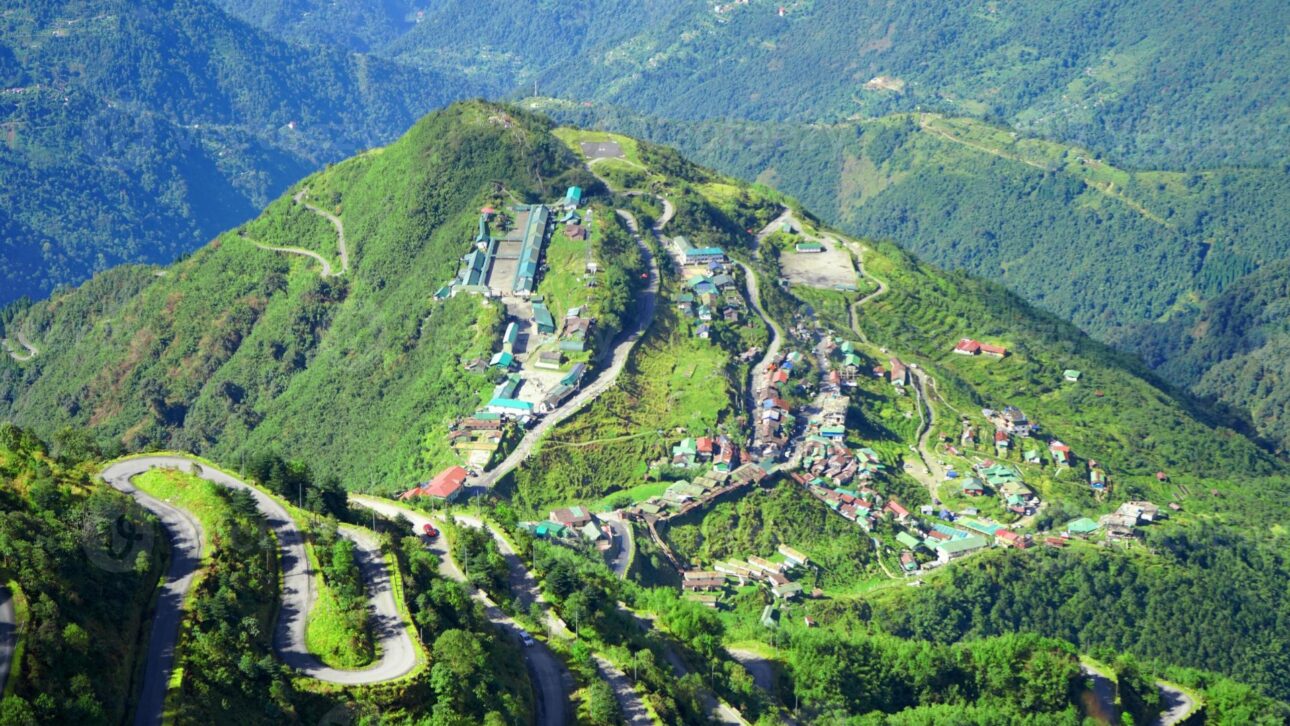
Behind the postcard landscape lies a tough routine. Zuluk is a small village, planted in a place where the air is thin and the cold is biting, and the local economy fits into three paths. According to reports from residents gathered by local guides, those who live there work on BRO construction projects, serve as porters for the Indian Army, or cater to the tourism that has started to arrive.
This tourism, by the way, is recent. For a long time, the Zuluk road was known only to the military, residents, and a few adventurers, and only in the last decade has the place entered the map of the common traveler. The driving force behind this flow is the view. From the top of Thambi View Point, at the end of the zigzag curves, visitors can see the sunrise over Kangchendzonga, the third highest mountain in the world, at 8,586 meters, in a spectacle that rewards the effort of the climb.
The price of this beauty is the altitude. At over 3,400 meters, the body feels the lack of oxygen, the weather changes in minutes, and snow can block the passage. It is an environment where the same Silk Route that enriched merchants also claimed lives, and where today the engineering of the BRO in the Himalayas is what keeps the connection standing.
Brazil has its own snail road, and it has many more curves
If the Brazilian reader finds this layout familiar, there is a reason. Brazil has its own version of a snail road, and in terms of curves, it far surpasses Zuluk. The Serra do Rio do Rastro, in Santa Catarina, climbs the SC-390 highway and accumulates, according to the Diário do Comércio, no less than 284 curves in just 25 kilometers, many of them 180 degrees.
The comparison helps to size each one. The one in Santa Catarina wins in the volume of curves and proximity, as it is at 1,460 meters altitude and a mere 50 kilometers from the coast. The one in India wins in extremity, as it stacks its 32 zigzag curves more than twice as high, in the middle of the Himalayas, within a military border zone. One is a weekend challenge, the other is a geography of war.
The common point is what makes both go viral. Both the SC-390 and the Zuluk road turn the mundane act of climbing a mountain into an image that looks like a drawing, proving that a well-made road in impossible terrain becomes an attraction in itself. The difference is that in Sikkim, the beautiful photo hides access permission, an Army base, and the shadow of China on the other side of the mountain.
The Zuluk road is one of those stories that gets better the more you dig. What starts as a curious photo of 32 zigzag curves resembling a snail turns, paragraph by paragraph, into a saga of silk caravans, border war, military engineering at 3,400 meters, and a handful of residents who have only three ways to survive in the Himalayas. It is the ancient Silk Route of Sikkim surviving as a line of defense.
And you, would you take on this climb by car, or do you think our Serra do Rio do Rastro, with its 284 curves, is already enough excitement? Share your thoughts in the comments.





Be the first to react!