Portuguese
  Spanish


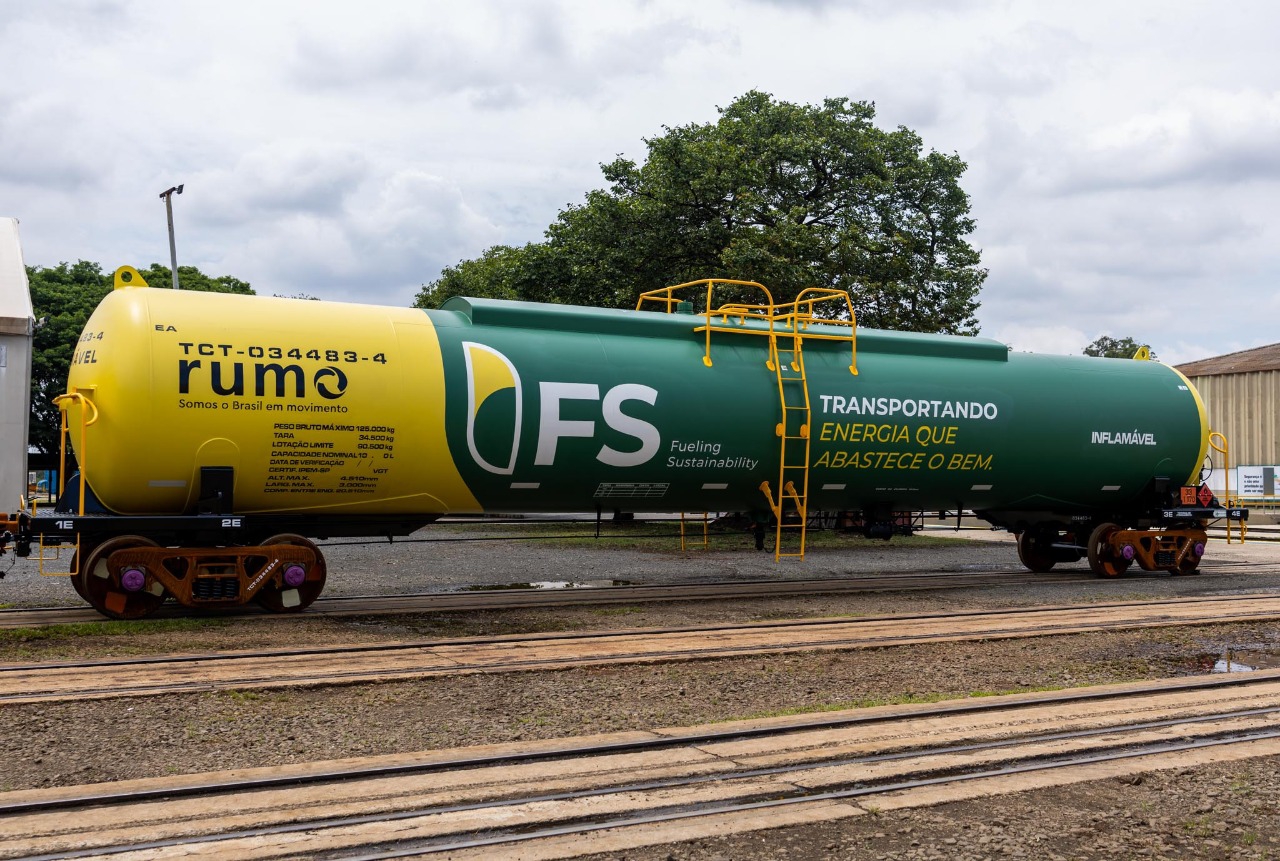

The New Freight Cars Acquired by FS, Biofuels Industry, Are Expected to Begin Operating in April, Increasing Ethanol Freight Transport Capacity by 25%.
Announced last November, the operation focused on transporting ethanol by rail is set to materialize by April. The initiative, considered a groundbreaking business for all involved companies, namely: Rumo, Greenbrier Maxion, and FS, required about R$ 115 million in investments.
FS, Rumo, and Greenbrier Maxion: The Partnership that Brought the Operation to Life
The goal of FS, a biofuels producer, is to transport 45% of production via railways located on the route between Lucas do Rio Verde (MT) and Sorriso (MT), with Paulínia (SP) as the final destination.
The company states that, in addition to cost savings in transportation, it would also result in reduced carbon emissions involved in the process, as it would decrease truck trips per year on the roads.
-
Green Hydrogen Projects in Northeastern Brazil Stalled for 18 Months Awaiting Government Decree, Delaying Billions in Investments

-
Brazil Concludes Largest Energy Auction in History, Secures 18.97 GW and Mobilizes $12.8 Billion to Ensure Supply Until 2031
-
How Norway Produces More Energy Than It Consumes with Nearly 1,800 Hydropower Plants and Over 1,100 Reservoirs

-
Belo Horizonte’s Beltway Project Risks Losing $5 Billion to Metro Expansion if Court Doesn’t Act Soon; State Government Plans New Lines with IDB Support


According to the agreement projection, FS acquired the cars to support the production flow system, while Rumo took charge of transportation.
According to a press release, the partnership between the companies will increase the volume transported to 75 million liters of ethanol per month, up from the previously transported approximately 50 million.
“The expansion of our rail transport capacity aligns with FS’s strategy to meet markets with maximum logistical efficiency and minimal environmental footprint,” comments Rafael Abud, CEO of FS.
The goods leaving the units located in Mato Grosso will travel by road to Rondonópolis (MT), with Paulínia (SP) as the destination, via rail line.
Rumo Logística, a railway company belonging to the Cosan Group, transports approximately 45% of the diesel volume in the state of Mato Grosso. The company recorded a 20% increase in biofuel transport in 2022.
According to Pedro Palma, Vice President of Rumo, the cars are nearly always running full. “The flows are planned for optimal logistical efficiency. The car invested by FS travels from Mato Grosso to Paulínia and returns with petroleum derivatives to be distributed throughout the state,” he states.
Combining Low Maintenance Costs and High Performance, Greenbrier Emphasizes the Need for Dialogue Among Companies
The cars purchased by FS are being produced by Greenbrier Maxion, a company considered the largest railway operation in South America.
They are made of low-alloy steel, with high mechanical strength and resistance to atmospheric corrosion.
According to Greenbrier Maxion, the cars provided to FS have a capacity of 105 thousand liters each, designed for upper loading and lower unloading.
Another important feature in the production of the cars is that they were developed specifically for the operational conditions of Brazilian railways, enhancing the safety and lifespan of the components involved in the operation, thereby reducing maintenance costs.
According to Luis Gustavo Vilas Boas, Sales and Marketing Director at Greenbrier Maxion, it is crucial to have a partnership among industry, operator, and user in the procurement process of project development.
“The cars were developed with cutting-edge technology, innovation, and the full expertise of the engineering field, meeting the technical specifications of FS and Rumo, providing cost reduction, energy efficiency, and productivity for the entire cycle, thus making rail freight transport more competitive and sustainable,” he expresses.