






 Portuguese
  Spanish
  4 min of reading
  1 comment




As Thousands Of Species Disappear Every Year, A Rare Case Of Reintroduction Surprised Scientists And Reignited The Debate On Extinction, Conservation And Limits Of Human Intervention
Extinction is often associated with catastrophic and distant events, such as the end of the dinosaurs about 66 million years ago. However, the reality is much closer and far more concerning. Species Disappear From Earth at an alarming rate, often in silence, far from the spotlight of science and society.
According to estimates from WWF, an international organization dedicated to environmental conservation, about 10,000 species disappear every year. Still, experts themselves admit: this number could be even higher, as no one knows exactly how many species exist on the planet.
For this reason, dates like the International Day for the Memory of Lost Species, celebrated on November 30, serve as a global alert. Next, remember eight animals we will never see again and one that, surprisingly, managed to come back from extinction.
-
Survivor of 1966 SS Daniel J. Morrell Shipwreck in Lake Huron Recounts 38-Hour Ordeal in Extreme Cold

-
The Greatest Hoax in World Cup History? The Film That Denied Brazil’s 1958 Victory and Exposed How Fake Evidence Can Seem Convincing on TV
-
Fake South Korean Online Stores Offer Shopping Thrill Without Spending Money or Receiving Products
-
The War of Jenkins’ Ear: How a Severed Ear Sparked One of the 18th Century’s Most Unusual Conflicts


Extinction Is Not The Past: It Happens Now
While dinosaurs disappeared after an abrupt event, many modern species have slowly vanished, pressured by ongoing human actions. Deforestation, overhunting, pollution, and climate change have altered entire ecosystems and pushed animals to a point of no return.
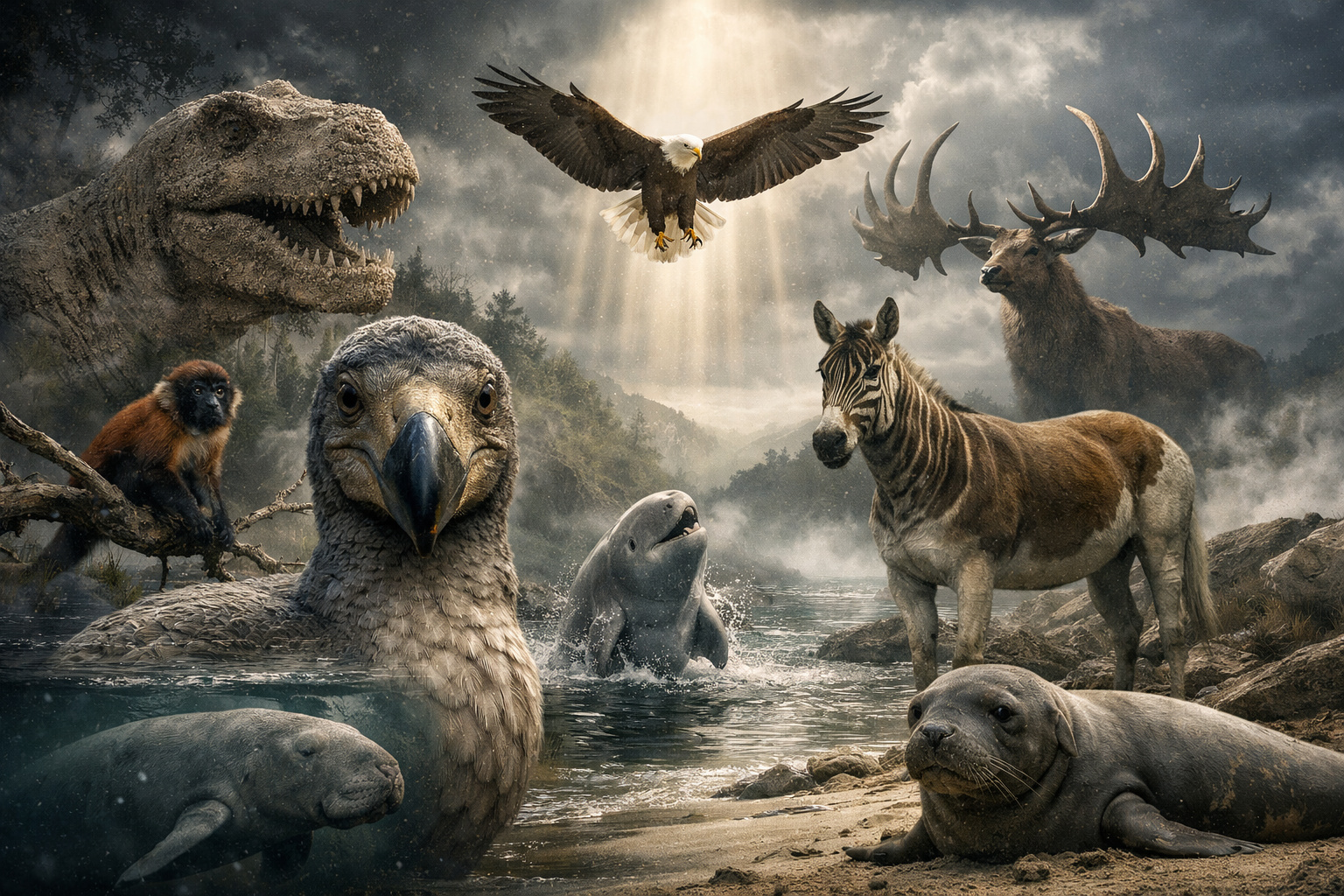
A recent example is the Miss Waldron’s Red Colobus, a medium-sized monkey that lived between Ghana and Côte d’Ivoire. Lacking thumbs and accustomed to large groups in the treetops, it lost habitat as forests shrank. As a result, its groups became smaller and more vulnerable to predators and genetic inbreeding. In the early 2000s, scientists began to consider it officially extinct.
A similar situation occurred with the Baiji Dolphin from the Yangtze River in China. Declared extinct in 2006, it had one of the most sophisticated echolocation systems ever recorded, capable of identifying individual fish. However, heavy boat traffic, pollution, and industrial fishing turned the river into an environment too hostile for its survival.
Furthermore, the disappearance of the Caribbean Monk Seal, last recorded sighting in 1952 between Jamaica and Nicaragua, highlights another problem: direct exploitation. Hunting focused on body oil extraction and overfishing destroyed its food base, leading the species to definitive collapse.
When Human Impact Leaves Irreversible Marks
Not all extinctions involve large or charismatic animals. The so-called Alabama Bivalve, a small river mussel that lived in the Mobile River in the United States, played an essential role: it filtered impurities from the water. However, chemical contamination coming from factories overwhelmed its biological limits. By around 2006, it completely disappeared.
On the other hand, some extinctions gained worldwide fame. The dodo, a flightless bird from Mauritius, became the greatest symbol of extinction caused by humans. Without natural predators, it could not withstand the arrival of humans, invasive animals, and hunting. The last recorded sighting of the species dates back to the late 18th century.
Meanwhile, the Steller’s Sea Cow, a giant relative of the manatee, impressed with its size: reaching up to nine meters in length. However, its meat, fat, and skin intensely attracted hunters. Within a few decades after its scientific discovery in the 18th century, the species disappeared from between Alaska and Russia.
Another emblematic case involves the quagga, an African animal similar to a zebra, but with stripes only on the front part of its body. Hunters exterminated the species for its unusual appearance. The last quagga died in captivity in Amsterdam in 1883.
Meanwhile, the Irish Elk, which lived about 7,700 years ago, drew attention for its giant antlers, which reached 3.65 meters from tip to tip. Researchers believe that the combination of human hunting and climate change accelerated its disappearance.
The Animal That Came Back From The Dead (And Why This Is An Exception)
Not all stories end tragically. The Golden Eagle, a bird of prey with a wingspan of over two meters, was extinct in the UK in the early 20th century after decades of human persecution.
However, unlike most species on this list, it still survived in other regions of Europe. When hunting became illegal, reintroduction programs brought the bird back to British territory. Today, it soars over rivers and coasts of the country again, symbolizing a rare victory for conservation.
Still, this type of “return from the dead” represents an extreme exception. For most extinct species, there is no second chance.
The information was originally disclosed by international outlets such as the BBC, based on data from environmental organizations and scientific records, reinforcing a clear warning: extinction does not belong only to the past — it is happening now, before our eyes.
If science has already managed to bring an animal “back from the dead,” which species do you believe could still be saved if humanity acted in time?





Gostaria de ter informações aprofundadas a respeito das pesquisas de petróleo na costa do Amapá, próximo a foz do Amazonas.